Fishing Operations – Recovering Junk and Lost Tools Downhole
Something just went wrong downhole. Maybe the string parted, maybe a bit cone came off, maybe a wrench took a ride down the hole while everybody was looking the other way. Now the rig is stopped, the clock is running, and somebody says the word nobody wants to hear: fishing. So what are fishing operations, and how do crews actually get lost tools and junk back out of a well?
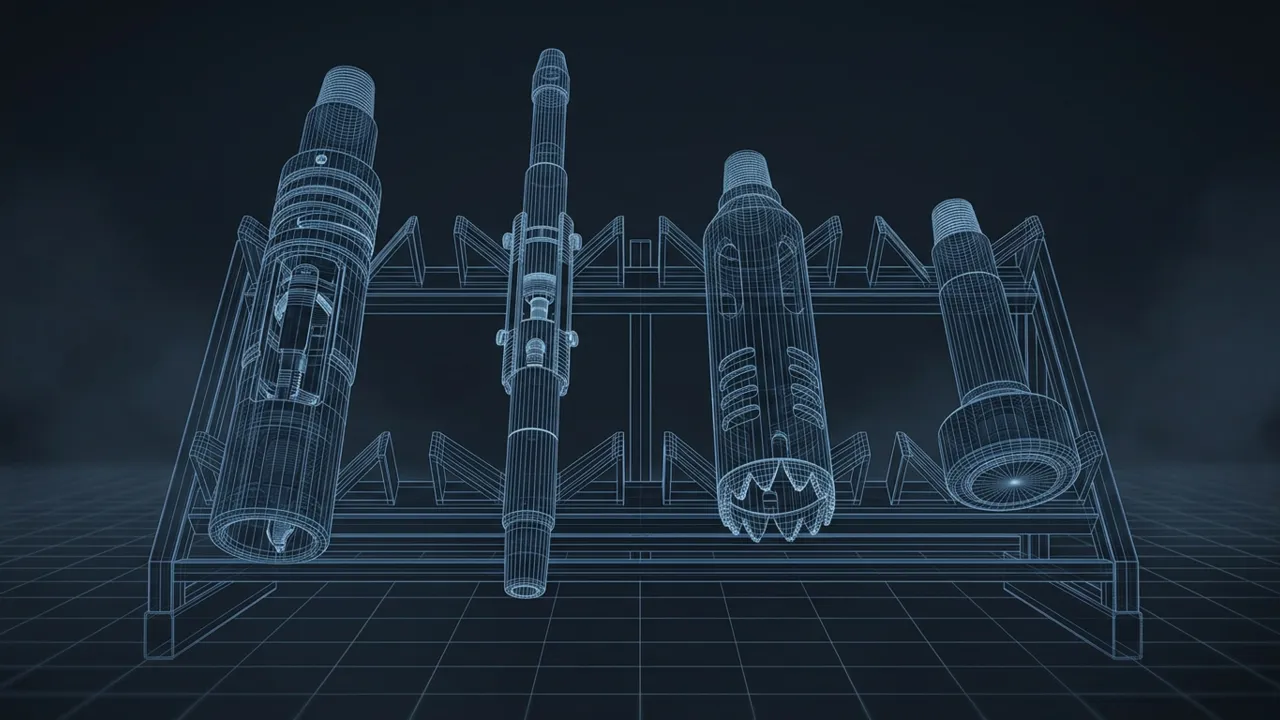
Fishing operations are the jobs a rig crew and a fishing specialist run to recover anything stuck or left in a wellbore that should not be there. The "fish" can be a parted section of drillstring, a stuck bottomhole assembly, a logging tool, a packer, or small pieces of downhole junk like bit cones, hand tools and broken slips. The method is simple: learn exactly what is down there, pick a tool that can grab it or grind it up, run it on pipe (or wireline or coiled tubing), and pull or mill until the hole is clean.
The hard part is judgment. Every hour spent fishing costs money, so there is always a point where it makes more sense to cement a plug and sidetrack around the fish than to keep chasing it.
What Counts as a Fish, and What Is Downhole Junk?
A fish is any object in the hole that blocks normal operations and has to come out. The term usually refers to bigger, connected pieces: a length of drillpipe that twisted off, a stuck BHA you backed off above, or a wireline tool that came off the cable.
Downhole junk is the smaller stuff. Think bit cones, PDC cutters, broken slip dies, a dropped hammer, chain tong parts, pieces of a float. The SLB glossary defines junk as debris in the wellbore that shouldn't be there, and that's about as plain as it gets.
The difference matters because the tools are different. You catch a fish by its body or its bore. You catch junk by trapping it, sticking to it with a magnet, or grinding it into cuttings small enough to circulate out.
How Does Stuff End Up Lost in the Hole?
Murphy's Law works overtime downhole. Here are the usual ways a well ends up needing a fishing job:
- Twist-offs. Fatigue cracks or a washed-out connection let the string part under torque.
- Stuck pipe that can't be freed. When jarring fails, the crew backs off or cuts the string above the stuck point, and everything below becomes a fish.
- Bit and BHA failures. Roller cone bits can lose cones or bearings. PDC bits can shed cutters. Stabilizer blades and motor parts can break loose.
- Dropped objects. Hand tools, tong dies and slip segments fall through an open rotary when nobody has the hole covered.
- Wireline and slickline mishaps. A tool gets stuck, the line pulls out of the rope socket, and now there's a tool string (and maybe a pile of cable) in the hole.
Most fishing jobs that start with stuck pipe have a backstory: poor hole cleaning, differential sticking against a permeable zone, or a swelling shale. If that is your situation, read up on stuck pipe causes before you run the fishing string. Fixing the cause keeps you from sticking the fishing tools too.
What Do You Do First When Something Is Lost Downhole?
Here's the order I'd want on any tour. Your company man, toolpusher and the fishing hand make the final calls, and your well-site procedures come first, but the logic is the same almost everywhere.
- Stop and secure the well. Make sure the well is static and under control before anybody gets clever. A fishing job can turn into a well control job if you swab or lose returns.
- Write down what's in the hole. Exact lengths, outside and inside diameters, connection types and the top-of-fish depth. A good tally and a BHA sheet are worth gold here.
- Figure out what the top of the fish looks like. A clean box looks very different from a split, flared pin. Crews often run an impression block (a lead-faced block) to get a print of the top.
- Pick the catch tool. Outside catch, inside catch, or mill it. Never run a tool you can't release from if things go wrong.
- Build the fishing string with a plan B. Jars, a bumper sub and a safety joint are standard so you can hit the fish hard and still get off it.
- Set a limit. Agree up front on how many days or dollars the fish is worth before you call it and sidetrack.
A classic fishing mistake: running in blind without knowing the fish's exact dimensions. If the overshot grapple is the wrong size, you'll spend a round trip finding that out.
What Are the Most Common Fishing Tools?
The toolbox is big, but a handful of tools do most of the work. Here's what each one is for.
| Tool | What it does | Best for |
|---|---|---|
| Overshot | Slides over the outside of the fish and grips it with a grapple | Pipe, collars and tools with a clean outside diameter |
| Spear | Goes inside the fish's bore and grips the inside wall | Fish with a damaged outside or a known inside diameter |
| Junk basket | Traps loose pieces as fluid and rotation sweep them in | Bit cones, small hardware, broken parts |
| Fishing magnet | Picks up loose steel with a strong magnet | Small ferrous junk, cutters, tong dies |
| Junk mill | Grinds junk into cuttings that circulate out | Junk too big or too stuck to catch |
| Washover pipe | Larger pipe that drills around a stuck fish to free it | Pipe held by fill, cuttings or a collapsed hole |
| Fishing jars | Deliver sharp up or down blows to shock the fish loose | Nearly every fishing string |
You'll also hear about taper taps and die collars (they cut threads into the fish to bite it), cutters that sever pipe from the inside or outside, and wireline grabs for recovering cable. The SLB entry on fishing covers the general terms if you want the textbook version.
Overshot vs. Spear: Which One Do You Run?
Run an overshot when the outside of the fish is in decent shape. Run a spear when the outside is damaged or the hole is too tight for an overshot to fit over it.
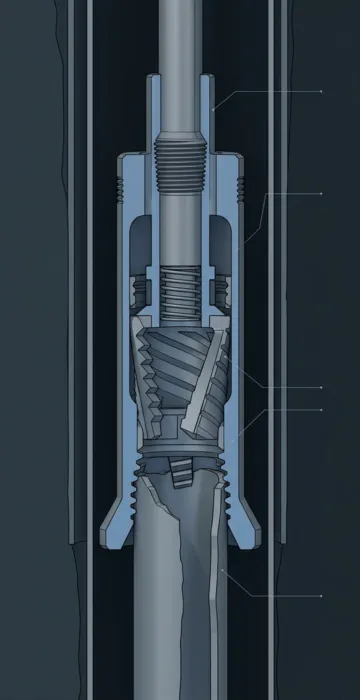
That's the short version of the overshot vs spear debate. The overshot is the go-to tool on most rigs because it grips a lot of surface area and lets you circulate through the fish. Its grapple is sized to the fish's outside diameter, and a mill control or guide on the bottom can dress a ragged top so the grapple can slide on.
The spear works from the inside. It's handy when the outside of the fish is split or flared, or when there's not enough room between the fish and the hole wall. The downside is that a spear partly blocks the bore, so circulation can be limited, and a weak or thin-walled fish may split when you pull.
Both tools are built to release. You can rotate off them if the fish won't come. That release feature is the whole point: the worst outcome is turning your fishing string into a second fish.
How Does a Junk Basket Work?
A junk basket catches loose pieces that are lying on bottom. It sits just above a mill or shoe, and when the crew circulates and rotates slowly, the junk gets swept up into the barrel. Fingers or catchers at the bottom close behind it so it can't fall back out.
There are two main styles. A reverse circulation junk basket changes the flow path so fluid jets down the outside and back up through the middle, which sucks junk into the barrel. A boot basket (or junk sub) rides above the bit while drilling and catches heavy pieces that fall out of the fluid stream where the annulus gets bigger.
Junk baskets work best on small, loose pieces. They won't help with a big chunk wedged against the wall. For that, you're usually milling.
When Do You Mill Instead of Catch?
You mill when the fish can't be grabbed or won't come out whole. A junk mill is dressed with tungsten carbide and grinds metal into small cuttings. Section mills and pilot mills do similar work on casing or tubulars.
Milling sounds easy but it isn't. Here's what to watch for:
- Cuttings returns at the shakers. Steel shavings coming over the screens tell you the mill is cutting. Ditch magnets help you track it.
- Torque and weight. Erratic torque can mean the junk is spinning under the mill instead of being cut.
- Hole cleaning. Metal cuttings are heavy. If your mud can't carry them, they settle and cause new trouble.
- Casing wear. Milling inside casing can damage it if the mill walks to one side.
Expect milling to take time. Patience usually beats more weight on a mill.
When Should You Quit Fishing and Sidetrack?
Quit when the cost of continuing to fish passes the cost of plugging back and drilling around the fish. That's the core economic test, and it's the operator's call, not the crew's.
The math includes rig day rate, fishing tool rental, the value of the hole already drilled, and the replacement cost of what's down there. Expensive tools change the equation. Equipment with radioactive sources, like some logging tools, can come with special regulatory requirements before anyone can walk away from them, so those jobs follow a strict plan.
Many operators tie the fishing budget to a set number of days or a set share of the sidetrack cost. Whatever the number, decide it early. Fishing has a way of pulling people into "just one more run."
How Can Crews Prevent Fishing Jobs?
Most fishing jobs are preventable. Not all of them, because the formation always gets a vote, but plenty start with a small slip on the floor or in the planning.
- Keep the hole covered any time the string is out.
- Inspect drillpipe and BHA components on schedule, and lay down anything suspect.
- Track tool hours and bit runs so tired equipment comes out before it fails.
- Keep accurate measurements of every tool that goes in the hole.
- Watch for early signs of trouble: rising drag, overpull, torque spikes and fill on bottom.
- Speak up. If something looks off, tell the driller. Nobody ever got run off for asking about a loose part.
Are Fishing Operations Worth the Fight? Recovering Junk Without Making It Worse
Fishing operations are the rig's way of cleaning up after Murphy. You identify the fish, measure it, choose an overshot, spear, junk basket, magnet or mill, and run it with jars and a safety joint so you can always get back off.
Most of the time, careful fishing gets the hole back. When it doesn't, a planned sidetrack is not a failure; it's a business decision. The real wins happen before anything goes in the hole: good records, tool inspections and a covered rotary.
If you're on tour when something goes downhole that shouldn't, slow down, get the numbers, and let the fishing hand and the company man set the plan. Your job is to give them clean information and keep the well under control.