Live demo
Explore an Interactive 3D Drilling Rig
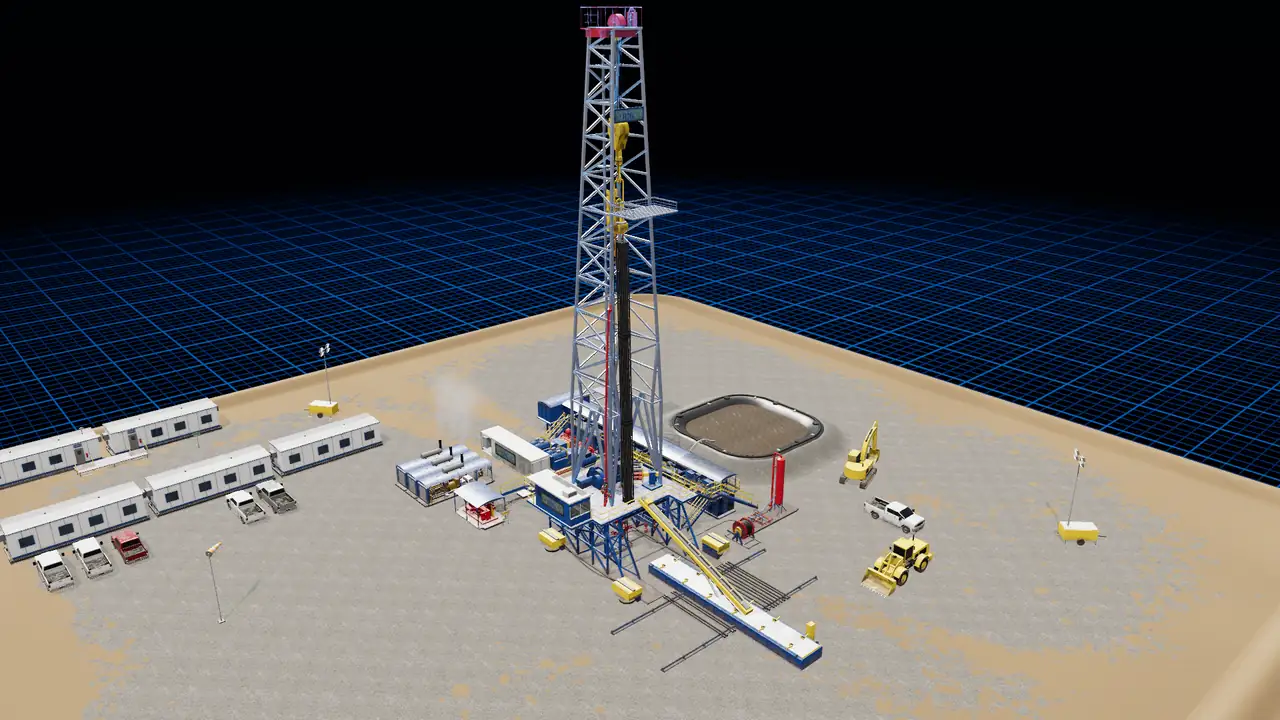
This is a complete super-spec AC land rig running live in your browser. Click any of 25 parts to learn what it does, take the narrated tour, switch to night or walk the pad at real scale. We built it to show what we can build for your equipment.
 Click it. This rig is live.25 parts · narrated tour · opens in secondsLaunch the 3D Rig
- 25 clickable parts with specs and narration
- Runs in your browser on phone or desktop
- No install and no sign-up
Free. The first load is about 10 MB, and narration loads as you need it. Turn your sound on for the tour. See all 25 parts.
What You Can Do in the 3D Rig
The demo is a complete drilling location: the rig, the mud system, the power plant, the pipe racks and the camp. Everything works with a mouse, a trackpad or a finger.
- Click any part. Each of the 25 numbered parts, from the crown block to the crew quarters, opens a panel with a plain-English description, key specs and a short narration.
- Take the guided tour. It flies to each part in turn and plays its narration. The full tour runs about 13 to 14 minutes, and you can pause or leave it at any time.
- Look inside the BOP. The blowout preventer panel shows the stack cut open, so you can see what is inside it.
- Switch to night. Night mode lights the location with light towers and mast floodlights.
- Walk the pad. Walk mode puts you on the ground at real scale, so you can walk up to the equipment and look up at the mast.
- Watch it drill. The top drive drills down a stand, the slips are set and the iron roughneck makes up the next connection, on a loop.
How the 3D Rig Was Built
The rig is a modern US super-spec pad rig: about 1,500 hp, AC powered, with a 750,000 lb hookload, a 7,500 psi mud system and a hydraulic walking system. We started from an existing 3D rig model, rescaled it to real size and updated it with a top drive, iron roughneck, pipe-handling catwalk and walking feet. Then we wrote the specs and added a narration for every part.
After that we made it light enough for the web. The model and textures are compressed to keep the first load to about 10 MB, and each narration clip loads only when it is played. It uses WebGPU where the browser supports it and falls back to WebGL 2 everywhere else, so it runs in current versions of Chrome, Edge, Safari and Firefox with no plug-in.
The viewer also picks a graphics level to suit the device and steps down by itself if a phone or an older laptop struggles.
What This Means for Your Equipment
The rig is our own demo. It is a generic rig, not a client project. What matters is the method, and the method works for any equipment that is hard to see, hard to reach or hard to explain: a top drive, a BOP stack, a mud pump, a downhole tool or a whole location.
For your version, we would:
- Build the model from your CAD, or from drawings, photos and spec sheets if CAD is not available.
- Use your part list, your specs and your wording, checked by your engineers.
- Put your logo and colors on the model and the page.
- Give every part its own link, so an email, a QR code or a spec sheet can open straight to it.
- Deliver a folder of plain files that runs on your own website with no special server software.
Four Places an Interactive 3D Model Gets Used
- Sales. Send a link instead of a spec sheet. A buyer in a conference room can open the exact part you are talking about and see how it fits the rest of the system.
- Trade show kiosk. Put it on a touch screen at the booth and let visitors drive. It can run without an internet connection, and once the guided tour is started it runs hands-free while you talk.
- Training. New hands learn the names, locations and jobs of the equipment before they step on location. The narrated tour works as an orientation they can repeat as often as they like.
- Your website. Give visitors something to do, not just something to look at. The model can also report which parts people open, so you learn what buyers are curious about.
Interactive 3D or Animation? Often Both
An interactive model is best when people need to explore at their own pace. An animation is best when you need to tell one clear story in a minute or two, or show something no camera can reach, like a packer setting downhole. The 3D model is the biggest piece of work in either one, and the same model can serve both, plus stills and trade show loops.
Not sure which you need? Tell us what you want to show and who will see it. We will recommend a format and send a quote.
Questions About the 3D Rig
Do I need to install anything to use the 3D rig?
No. It runs in the browser on a phone, tablet or desktop. Current versions of Chrome, Edge, Safari and Firefox all work, and there is no app, plug-in or sign-up.
Is this a real rig?
It is a generic modern super-spec AC land rig, not a copy of any one contractor's rig, and it is our own demo, not a client project. The specs shown for each part are typical values for this class of rig.
Can you build one of these for our equipment?
Yes. CAD files are the best starting point, but we can also work from drawings, photos, spec sheets or a walkaround video. It does not have to be a whole rig. A single tool, skid or system works the same way.
Can we put it on our own website or run it at a trade show?
Yes. The finished viewer is a folder of plain files that any web host can serve, with your branding and your links. The same files can run on a booth touch screen without an internet connection.
What does an interactive 3D model cost?
It depends on how much equipment is in the model, how many parts get specs and narration, and what you can give us to start from. A single tool is far less work than a full rig. Send a few details and we will give you a clear quote with no obligation.
Want One of These for Your Equipment?
Tell us what the equipment is and who needs to understand it. We will reply with ideas and a quote.
The 25 Parts You Can Open
Each part below opens straight to its panel in the 3D rig, with specs and a short narration. Several link to a plain-English article if you want the full story first.
01 Mast and Crown Block
The tall steel tower that carries every load the rig lifts. The crown block at the top holds the fixed sheaves the drilling line runs over.
Clear height: 142 ft · Rated hookload: 750,000 lb
Open in 3D : Mast and Crown Block Read: Crown Block and Traveling Block
02 Traveling Block
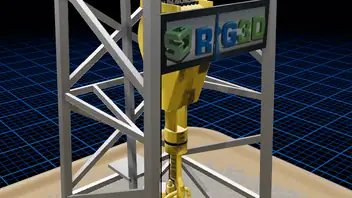
A moving set of sheaves strung to the crown block. Together they multiply the pull of the drawworks to lift the drill string.
Lines strung: 8 to 12 · Rated load: 500 ton class
Open in 3D : Traveling Block Read: Crown Block and Traveling Block
03 Top Drive
A powerful AC motor that hangs from the traveling block and turns the drill string from the top, while drilling mud is pumped through it.
Rating: 500 ton · Drive: AC electric
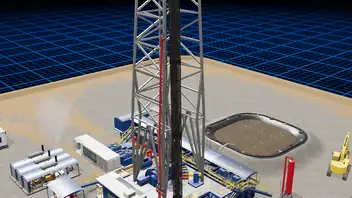
04 Racking Board and Stands
A platform high in the mast where stands of pipe are stored upright while the drill string is pulled out of or run into the hole.
Board height: About 85 ft · Stand length: 90 ft (triples)
Open in 3D : Racking Board and Stands Read: What Does a Derrickman Do?
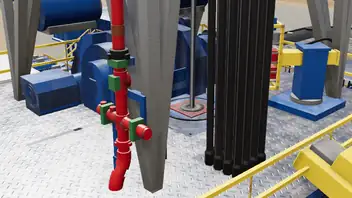
05 Drill Floor and Rotary Table
The main work deck over the well. The rotary table at its center holds the slips that grip the pipe when it is not hanging from the top drive.
Floor height: About 20 ft · Rotary opening: 27.5 in typical
Open in 3D : Drill Floor and Rotary Table Read: Rig Floor Equipment
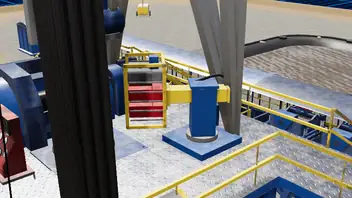
06 Iron Roughneck
A hydraulic robot on the drill floor that spins pipe connections together and applies the final torque, replacing manual tongs.
Functions: Spin, make-up, break-out · Control: From driller's cabin
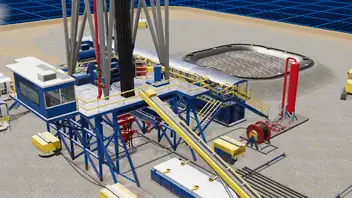
07 Drawworks
The rig's giant winch. Its drum spools the drilling line to raise and lower the traveling block, top drive and drill string.
Power: 1,500 hp AC · Braking: Regenerative + mechanical
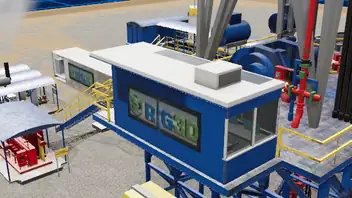
08 Driller's Cabin
The climate-controlled cabin on the drill floor where the driller runs the rig from joystick chairs and screens.
Seats: Driller + assistant · Controls: Joysticks, touch screens
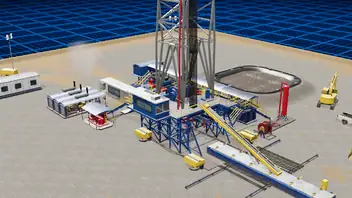
09 Substructure
The tall steel base that lifts the drill floor about 20 ft, leaving room underneath for the blowout preventer stack.
Floor height: About 20 ft · Clear height: Room for BOP stack
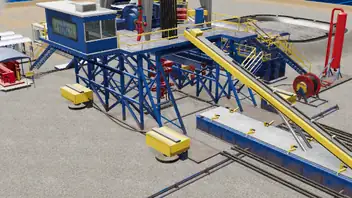
10 Walking System
Hydraulic feet at the corners of the substructure that lift the rig and step it to the next well on the pad.
Feet: 4 hydraulic walkers · Typical move: Tens of feet per well
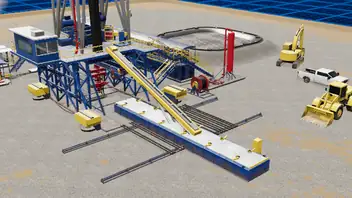
11 Pipe-Handling Catwalk
A hydraulic machine that carries pipe from the ground-level racks up to the drill floor through the V-door.
Lifts: Pipe, collars, casing · Reach: Up to drill floor
Open in 3D : Pipe-Handling Catwalk Read: Pipe Handling Systems
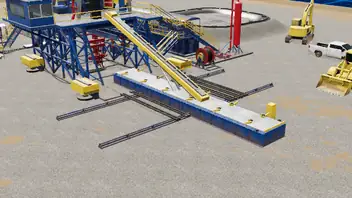
12 Pipe Racks
Ground-level racks that hold drill pipe, drill collars and casing waiting to go into the hole.
Holds: Drill pipe, collars, casing · Joint length: About 31 ft
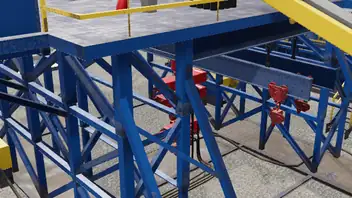
13 Blowout Preventer Stack
A stack of large valves bolted to the wellhead that can seal the well if pressure from the formation surges up the hole.
Size: 13-5/8 in · Rating: 10,000 psi
Open in 3D : Blowout Preventer Stack Read: What Is a Blowout Preventer?
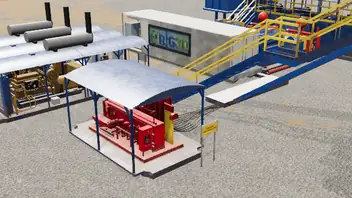
14 BOP Accumulator
A bank of pressurized bottles that stores hydraulic energy so the blowout preventers can be closed within seconds, even without rig power.
Pressure: 3,000 psi · Close time: Seconds
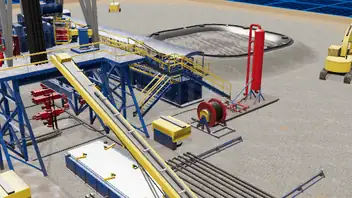
15 Choke Manifold
An arrangement of valves and adjustable chokes used to release well pressure in a controlled way after the BOPs are closed.
Rating: 10,000 psi · Chokes: Adjustable + remote
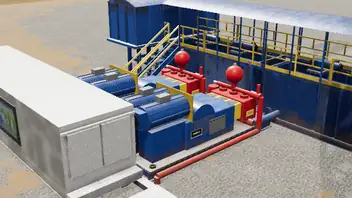
16 Mud Pumps
Large high-pressure pumps that push drilling fluid down the drill string, out through the bit and back up to the surface.
Type: Triplex · Power: 1,600 hp each
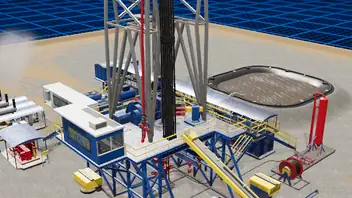
17 Mud Tanks
A row of steel tanks that store, mix and condition the drilling fluid before it goes back down the hole.
Active volume: About 850 bbl · Equipment: Agitators, mixing hopper
Open in 3D : Mud Tanks Read: What Is a Trip Tank and Why Does It Matter?
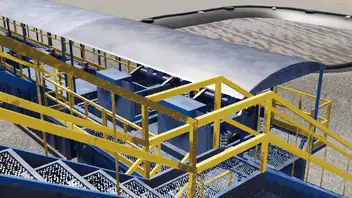
18 Shale Shakers
Vibrating screens that strip rock cuttings out of the mud returning from the well.
Stage: First solids removal · Screens: Fine mesh, vibrating
Open in 3D : Shale Shakers Read: How Does a Shale Shaker Work?
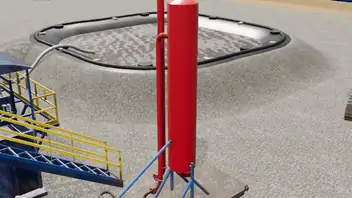
19 Mud-Gas Separator
A tall vessel, often called a gas buster, that separates gas from returning mud and vents it safely away from the rig.
Also called: Gas buster · Feeds from: Choke manifold
Open in 3D : Mud-Gas Separator Read: Mud Gas Separator vs. Vacuum Degasser
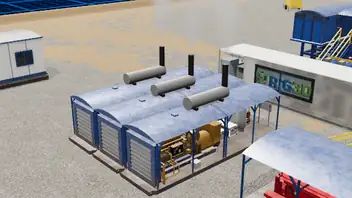
20 Generator Sets
Diesel or natural gas engines driving electric generators that power the entire rig.
Units: 3 to 4 sets · Output: About 1,100 kW each
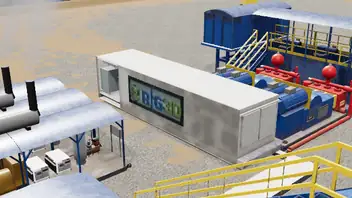
21 VFD House
The electrical control house. Its variable-frequency drives control the speed and torque of the AC motors across the rig.
Controls: Drawworks, top drive, pumps · Technology: Variable-frequency drives
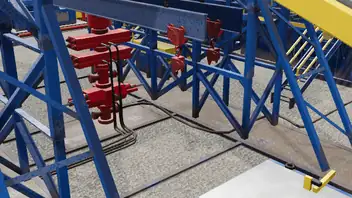
22 Drill Bit and BHA
The tools at the bottom of the drill string: the bit that cuts the rock, a mud motor and the measurement tools that steer the hole.
Bit: PDC, 8-3/4 in typical · Motor: Bent-housing mud motor
Open in 3D : Drill Bit and BHA Read: Bottomhole Assembly Design
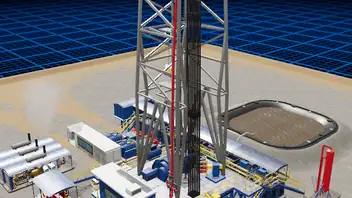
23 Standpipe and Rotary Hose
The vertical high-pressure pipe on the mast that carries mud from the pumps up to the rotary hose, which loops across to the top drive.
Rating: 7,500 psi · Hose: Flexible, steel-reinforced
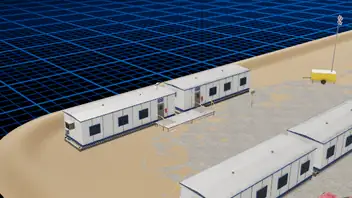
24 Offices
Skid-mounted office trailers for the company man and the toolpusher, where the well is planned, monitored and reported.
Occupants: Company man, toolpusher · Typical size: 40 ft x 12 ft skid house
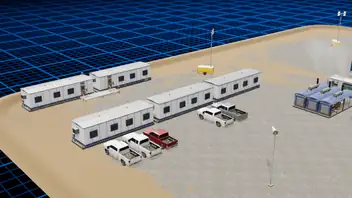
25 Crew Quarters
Skid houses where the crews eat, sleep and rest between twelve-hour shifts, often weeks at a time.
Shifts: Two 12-hour tours · Typical hitch: 14 days on, 14 off
Seen enough to picture your own equipment in 3D? Tell us what it is and we will reply with ideas and a quote. Get a Quote