Drawworks – How the Rig's Hoisting System and Brake Work

Stand on any rig floor and the loudest, busiest machine you'll hear when the crew is tripping pipe is the drawworks. It's sitting there by the driller, winding and unwinding steel cable all day long. Every pound that goes up or down in the derrick goes through it. So what is this thing, and how does it hold a few hundred thousand pounds without letting go? How do the drawworks and its brake actually work?
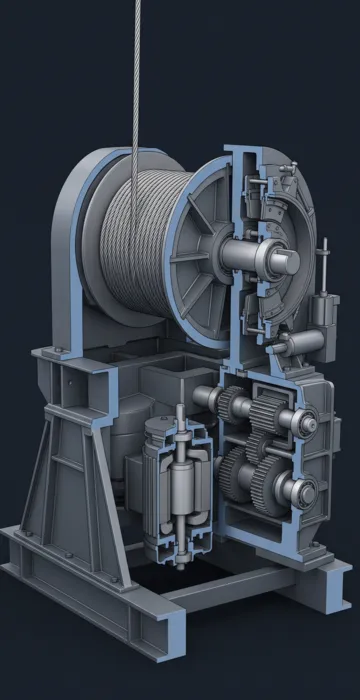
The drawworks is the rig's main hoisting machine, a big powered drum that reels the drilling line in and out to raise and lower the traveling block and everything hanging from it. The drilling line runs from the drum up to the crown block and down through the traveling block, so a short pull on the drum lifts a heavy load. The brake system is what holds that load still and lets the driller lower it under control. On a modern rig that means a main friction or disc brake plus an auxiliary brake that soaks up energy on the way down.
What Does the Drawworks Do on a Drilling Rig?
The drawworks lifts and lowers the drill string, casing and anything else hung from the hook. That's its whole job, and it's a big one.
When you're tripping out, the drawworks pulls stand after stand out of the hole. When you're drilling, it holds the string and slowly feeds it down as the bit makes hole. When you're running casing, it lowers some of the heaviest loads the rig will ever carry. On many land rigs, it's also the machine that raises and lowers the mast during a rig up or rig down.
Here's a detail plenty of hands never think about. The drawworks doesn't really lift the load by itself. It works together with the crown block and traveling block, which multiply its pull. Without that pulley system, no drum on earth would be big enough.
What Are the Main Parts of a Drawworks?
A drawworks is simple in idea and heavy in practice. Here's what's in the box:
- The drum, a large spool where the drilling line wraps. It's usually grooved so the line spools in neat layers instead of crushing itself.
- The motors, usually electric on modern rigs. Older mechanical rigs drove the drawworks from diesel engines through a compound of chains and shafts.
- The transmission or gearing, which sets the speed range. Some drawworks have several gears, and many AC rigs use a simpler gearbox and let the motor drive handle speed.
- The main brake, which holds the drum and controls lowering.
- The auxiliary brake, which takes the heat off the main brake on long, heavy lowers.
- Catheads on older designs, small spinning drums on the ends of the shaft used for pulling tongs and light lifting.
Drawworks are usually rated by input horsepower. A bigger horsepower rating means the rig can pick up heavier strings faster, which is part of how a rig gets matched to the depth of the wells it'll drill.
How Do Drawworks Work When Hoisting?
When the driller wants to pick up, he engages the drum and the motors spin it, winding drilling line on. That line runs up the mast as the fast line, over the crown block sheaves and down through the traveling block several times. Every turn of the drum shortens the lines between the two blocks, and the traveling block rises.
The other end of the drilling line doesn't move. It's clamped down at the deadline anchor, usually on the rig floor or substructure. That's also where the weight indicator sensor typically sits, reading the tension in the dead line.
On older rigs, the driller controlled hoisting with clutches, throttles and a long brake handle. On a modern AC rig, a lot of it happens through joysticks and a computer that controls motor speed and torque. The machine is smarter now, but the physics hasn't changed a bit.
How Does a Drawworks Brake Work?
The drawworks brake works by friction, by absorbing energy in an auxiliary brake, or by using the drive motors themselves to hold back the load. Most rigs use more than one of these at once. Here's how each type works.
Band Brakes
The classic drawworks brake is a pair of steel bands lined with brake blocks, wrapped around flanges on the drum. When the driller pulls the brake handle down, the bands tighten and friction holds the drum. Lift the handle a little and the drum turns, letting the load down.
A good driller on a band brake could feel the hole through that handle. But band brakes get hot, the linings wear, and they need regular adjustment and inspection. Water cooling of the brake rims helped a lot.
Disc Brakes
Many newer drawworks use hydraulic disc brakes, a lot like the brakes on your truck, only much bigger. Calipers squeeze discs mounted on the drum shaft. They tend to be easier to control and maintain than bands, and they're usually designed to fail safe, meaning they set when hydraulic pressure is lost.
Auxiliary Brakes
Lowering a heavy string is a lot of energy coming down. The auxiliary brake absorbs most of it so the main brake doesn't overheat. There are a few kinds:
- Eddy current brakes use magnetic fields to resist rotation without touching, turning motion into heat in a cooled rotor.
- Hydrodynamic brakes churn water to slow the drum, the way a turbine runs in reverse.
- Regenerative or dynamic braking on AC rigs uses the drive motors as generators to hold back the load.
Why Is the Drawworks Brake So Important?
Because if the brake fails, the traveling block and everything on it falls. On a rig floor, that's about as bad as it gets.
A dropped string can wreck the equipment, part the drilling line, damage the hole and hurt or kill people on the floor. The other big danger is running the traveling block into the crown at the top of the mast, which drillers call crowning out. That's why rigs carry crown protection systems that automatically stop the drawworks before the block gets too high, and floor savers that stop it before it comes down too low.
So the brake system gets checked often. Linings, bands or calipers, cooling water, hydraulic pressure and the crown protection device all get tested on a schedule. Never treat a brake test as paperwork. That's your life hanging on that handle.
What Is Drawworks Operation Like for the Driller?
Drawworks operation is the driller's main job, and it takes feel, focus and patience. The driller controls hook speed, watches the weight indicator and decides when to pick up, slack off or stop.
While drilling, the driller feeds weight to the bit by letting the drawworks pay out line a little at a time. Many rigs use an autodriller for this, which lets the drum release line automatically to hold a set weight on bit or rate of penetration. The driller still sets the targets and stays on the controls.
During trips, the driller has to watch for drag and overpull. If the weight jumps when pulling out, the string may be getting tight in the hole. Pulling harder is the rookie move. Stopping and working the pipe, under the rig's procedures, is what keeps a tight spot from becoming stuck pipe.
OSHA's guide to tripping out and in covers the hazards around hoisting, and it's good reading for anybody new to the floor.
How Has the Drawworks Changed Over the Years?
The biggest change has been the move from mechanical drive to electric, and then from DC motors to AC motors with variable frequency drives. A mechanical drawworks needed clutches, chains and a lot of skill on the brake handle. An AC drawworks lets the motors do much of the holding and lowering with precise speed control.
My opinion? The newer machines are easier on the crew and on the iron. They're smoother, they're more predictable, and the computer won't let you do some of the dumb things a tired hand might try at 3 a.m. But they're still only as good as the people maintaining them and running them.
Drawworks: The Muscle Behind Every Trip
The drawworks is the rig's hoisting machine, a powered drum that winds drilling line to raise and lower the traveling block. It works with the crown and traveling blocks to multiply its pull. Its brakes, both the main brake and the auxiliary brake, are what keep heavy loads under control.
If you're breaking in on a rig, spend some time learning this machine. Watch how the driller handles it, learn what the brake checks are for and ask questions. Respect the drawworks and it'll take care of you for a whole career.