Drilling Rig Components – Every Major System, Labeled
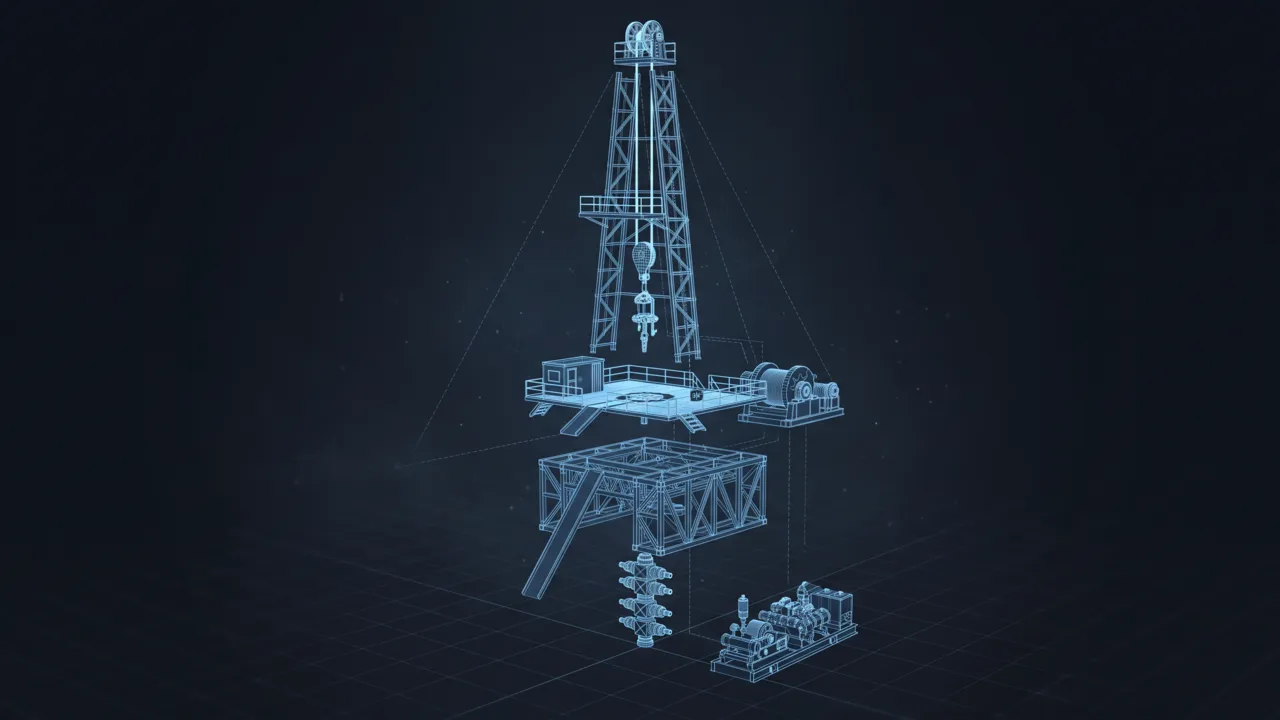
The first time you step onto a location, nobody hands you a map. There's iron everywhere, half of it has two names, and the hands talk in shorthand. You can learn it the slow way over a few hitches, or you can learn the layout now. So what is all that equipment, and how does it fit together? What are the main drilling rig components, and what does each one do?
The main drilling rig components fall into five systems: power, hoisting, rotating, circulating and well control, all held up by the rig's structure. The hoisting system includes the drawworks, drilling line, crown block and traveling block. The rotating system is the top drive or the kelly and rotary table, plus the drill string and bit. The circulating system covers the mud pumps, standpipe, mud tanks and solids control equipment, while the BOP stack, accumulator and choke manifold handle well control. Engines and generators power it all, and the mast and substructure carry the load.
What Are the Five Systems of a Drilling Rig?
Think of the rig as five teams sharing one structure. Each system has its own job, and each one depends on the others.
- Power system: makes the energy.
- Hoisting system: lifts and lowers the drill string.
- Rotating system: turns the drill string and bit.
- Circulating system: moves drilling mud down the hole and back.
- Well control system: seals the well if pressure gets away.
The structure (mast and substructure) is sometimes counted as a sixth system. I'll cover it first, because everything else hangs off it or sits on it.
Oil Rig Diagram in Words: The Parts From Top to Bottom
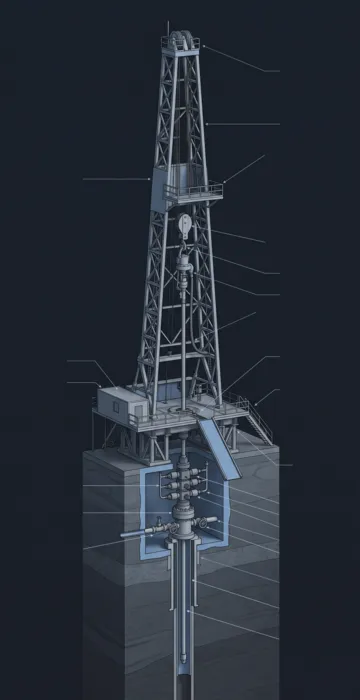
If you could slice a land rig in half and label it, here's what you'd see, starting at the top of the mast and working down to the hole. Keep this list handy your first week.
- Crown block: fixed pulleys at the very top of the mast.
- Monkeyboard: the derrickman's platform, high up the mast.
- Fingerboard: steel fingers that hold the tops of racked pipe stands.
- Traveling block: moving pulleys hanging from the drilling line.
- Top drive (or hook, swivel and kelly on older rigs): turns the pipe.
- Mast or derrick: the tower holding all of the above.
- Drilling line: wire rope running from the drawworks over the crown.
- Standpipe and rotary hose: carry mud from the pumps up to the top drive.
- Rig floor: the work deck where pipe is handled.
- Doghouse and driller's cabin: the driller's controls and the crew's shelter.
- Drawworks: the hoisting drum on the floor.
- Rotary table: the turntable in the floor with the slips.
- Setback area: where pipe stands rest on the floor.
- Substructure: the steel base lifting the floor high off the ground.
- BOP stack: the blowout preventers under the floor, on the wellhead.
- Wellhead and casing: the top of the well itself.
- Mud pumps, mud tanks and shakers: off to the side of the rig.
- Engines, generators and the power house: usually at the back of location.
- Accumulator and choke manifold: set back from the wellhead for safety.
- Pipe racks and catwalk: where pipe waits before it goes to the floor.
For pictures to go with the words, OSHA keeps an illustrated glossary of rig components with labeled drawings. It's one of the better free references out there.
What Holds the Rig Up? Mast, Derrick and Substructure
The structure carries every pound the rig lifts. On land, it's made of two main pieces: the substructure and the mast.
The substructure is the steel base that raises the rig floor high enough to fit the BOP stack and wellhead underneath. It has to carry the weight of the drill string, plus the pipe racked on the floor, plus the floor equipment.
Above it stands the mast or derrick. A true derrick is a bolted-together tower built in place, the old kind you see in history photos. Most modern land rigs use a mast instead, which folds down and gets raised as a unit with the drawworks. Hands still say "derrick" for both, and nobody will correct you.
If you want the full story of how those pieces go together on location, see this article on how an oil rig is built.
What Are the Parts of the Hoisting System?
The hoisting system lifts the drill string, holds it while drilling, and runs pipe in and out of the hole. It's a big block and tackle with a powered drum.
Drawworks
The drawworks is the hoisting machine. It's a large drum wrapped with drilling line, driven by electric motors (or engines on mechanical rigs), with a brake system to stop and hold the load. The driller controls it from the console. It's the biggest single machine on the floor.
Drilling Line and Deadline Anchor
The drilling line is heavy steel wire rope. One end wraps on the drawworks drum (the fast line). The other end is clamped to the deadline anchor on the substructure (the dead line). In between, it's strung back and forth through the blocks. A storage reel holds fresh line so worn sections can be slipped and cut off.
Crown Block and Traveling Block
The crown block is a set of sheaves fixed to the top of the mast. The traveling block hangs below it on the drilling line and moves up and down. With several lines strung between them, the drawworks gets enough mechanical advantage to lift a very heavy string.
Hook and Elevators
On older rigs a big hook hangs under the traveling block to carry the swivel and kelly. On top drive rigs, the top drive hangs there instead. Elevators hang from bails below and clamp around the pipe so it can be lifted.
What Parts Turn the Drill String?
The rotating system turns the pipe and the bit. Modern rigs do most of it with a top drive, while older and smaller rigs use a rotary table and kelly.
- Top drive: an electric or hydraulic motor hanging from the traveling block that screws into the top of the drill string and turns it. Mud passes through it via a washpipe.
- Kelly: a square or hexagonal pipe that slides through the rotary table and turns the string.
- Swivel: hangs the kelly from the hook, lets it turn, and passes mud into it.
- Rotary table: the turntable in the rig floor. With a top drive, it mostly just holds the slips.
Honestly, the top drive is the best thing that ever happened to the rig floor. Fewer connections, better control, and the ability to rotate and circulate while pulling out of a tight spot.
Drill String and Bottomhole Assembly
The drill string is everything hanging below the top drive. Drill pipe makes up most of it, in joints around 30 feet long with thick threaded tool joints on each end. Below that come heavyweight pipe and drill collars, which provide weight to push the bit into the rock.
The bottomhole assembly (BHA) is the business end. It can include stabilizers, a mud motor, MWD and LWD tools, jars, and finally the bit. Each piece has a job, whether that's steering, measuring, or getting you unstuck.
What Parts Make Up the Circulating System?
The circulating system keeps mud moving. It's a big loop that runs from the tanks, down the pipe, up the hole and back to the tanks.
- Mud tanks (pits): hold and mix the drilling fluid.
- Mud pumps: big reciprocating pumps, usually triplex, that push mud at high pressure.
- Standpipe: steel pipe running up the mast that carries mud toward the top drive.
- Rotary hose (kelly hose): the flexible line from the standpipe to the top drive or swivel.
- Flowline: carries returning mud from under the floor to the solids control equipment.
- Shale shakers: vibrating screens that strip cuttings out of the mud.
- Desander and desilter: cone-shaped hydrocyclones that spin out finer solids.
- Centrifuge: removes the finest solids or recovers weighting material.
- Degasser: pulls gas out of mud that has picked some up downhole.
- Mixing hopper: where the crew adds dry products to the mud.
The derrickman usually tends the pumps and shakers when he's not up in the derrick. Mud is the lifeblood of the well, and he's the one checking its pulse.
Which Components Handle Well Control?
Well control equipment exists to keep formation fluids from coming up the hole uncontrolled. The mud weight is the first barrier. The equipment below is the backup.
Blowout Preventer Stack
The BOP stack bolts on top of the wellhead under the rig floor. It usually has an annular preventer on top, which uses a big rubber element to seal around almost anything, and several ram preventers below it. Pipe rams close around drill pipe. Blind rams seal an open hole. Shear rams cut the pipe and seal in an emergency.
Accumulator (Closing Unit)
The accumulator stores hydraulic fluid under pressure in bottles so the BOP can be closed fast, even if the rig loses power. Hands often call it the Koomey unit after an early manufacturer, the same way people say Kleenex.
Choke Manifold and Mud-Gas Separator
When the well is shut in after a kick, the crew circulates the kick out through the choke manifold. The adjustable chokes hold back pressure while heavier mud goes in. The mud-gas separator (gas buster) then pulls the gas out of the returns and sends it to the flare line.
What Powers All These Components?
Most rigs run on diesel engines driving generators. Many newer rigs can also run on natural gas or grid power. On an electric rig, the generators feed a power control room (SCR or VFD house) that sends controlled power to each motor.
Mechanical rigs skip the electricity and drive the equipment straight from the engines through a compound of chains and clutches. They're simpler but give the driller less fine control.
Supporting the power system you'll also find fuel tanks, air compressors for pneumatic tools and controls, and a water tank. Small stuff, but the rig stops without it.
What Other Equipment Is on the Rig Floor?
The rig floor has its own crowd of tools. These are the ones you'll put your hands on most:
- Slips: wedge-shaped grips that hold the pipe in the rotary table.
- Tongs: big wrenches for making up and breaking out connections.
- Iron roughneck: a machine that spins and torques connections.
- Mousehole: a socket in the floor for staging the next joint.
- Rathole: a socket for storing the kelly on kelly rigs.
- Catwalk and V-door: the ramp and opening where pipe comes up to the floor.
- Air hoists (tuggers): small winches for lifting tools and equipment.
- Driller's console: the controls for hoisting, rotating and pumping.
Every one of these can hurt you if you get careless. Learn where your hands and feet belong around each one before you start moving fast.
Drilling Rig Components at a Glance
Here's the whole rig on one page. This table lists the main drilling rig components, the system each belongs to, what it does and where you'll find it.
| Component | System | What it does | Where it sits |
|---|---|---|---|
| Engines and generators | Power | Make the electricity or mechanical power that runs everything | Engine house, off to the side of the rig |
| Mast or derrick | Hoisting | Holds up the crown block and the full hook load | Standing on the substructure over the hole |
| Substructure | Structure | Raises the rig floor and carries the weight of the rig and pipe | Under the rig floor |
| Crown block | Hoisting | Fixed sheaves that the drilling line runs over | Top of the mast |
| Traveling block | Hoisting | Moving sheaves that raise and lower the load | Hanging inside the mast |
| Drilling line | Hoisting | Wire rope strung between the drawworks and the blocks | Reeled on the drawworks, run up through the mast |
| Drawworks | Hoisting | Big winch that reels the drilling line in and out | On the rig floor, beside the driller |
| Top drive | Rotating | Turns the drill string from above | Hanging from the traveling block |
| Kelly and rotary table | Rotating | Older way of turning the string from the floor | Center of the rig floor |
| Swivel | Rotating / circulating | Lets the string turn while mud flows in | Below the hook on kelly rigs |
| Drill pipe | Rotating | Carries torque and mud down to the bit | In the hole or racked in the derrick |
| Drill collars and BHA | Rotating | Put weight on the bit and hold downhole tools | Bottom of the drill string |
| Drill bit | Rotating | Cuts the rock | Very bottom of the hole |
| Mud pumps | Circulating | Push drilling fluid down the string | Pump house near the mud tanks |
| Mud tanks (pits) | Circulating | Hold, mix and treat the drilling fluid | Beside the rig on the ground |
| Shale shakers | Circulating | Screen cuttings out of the returning mud | Where the flowline enters the tanks |
| Desander, desilter, centrifuge | Circulating | Remove finer solids from the mud | On top of or next to the mud tanks |
| Blowout preventer (BOP) | Well control | Seals the well if it kicks | Under the rig floor, on the wellhead |
| Choke manifold | Well control | Controls flow out of the well while circulating a kick | Near the rig floor, tied into the BOP |
| Driller's console | Control | Runs the hoisting, rotating and pumping | On the rig floor, in the driller's cabin |
Don't try to memorize it in one sitting. Pick a system, walk out and find each piece, then do the next one. Rigs differ, so yours might have extra pieces or put them in a different spot. A kelly rig won't have a top drive, for one.
Once the names stick, you'll start hearing the rig differently. A change in pump noise or the sound of the drawworks tells you something, and you'll know which piece of iron it's coming from.
Drilling Rig Components: How Do the Parts of a Drilling Rig Work Together?
The drilling rig components only make sense as a team. The engines power the drawworks, which raises the blocks and top drive. The top drive turns the string while the mud pumps push fluid through it. The mud carries cuttings out, and the BOP stands guard underneath the whole time.
If you're new, learn the five systems first, then put names to the iron one piece at a time. Walk the location with the parts list above and point at each item until you know it cold. Ask questions. Good hands like a new hand who wants to learn, and the one who knows the equipment is the one who goes home in one piece.