What Are the Main Types of Drilling Rigs? – Land and Offshore
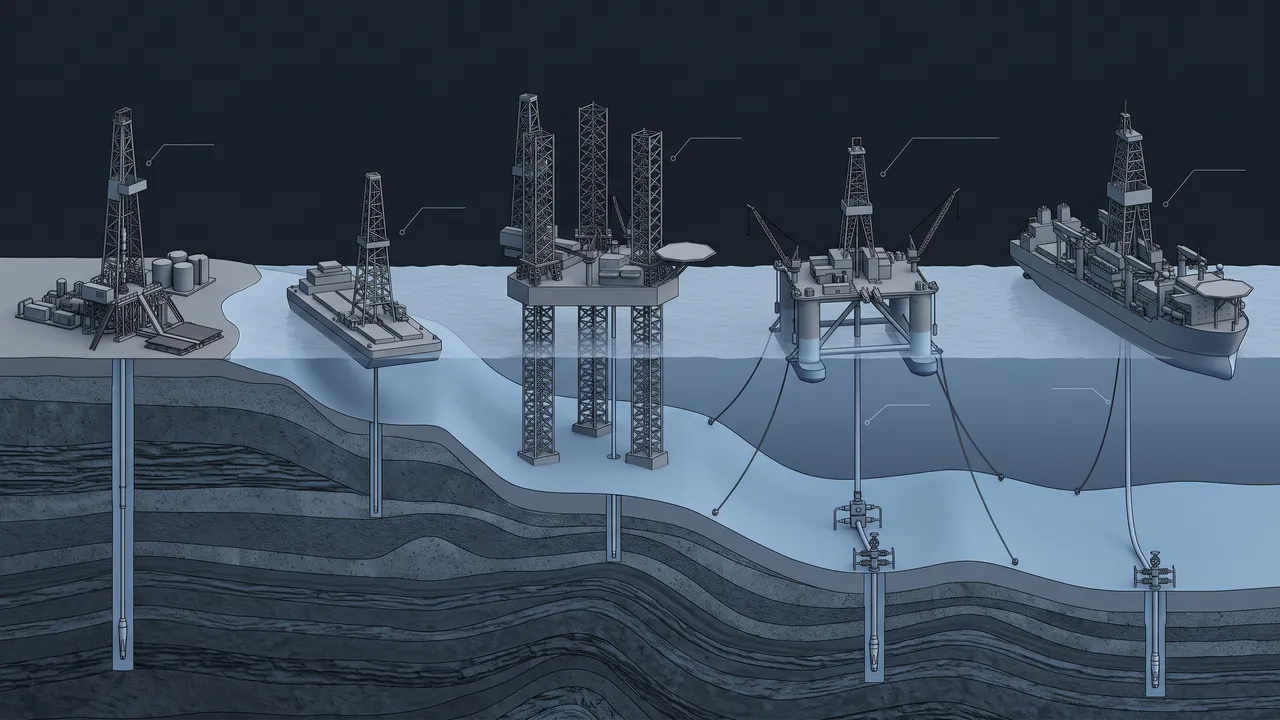
Say "oil rig" and one person pictures a steel tower in a West Texas pasture while another pictures a floating city in the Gulf. They're both right. The industry builds very different machines for very different jobs, and the names get thrown around loosely. So which is which, and why does it matter? What are the main types of drilling rigs?
The main drilling rig types are land rigs and offshore rigs, and offshore rigs split into bottom-supported units (barges, platform rigs and jackups) and floating units (semisubmersibles and drillships). Land rigs drill on solid ground and move by truck or by walking across a pad. Bottom-supported rigs rest on the seafloor, so they're limited to shallower water. Floating rigs hold position with anchors or computer-controlled thrusters and handle the deepest water. Water depth, weather and the well's depth decide which rig an operator hires.
How Are Drilling Rigs Classified?
The simplest way to sort rigs is by where they work: on land or on water. From there, offshore rigs get sorted by how they stay put. Either they stand on the bottom, or they float.
Inside each group, rigs get ranked by how much they can do. On land that usually means hook load capacity, horsepower and how deep they can drill. Offshore, the big question is water depth rating, followed by drilling depth and how rough a sea the rig can handle.
No matter the type, the heart of the machine is the same. Every rig has the same basic drilling rig components: a hoist, something to turn the pipe, mud pumps and a blowout preventer. What changes is the platform those systems sit on.
What Types of Land Rigs Are There?
Land rigs drill most of the wells in North America. They range from small truck-mounted units that drill shallow wells to big pad rigs that drill long horizontal laterals in shale.
Conventional Land Rigs
A conventional land rig is built in pieces and hauled on trucks. Crews set the substructure, raise the mast, and hook up the engines, pumps and tanks. When the well is done, it all comes apart again for the move. A full rig move can take days and dozens of truckloads.
Mobile and Truck-Mounted Rigs
Mobile rigs have the mast and drawworks built onto a truck or trailer. They're quick to rig up and rig down, which makes them handy for shallower wells and for workover jobs. They don't have the hook load of a big rig, so you won't see them drilling a deep gas well.
Walking and Skidding Pad Rigs
Shale drilling changed land rigs more than anything in my time. Operators now drill several wells from one pad, sometimes a dozen or more, lined up a few feet apart. Pad rigs can walk or skid from one well to the next without coming apart. Hydraulic feet lift the whole rig and step it over, mast up, with much of the pipe still racked in the derrick.
Honestly, a walking rig moving a few yards in a few hours is a sight worth seeing. It saves the operator a lot of days on a big pad.
Land Rig vs. Offshore Rig: What's the Difference?
The drilling process is the same on land and offshore. The difference is everything around it. A land rig sits on dirt and gets its supplies by truck. An offshore rig sits on water, gets supplies by boat and helicopter, and houses its crew on board.
Here are the big differences in plain terms:
- Cost: offshore rigs cost far more to build and to hire per day than land rigs.
- Crew: a land rig crew on tour is a handful of hands; an offshore rig can have well over a hundred people on board.
- BOP location: on land and on jackups, the BOP sits under the rig floor. On floaters, it usually sits on the seafloor.
- Weather: offshore rigs have to be built for waves, wind and storms.
- Moving: land rigs move by truck. Offshore rigs are towed or sail under their own power.
Both kinds of hands work hard. Offshore just stacks more logistics on the same job.
What Are the Types of Offshore Rigs?
Offshore rigs come in five main kinds. The table below lays out where each one works and how it holds position. Depths are general ranges, since every rig has its own rating.
| Rig type | Typical water depth | How it stays put |
|---|---|---|
| Barge rig | Very shallow, protected water (marshes, bays, lakes) | Hull flooded and set on the bottom |
| Platform rig | Wherever the fixed platform stands | Sits on a fixed production platform |
| Jackup | Shallow water, up to a few hundred feet | Legs lowered to the seafloor, hull jacked up above the waves |
| Semisubmersible | Moderate to ultra-deep water | Anchors and mooring lines, or dynamic positioning |
| Drillship | Deep to ultra-deep water | Dynamic positioning thrusters |
Let's take them one at a time.
What Is a Barge Rig?
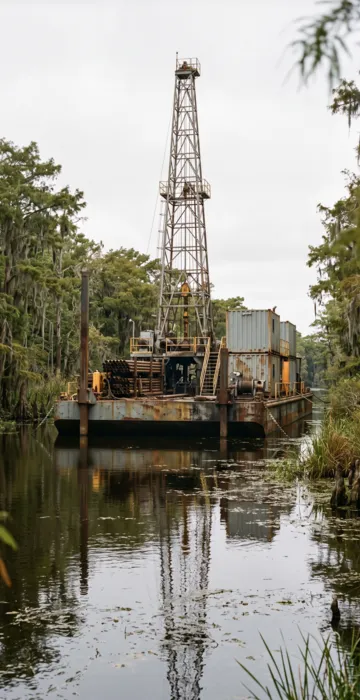
A barge rig is a drilling rig built on a flat-bottomed barge. It gets towed into place in a marsh, bay or lake, then the hull is flooded so it settles onto the bottom. That gives it a solid footing while it drills.
Barge rigs fill a narrow niche. The water is too wet for a land rig and too shallow for most jackups. You'll find them in places like the bayous and inland waters of Louisiana.
What Is a Platform Rig?
A platform rig is a drilling package installed on top of a fixed offshore platform. The platform itself is the foundation, standing on steel legs pinned to the seafloor. The rig drills a batch of wells from that one spot, then may be removed or left for later work.
Some platforms can't carry a full rig's weight. In that case, a tender rig ties up alongside and holds the heavy stuff, like mud tanks and living quarters, while a lighter drilling package sits on the platform. It's a clever arrangement and you'll still see it in some parts of the world.
Jackups: Rigs That Stand on the Seafloor
A jackup is a floating hull with tall legs, usually three or four. It gets towed to location with the legs up. Once in place, the crew drives the legs down to the seafloor and then jacks the hull up out of the water, high enough that waves pass underneath.
Because it stands on the bottom, a jackup is a very stable platform. It works a lot like a land rig on stilts. The BOP sits right under the rig floor, and the crew can see it.
The limit is leg length. Most jackups work in fairly shallow water, up to a few hundred feet, which covers a big share of the world's continental shelf. Rigzone's explainer on how jackups work covers the leg and jacking systems well. Soft seafloor can be a problem, since a leg can punch through a weak layer, so the site gets surveyed first.
Which Rig Is Used in Deep Water?
Deep water belongs to floating rigs: semisubmersibles and drillships. Once the water gets too deep for legs, the only option is to float and hold position over the well.
Semisubmersibles
A semisubmersible floats on big pontoons connected to the deck by thick columns. When it gets to location, it takes on ballast water and sinks down partway. With the pontoons well below the surface, waves have less to push against, so the rig stays steadier than a regular hull would.
Semis hold position with anchors in moderate depths. In deeper water they use dynamic positioning, where computers run thrusters to keep the rig over the well using satellite and acoustic references. They're known for handling rough seas well, which is why you'll see them in harsh areas like the North Sea.
Drillships
A drillship is exactly what it sounds like: a ship with a derrick in the middle. The pipe runs down through an opening in the hull called the moonpool. Drillships use dynamic positioning to hold station, and the newest ones are rated for very deep water and very deep wells.
The big advantage is mobility and storage. A drillship can sail itself to a new location quickly and carry a lot of pipe, mud and supplies. They work in the deepest parts of places like the Gulf, Brazil and West Africa.
What Floaters Have in Common
Both kinds of floaters run a marine riser down to a subsea BOP on the seafloor. Both need heave compensation, which keeps the drill string steady while the rig rises and falls with the swell. And both have a much more complicated well control setup than a land rig, because the BOP is a long way from the rig floor.
Do Land Rigs Differ by How They're Powered?
Yes, and it's one of the first things a hand notices on a new rig. Land rigs fall into three broad groups by power: mechanical, SCR and AC.
- Mechanical rigs send diesel engine power through a compound of chains, clutches and shafts straight to the drawworks, pumps and rotary table.
- SCR rigs use diesel engines to run generators, then convert the power to drive DC motors on each piece of equipment.
- AC rigs use variable frequency drives to run AC motors, which gives the driller very fine control over speed and torque.
Mechanical rigs are simple, tough and cheaper. Plenty of them still drill shallow and mid-depth wells. But for long horizontal wells and automated drilling, AC rigs have mostly taken over the top of the market. The driller can hold weight on bit and rotary speed much more precisely, and the computer can help run the hoist.
When you hear someone call a rig "high-spec," they usually mean an AC rig with a top drive, high-pressure pumps, a big hook load rating and the ability to walk between wells on a pad.
What Happened to Older Rig Types?
Some rig types have mostly faded out, but they're worth knowing because you'll hear old hands talk about them.
Cable tool rigs drilled most of the early oil wells. Instead of turning a bit, they lifted a heavy bit on a cable and dropped it over and over to pound the rock. Rotary rigs replaced them because rotary drilling was faster and could handle the pressure of deeper wells. A few cable tool rigs still work on water wells and shallow jobs.
Submersible rigs were an early offshore design. They sat on the bottom by flooding pontoons, a lot like a barge but built for somewhat deeper water. Jackups pushed most of them out, since a jackup can work in deeper water and gets its deck well clear of the waves.
The old rigs teach a lesson. Rig types change when the wells change. Deeper water brought floaters. Shale pads brought walking rigs. Whatever the next big play needs, somebody will build a rig for it.
Are Drilling Rigs and Workover Rigs the Same?
No. A drilling rig makes a new hole. A workover rig, sometimes called a well service rig or pulling unit, works on wells that are already drilled. It pulls tubing and rods, swaps out pumps, fixes leaks and handles other repairs.
Workover rigs look like small drilling rigs, and new hands mix them up all the time. The tell is size and what's around them. A workover rig is usually a single truck with a short mast and much less equipment on location.
There are other specialty units too. Coiled tubing units run a continuous reel of pipe instead of jointed pipe, and some are set up to drill. Snubbing units can run pipe into a well that's still under pressure. They're all part of the same family, just with different jobs.
How Do Operators Choose a Rig Type?
The well decides. An operator starts with a few questions and the answers narrow the field quickly:
- Is the well on land or offshore?
- If offshore, how deep is the water?
- How deep is the well, and how much hook load and pump capacity will it need?
- What kind of weather and seas will the rig face?
- How many wells are planned from the same spot?
- What's available, and what does it cost per day?
On land, that usually comes down to picking a rig with enough capacity for the deepest, longest well on the program. Offshore, water depth does most of the deciding. You don't send a drillship to do a jackup's job, because the day rate would make the company man cry.
Drilling Rig Types, Boiled Down: Pick the Rig That Fits the Well
The main drilling rig types come down to land rigs, bottom-supported offshore rigs, and floating offshore rigs. Land rigs handle dirt. Barges, platform rigs and jackups handle shallow water by standing on the bottom. Semisubmersibles and drillships float and handle deep water.
Underneath all that variety, the same core machine is doing the same core job: hoisting pipe, turning a bit, circulating mud and keeping the well under control. Learn those systems on any rig and you'll understand the rest of them.
If you're new to the industry, start by learning the rig type you'll actually work on. Then pay attention to what makes it different. That's where the surprises tend to hide.