Crown Block and Traveling Block – How the Rig's Pulley System Works

Look up the mast of any drilling rig and you'll see two big sets of pulleys. One sits bolted to the very top and never moves. The other hangs on a nest of steel cable and rides up and down all day. New hands see it and wonder why a rig needs all that cable when it could just have one big winch. How do the crown block and traveling block work together to lift the drill string?
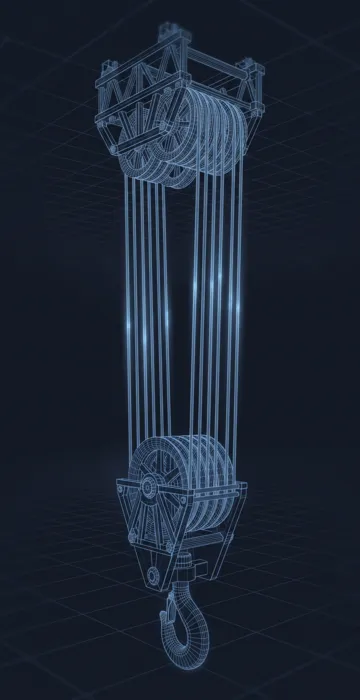
The crown block and traveling block form a block and tackle, a pulley system that multiplies the pull of the drawworks so it can lift the huge weight of the drill string. The crown block is a fixed set of sheaves at the top of the mast. The traveling block is a moving set of sheaves that hangs below it, with the hook or top drive underneath. The drilling line is threaded back and forth between them several times. Each extra line between the blocks shares the load, so the drawworks pulls far less than the weight on the hook.
What Is a Crown Block?
The crown block is the stationary sheave assembly at the top of the derrick or mast. It's a row of grooved wheels (sheaves) on a heavy shaft, mounted on the crown platform, and it carries the entire hoisting load of the rig.
A crown block assembly includes more than just the working sheaves. There's usually a fast line sheave, where the line comes up from the drawworks, and a dead line sheave, where the line goes back down to the anchor. Many crowns also carry a few small sheaves for utility lines. The whole thing sits on beams designed to hand the load down through the mast legs to the substructure. You can see the textbook definition of the crown block in the SLB Energy Glossary.
Here's the thing about the crown. It's the one part of the hoisting system you can't easily get to. Inspecting it means climbing to the top of the mast, so it pays to do that job right and on schedule.
What Is a Traveling Block?
The traveling block is the moving set of sheaves that hangs from the drilling line below the crown. It rides up and down the mast, and it's what everything else hangs from.
On older rigs, a big hook hangs under the traveling block, and the swivel and kelly hang from that hook. On a top drive rig, the top drive usually connects to the traveling block, sometimes through a combined block and hook unit. Either way, the elevators that grab the pipe hang from bails below.
A traveling block has one fewer sheave than the crown that works with it. That's because the fast line and dead line both run over sheaves on the crown, and the line has to start and end up top.
How Does the Block and Tackle Multiply Force?
Here's the plain math. When a load hangs from several lines, each line carries a share of it. If you have 10 lines strung between the crown and traveling block, each line ideally carries one-tenth of the load.
The drawworks only pulls on one of those lines, the fast line. So in a perfect world:
- Fast line pull = hook load divided by number of lines
- With a 500,000-pound hook load on 10 lines, that's 50,000 pounds of pull at the drawworks
- With 12 lines, it drops to about 41,700 pounds
Nothing is free, though. To raise the traveling block 1 foot with 10 lines strung, the drawworks has to reel in 10 feet of line. You trade speed for force, same as a low gear in a truck.
Real sheaves also have friction in their bearings, and the line itself loses a little every time it bends over a sheave. So the actual fast line pull is higher than the ideal number. Engineers use an efficiency factor for that, and it gets worse as you add more lines.
How Many Lines Are Strung on a Rig?
Most rigs string between 6 and 14 lines, and the exact number depends on the load the rig expects. It's almost always an even number, because the line goes up and comes back down for every sheave on the traveling block.
| Lines strung | Ideal fast line pull per 100,000 lb on the hook | Line reeled in per foot of block travel |
|---|---|---|
| 6 | about 16,700 lb | 6 ft |
| 8 | 12,500 lb | 8 ft |
| 10 | 10,000 lb | 10 ft |
| 12 | about 8,300 lb | 12 ft |
Crews sometimes restring to more lines before a heavy casing job and back down afterward for faster trips. Restringing is a big job with real hazards, and it's done only by the procedure, with the blocks secured.
What Is Hook Load?
Hook load is the total weight hanging from the traveling block, as read on the weight indicator. When the string is hanging free in the hole, it's the buoyed weight of the drill string plus the block, the top drive or hook, and the rest of the hardware hanging below the sheaves.
The weight indicator usually gets its reading from a sensor on the dead line, near the deadline anchor. Since the dead line carries a known share of the load, the gauge is calibrated to show the whole hook load. When you set the bit on bottom, the hook load drops, and that drop is your weight on bit.
The mast has to carry more than the hook load. It holds the hook load plus the pull on the fast line and the dead line. On a 10-line string-up, that's roughly 20 percent more than the hook load, before friction. That's why rigs have separate ratings for hook load and mast capacity.
Why Does the Drilling Line Wear Unevenly?
The drilling line doesn't wear evenly because certain spots sit on sheaves or at the drum crossover points over and over. Those spots bend under load every trip, and that bending is what kills wire rope.
That's why every rig runs a slip and cut program. The crew slips new line through the system so the worn spots move, then cuts off the old line at the drum. It keeps the line from failing in the same place every time.
Take care of your drilling line and your sheaves, the blocks will take care of you. Worn sheave grooves chew up new line fast, so the grooves get gauged during inspections too.
The Crown Block and Traveling Block: Small Pull, Big Lift
The crown block and traveling block are the rig's block and tackle. The crown stays fixed at the top of the mast, the traveling block rides up and down, and the drilling line strung between them divides the load. More lines mean less pull at the drawworks and a slower block.
Know your string-up, know your hook load and know what the mast is rated for. Those three numbers tell you how much the rig can safely lift. And keep a close eye on the line and the sheaves, because they do the hardest work in the derrick.