Mud Gas Separator vs. Vacuum Degasser – Getting Gas Out of Mud

Gas and drilling mud don't mix well, at least not on purpose. When gas gets into the mud, it makes the fluid lighter, can starve pumps and, in the worst case, can bring flammable or toxic gas right onto the rig floor. Rigs carry two very different machines to deal with it, and people mix them up all the time. Both "get gas out of mud," so what's the real difference? When do you use a mud gas separator, and when do you use a vacuum degasser?
A mud gas separator handles large volumes of free gas coming out of the well during a kick, while a vacuum degasser removes small bubbles of gas trapped in the mud during normal drilling. The mud gas separator (often called a poor boy degasser) is a tall vessel downstream of the choke manifold that lets gas break out and vents it, usually to a flare. The vacuum degasser sits in the mud tanks after the shale shakers and uses a vacuum and thin-film flow to pull bubbles out of gas-cut mud. One is a well control tool. The other is a mud conditioning tool, and you generally need both.
Free Gas vs Entrained Gas: Why It Matters
To understand the two machines, start with the two kinds of gas.
- Free gas is gas in large slugs or pockets, like what comes out of the choke when a kick is being circulated out. It wants to separate on its own; you just have to give it a safe place to go.
- Entrained gas is made of tiny bubbles spread through the mud, like the bubbles in a milkshake. Mud's viscosity and gel strength hold them in place, so they won't leave without help.
The simplest way to think about it: the mud gas separator handles a big flow of gas that wants out, and the vacuum degasser handles a small amount of gas that wants to stay. That difference drives everything about how each machine is built.
Mud Gas Separator vs Vacuum Degasser at a Glance
| Feature | Mud gas separator | Vacuum degasser |
|---|---|---|
| Type of gas | Free gas, large volumes | Entrained bubbles, small volumes |
| When used | Circulating out a kick through the choke | Normal drilling with gas-cut mud |
| Location | Downstream of the choke manifold, before the shakers | In the mud tanks, after the shakers |
| How it separates | Gravity and baffles at near-atmospheric pressure | Vacuum plus thin-film flow over plates |
| Where gas goes | Vent line, usually to a flare | Discharged by the vacuum pump to a safe vent |
| Moving parts | None in the vessel | Vacuum pump and a jet or pump for discharge |
How Does a Mud Gas Separator Work?
A mud gas separator is a vertical steel vessel with an inlet partway up, baffles inside, a gas vent line out the top and a liquid outlet at the bottom. During a well control event, returns from the well pass through the choke manifold, where the pressure is reduced. The gassy mud then enters the separator.
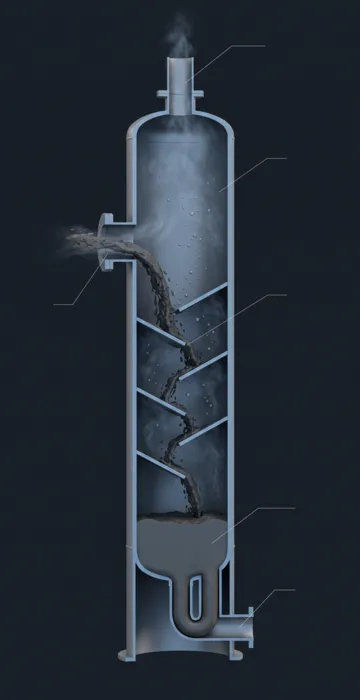
Inside, the mud splashes over the baffles. That spreads it out and slows it down, so the free gas breaks out and rises. The gas goes up the vent line and is carried well away from the rig, usually to a flare. The mud drops to the bottom and flows out to the shakers.
The bottom outlet is the clever part. It includes a liquid seal, often a U-shaped leg of pipe that always stays full of mud. That column of mud acts like the water in a sink's P-trap. Liquid can pass through, but gas can't push past it unless the pressure inside the vessel gets too high.
Why Is It Called a Poor Boy Degasser?
"Poor boy" is old oilfield slang for something simple and homemade. Early versions were built from pipe and plate on location. The name stuck, even though modern units are engineered and sized for specific well conditions.
What Limits a Mud Gas Separator?
The main limit is "blow-through." If gas comes in faster than the vent line can carry it away, pressure builds inside the vessel. Once that pressure beats the weight of the mud in the liquid seal, gas pushes out the bottom and heads to the shakers, which is exactly where you don't want it. That is why vessel size, vent line diameter and seal height are all designed together, and why choke operators manage gas arrival carefully.
How Does a Vacuum Degasser Work?
A vacuum degasser is a closed tank, usually mounted on the mud pits right after the shakers. A vacuum pump lowers the pressure inside, and that low pressure pulls mud up into the tank. The mud flows in a thin layer over a series of inclined plates.
Two things work together here. The vacuum makes each bubble expand, so it is bigger and rises more easily. The thin film means each bubble only has a short distance to travel before it reaches the surface and pops. Gas is pulled off by the vacuum pump and vented safely. The degassed mud is discharged back to the pits, often using a jet (eductor) that pulls it out of the tank.
Why not just let the bubbles float out on their own in the pits? Because they won't. Mud with decent gel strength can hold small bubbles almost indefinitely. If you want a short definition to keep handy, the SLB glossary's degasser entry is a good one.
Why Does Gas-Cut Mud Need a Degasser?
Gas-cut mud causes three practical problems:
- Lighter mud. Bubbles lower the density, which can reduce hydrostatic pressure if the mud goes back downhole unchanged.
- Pump trouble. Centrifugal pumps that feed the desander, desilter and mud pumps lose efficiency and can air-lock.
- Bad readings. Mud weight measured with a standard balance reads low, which can mislead the crew.
That is why the vacuum degasser sits ahead of the hydrocyclones in the solids control line. Gas readings from the mud also carry valuable information about the formation, which is a big part of mud logging.
When to Use a Mud Gas Separator
A mud gas separator is used any time the well is being circulated through the choke manifold with gas expected at surface. The most common case is circulating out a kick after the well has been shut in. It is also used for other operations where gas returns are routed through the choke, depending on the rig's procedures.
During normal drilling, returns go straight from the flowline to the shakers and bypass the separator entirely. The separator is lined up and ready, but it only sees flow when the crew routes returns through the choke. Well control procedures, the company representative and the toolpusher decide that routing on location.
Mud Gas Separator or Vacuum Degasser? You Need Both
A mud gas separator and a vacuum degasser both remove gas from drilling mud, but they solve different problems. The separator is a well control tool for big volumes of free gas coming through the choke. The degasser is a mud conditioning tool for small entrained bubbles during everyday drilling.
The easy way to keep them straight is to remember where each one sits. The separator sits upstream of the shakers, right after the choke. The vacuum degasser sits downstream of the shakers, in the pits. If you can place them on the rig, you understand what each one is for.