Decanter Centrifuges – What They Do on a Drilling Rig
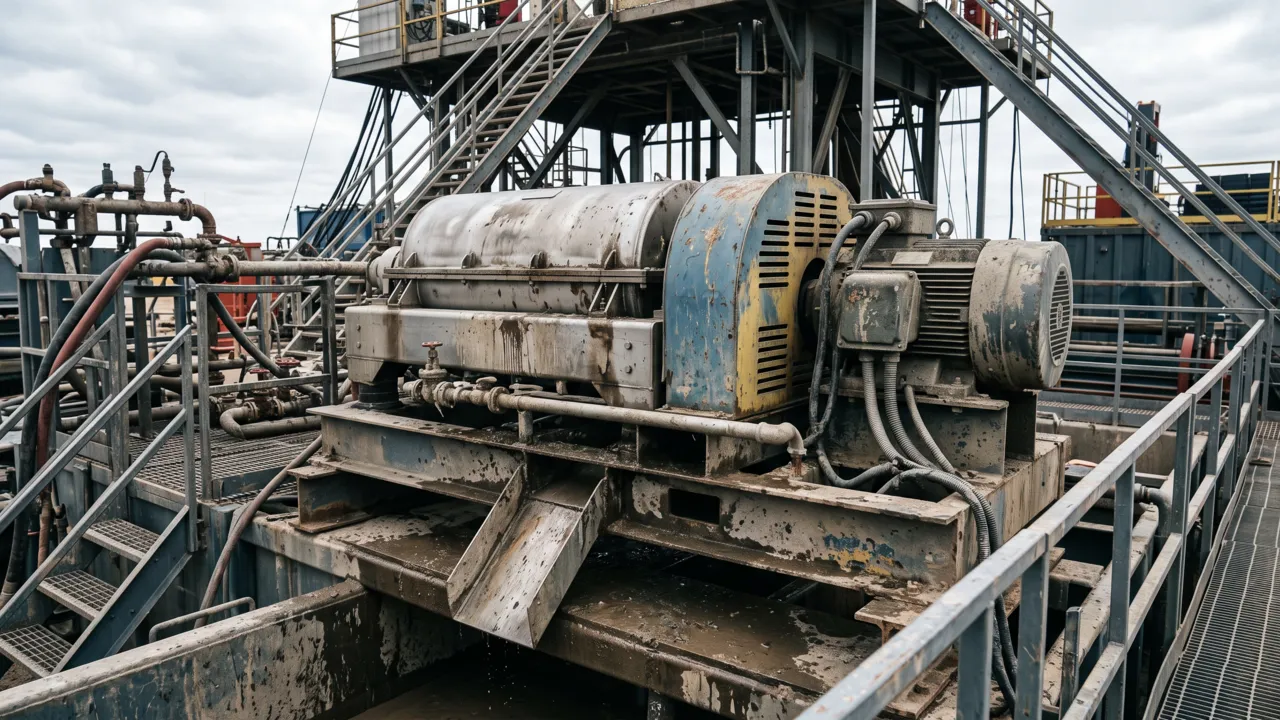
At the far end of a rig's mud tanks there is usually a long, horizontal machine that hums instead of rattles. It doesn't look like much from the outside, just a housing on a skid with a feed hose going in and two discharges coming out. Inside, though, it spins fast enough to pull out particles too small for any screen or cone to catch. So what does a decanter centrifuge actually do on a drilling rig?
A decanter centrifuge spins drilling mud in a rotating bowl so that fine solids are thrown to the wall and scraped out by an internal screw conveyor, while cleaner liquid flows out the other end. It is the last stage of solids control and can separate particles down to a few microns, far finer than shakers or hydrocyclones. On a rig it has two main uses. In unweighted mud, it removes fine drilled solids to keep mud weight and viscosity down. In weighted mud, it is often set up to recover barite for reuse while discarding the ultra-fine solids that thicken the mud.
How Does a Drilling Mud Centrifuge Work?
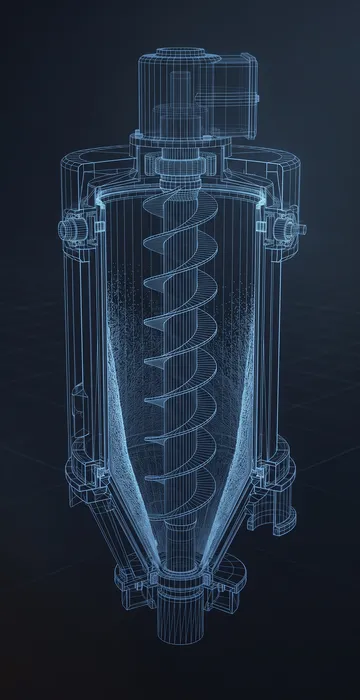
A drilling mud centrifuge works on the same principle as a washing machine's spin cycle, only much faster and continuously. Here's the basic layout:
- Bowl: a long horizontal drum, partly cylindrical and partly cone-shaped, that spins at high speed.
- Scroll (screw conveyor): a spiral inside the bowl that turns slightly slower or faster than the bowl.
- Gearbox: creates the speed difference between bowl and scroll.
- Feed tube: delivers mud into the center of the spinning assembly.
- Weirs or pond plates: set the depth of the liquid pool inside the bowl.
Let's follow the mud through the machine:
- A feed pump sends mud into the center of the bowl.
- The spinning bowl flings the mud outward, forming a ring of liquid against the wall.
- Solids, being denser, settle against the bowl wall far faster than they would in a tank.
- The scroll's speed difference drags the settled solids toward the narrow conical end, up a dry "beach" and out the solids discharge (the underflow).
- The cleaned liquid flows the other way and spills over the weirs (the overflow, also called the effluent or centrate).
This is the whole trick: gravity alone might take hours or days to settle a fine particle in a tank. The centrifuge multiplies that pull by hundreds or thousands of times, so the same settling happens in seconds.
What Is Barite Recovery?
Barite recovery is using a centrifuge to keep the expensive weighting material in the mud while getting rid of the troublesome fine drilled solids. It works because barite is much denser than most drilled rock. At the right speed, barite settles and leaves in the underflow, while the lightest and finest particles stay in the liquid.
In a barite recovery setup, the underflow (rich in barite) goes back into the active mud system. The overflow (liquid plus colloidal fines) is either discarded or sent to a second machine for more processing. Crews then add fresh base fluid and chemicals to replace the liquid that was removed.
Why bother? Because colloid-sized solids are the worst offenders for mud viscosity and gel strength. They are too small for anything else to catch, and they build up with every circulation. Barite recovery lets the rig remove them without dumping its weighting material.
High-Speed vs Low-Speed Centrifuge: What's the Difference?
Centrifuge speed is a setting, and the speed you choose changes what the machine removes.
| Feature | Low-speed setup | High-speed setup |
|---|---|---|
| Force on particles | Lower, often several hundred G | Higher, often over a thousand G |
| Main use | Barite recovery in weighted mud | Removing fine drilled solids |
| Underflow goes | Back to the mud system | To waste |
| Overflow goes | To waste or a second centrifuge | Back to the mud system |
Many rigs drilling with weighted mud run two centrifuges in series. The first runs slower and returns barite to the active system. Its overflow feeds a second, faster machine that strips out the fine drilled solids and returns the cleaned liquid. That way the rig keeps both its barite and its base fluid, and only the junk leaves.
Where Does the Centrifuge Sit in the Solids Control System?
The centrifuge sits at the end of the line, after the shakers, degasser and hydrocyclones. It usually processes only part of the circulating volume, drawing from one pit and returning to another. Running it on mud that hasn't already been through the coarser equipment would overload it fast.
A centrifuge handles solids, not gas. Gas in the mud is removed earlier, either by a vacuum degasser during normal drilling or by a mud gas separator when a kick is circulated out through the choke. Gas-cut mud can also upset feed pumps, so getting the gas out first helps everything downstream work better.
What Can Go Wrong With a Decanter Centrifuge?
Most centrifuge problems trace back to feed rate, settings or wear:
- Feeding too fast leaves too little time for settling, so solids carry over into the overflow.
- The wrong pond depth or speed shifts the cut point away from what the mud needs.
- Abrasive solids wear the scroll flights, which then convey solids poorly.
- Vibration from an unbalanced bowl is a warning sign to shut down and inspect.
Because it spins so fast, a centrifuge also has guards and interlocks that should never be bypassed. For the dictionary-style definition, the SLB Energy Glossary entry on the centrifuge covers both its mud-cleaning role and its other oilfield uses.
Decanter Centrifuge: What It Does and Why the Rig Keeps It Spinning
A decanter centrifuge is the finest filter in the solids control system. It spins mud hard enough to pull out particles just a few microns across, and it can be tuned either to discard fine drilled solids or to recover barite.
If you remember one thing, make it the direction of the two streams. In unweighted mud, the liquid is kept and the solids go to waste. In barite recovery, the solids (mostly barite) are kept and much of the liquid goes. Knowing which stream is the "good" one tells you how the machine is set up.