Desander vs. Desilter – What's the Difference?
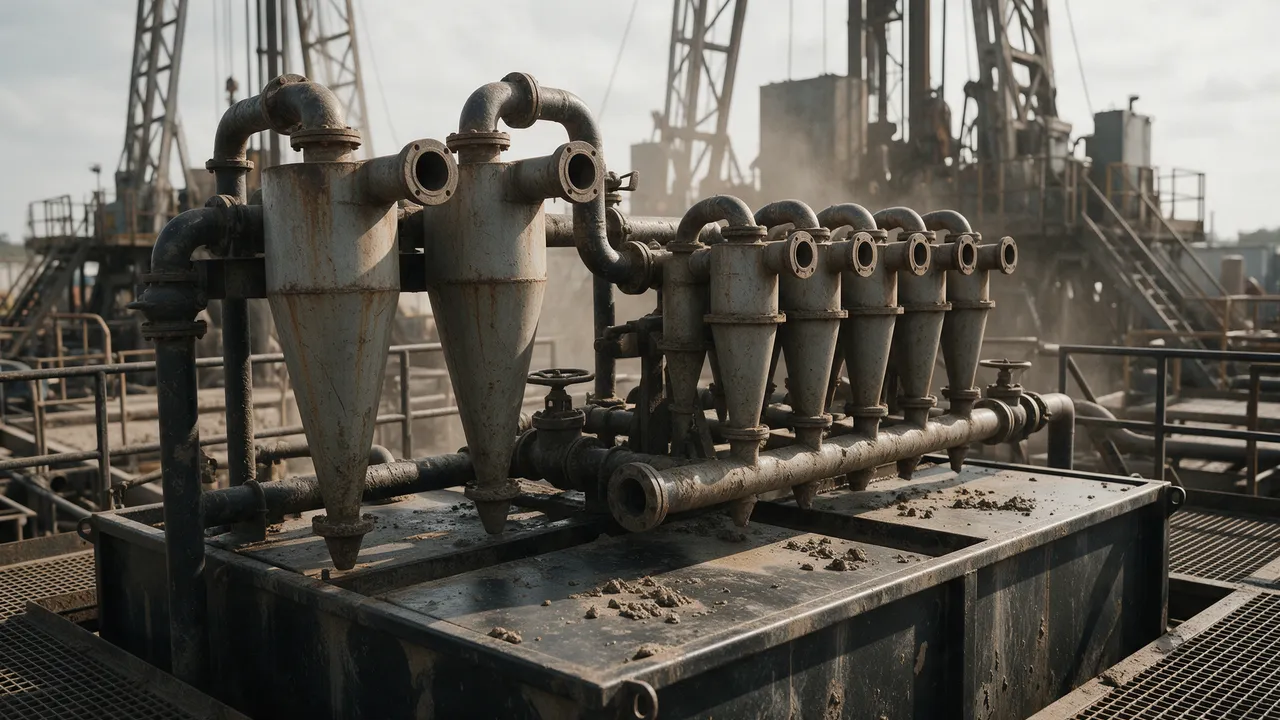
Walk past the shakers on most land rigs and you'll find a set of cones sitting on top of the mud tanks, angled down like upside-down ice cream cones with hoses running to them. Some are big and some are small. New hands often hear both called "the cones" and wonder why a rig needs two kinds. The whole desander vs desilter question comes down to particle size. So what's the difference between a desander and a desilter?
A desander and a desilter are both hydrocyclones that use spinning flow to throw solids out of drilling mud, but the desander uses larger cones to remove coarser sand-sized particles while the desilter uses smaller cones to remove finer silt. Desander cones are typically about 6 to 12 inches in diameter and remove particles down to roughly 40 microns or so. Desilter cones are typically about 2 to 5 inches across and reach down to roughly 15 to 25 microns. The desander runs first, so it takes the coarse load off the desilter. On heavily weighted mud, both would throw away costly barite.
What Is a Hydrocyclone?
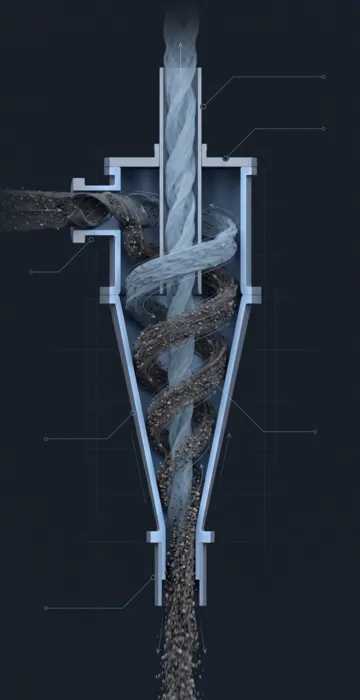
A hydrocyclone is a cone-shaped separator with no moving parts. A centrifugal pump feeds mud into the side of the cone at high speed, and the cone shape forces it into a tight spinning vortex. Heavy and large particles get thrown to the wall and spiral down to the small opening at the bottom, called the apex or underflow. The cleaner mud turns and travels up the center, leaving through the top, called the overflow.
A good everyday comparison is a salad spinner. The spinning pushes the water to the outside so the lettuce stays in the middle. In a hydrocyclone, the "water" being flung outward is the heavy solids, and the "lettuce" is the cleaner mud.
The physics comes down to this: smaller cones spin the fluid in a tighter circle, which creates stronger forces on each particle. That is why smaller desilter cones can pull out smaller particles than big desander cones. The trade-off is that each small cone handles less flow, so a desilter needs many more cones to process the same volume.
Desander vs Desilter Side by Side
| Feature | Desander | Desilter |
|---|---|---|
| Cone diameter | About 6 to 12 inches | About 2 to 5 inches |
| Typical cut point | Roughly 40 microns and up | Roughly 15 to 25 microns and up |
| Particles targeted | Sand and coarse silt | Silt |
| Number of cones | Fewer, larger cones | Many small cones |
| Position in the train | After shakers and degasser | After the desander |
| Use in weighted mud | Limited | Usually replaced by a mud cleaner |
Exact cut points vary with the manufacturer, cone design, feed pressure and the mud itself, so think of these as typical ranges rather than guarantees.
Why Does a Drilling Mud Desander Come First?
A drilling mud desander comes first because it protects the desilter. Small desilter cones have tiny apex openings. If coarse sand reaches them, they plug, wear and stop separating well. By pulling out the bigger particles first, the desander lets the desilter focus on the fine material it was designed for.
It's the same reason the shakers come before both. Each step in a solids control system handles the size range it does best and passes a cleaner, finer stream to the next machine.
What Feeds the Cones?
Hydrocyclones need pressure to spin, and that pressure comes from a centrifugal pump. Each unit usually has its own feed pump that draws from one mud tank compartment and discharges cleaned mud into the next one downstream. Setting the suction and discharge points in the right compartments keeps the cones from reprocessing mud they just cleaned, or worse, pulling from a compartment that hasn't been through the shakers yet.
Gas is the other thing to watch. Centrifugal pumps lose efficiency when the mud is full of small gas bubbles, and a weak feed means weak separation. That is why the degasser sits ahead of the desander in the solids control train.
How Do You Tell if the Cones Are Working?
The quickest check is the discharge pattern at the bottom of each cone:
- Spray discharge: a fine, umbrella-shaped spray. This is what you want.
- Rope discharge: a thick, solid stream. The cone is overloaded and passing solids out the top that it should be removing.
- No discharge or dripping: the apex may be plugged, or there may be nothing to remove.
Feed pressure is the other key setting. Each cone is designed to run at a certain head from the feed pump. Too little and the vortex is weak. Too much and the cone wears quickly. Many rigs keep a gauge on the cone manifold for exactly this reason.
Capacity matters too. A common practice is to size the cones to process somewhat more than the full circulating rate, so all the mud gets cleaned at least once per circulation.
What About a Mud Cleaner?
A mud cleaner is a desilter whose underflow drops onto a fine shaker screen. In weighted mud, barite particles are mostly in the silt size range, so a regular desilter would discard them. With a mud cleaner, barite passes through the screen and goes back into the system, while larger drilled solids are thrown away. The SLB glossary entry on the desilter touches on this same limitation.
For even finer solids, rigs turn to a decanter centrifuge, which can separate particles far smaller than any cone can reach and can also be set up to recover barite.
Desander vs Desilter: Which One Do You Need?
On most rigs drilling with unweighted mud, the answer is both. The desander takes out sand-sized solids with large cones, and the desilter follows with small cones to remove silt. Together they extend pump life, keep mud weight down and cut dilution costs.
In weighted mud, the setup changes, often to a mud cleaner and centrifuge. Either way, remember the simple rule: bigger cones for bigger particles, smaller cones for smaller particles, and always coarse before fine.