How Does a Shale Shaker Work?
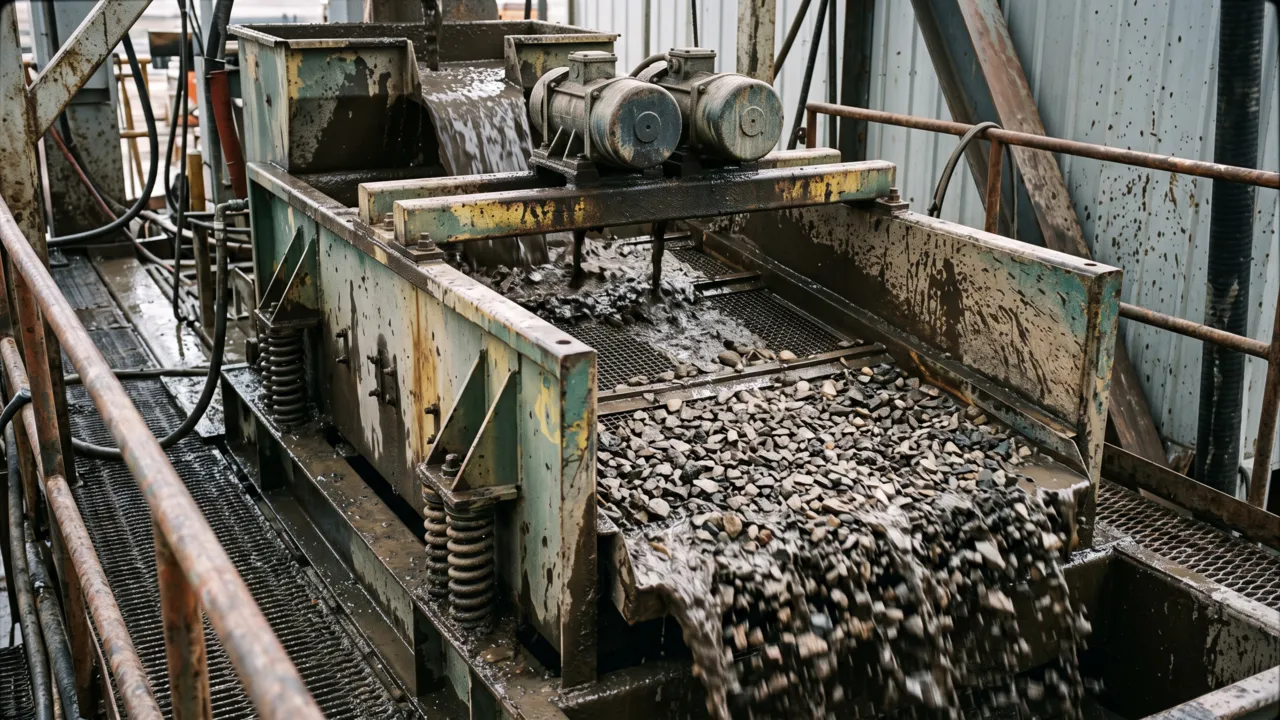
The first stop for mud coming out of a well is a row of loud, rattling machines at the end of the flowline. Cuttings march across their screens and fall off the end into a bin, while the mud disappears through the wire and heads back to the pits. It looks simple, and in a way it is. But a lot of thought goes into making that separation work well. So how does a shale shaker work?
A shale shaker works by vibrating one or more mesh screens so that drilling mud falls through the openings while rock cuttings too large to pass are carried along the screen and dumped off the discharge end. Returns enter a header box called the possum belly, which spreads them across the screens. Electric motors fitted with offset weights shake the screen basket, and that motion both speeds up the liquid's passage through the screen and conveys the solids toward the end. The screen's mesh size sets the smallest particle the shaker can remove. Shakers are the first and most important piece of solids control equipment on a rig.
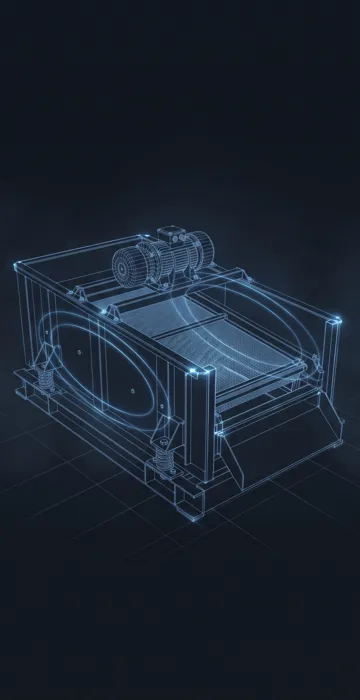
What Are the Parts of a Shale Shaker?
Most shakers share the same basic layout:
- Possum belly (feeder or header box): receives returns and spreads them across the screen width.
- Screen basket (bed): the vibrating frame that holds the screens.
- Screens: replaceable panels of wire mesh, often in two or three layers.
- Vibrator motors: electric motors with eccentric weights that create the motion.
- Isolation springs or rubber mounts: let the basket move while protecting the skid.
- Deck angle adjustment: tilts the basket to control how long mud stays on the screen.
- Sump or flow-back pan: collects the cleaned mud under the screens.
Rigs usually run several shakers side by side so they can handle the full circulating rate and keep drilling if one needs new screens.
How Does Shale Shaker Operation Work Step by Step?
Let's follow a load of returns across the screen:
- Mud and cuttings pour into the possum belly from the flowline.
- The mixture spills over a weir onto the back end of the vibrating screen.
- Vibration breaks the mud's surface tension and pushes liquid and fine particles down through the mesh.
- As liquid drains, the remaining solids become a drier pile that the motion walks toward the discharge end.
- The cuttings fall off the end into a chute or cuttings box.
- The screened mud drops into the sump below and moves on to the next piece of equipment.
The screen deck is usually tilted slightly uphill toward the discharge end. That keeps a pool of mud on the back part of the screen, which gives liquid more time to drain, and leaves a short "beach" where the cuttings dry before falling off. A good operator watches where the liquid ends on the screen and adjusts angle or flow to keep that line in the right place.
Linear vs Elliptical Motion: What's the Difference?
The motion of the screen basket controls how well a shaker conveys cuttings and how fine a screen it can run. There are three main types:
| Motion | How it's made | Strengths | Weaknesses |
|---|---|---|---|
| Circular | Single vibrator near the basket's center | Gentle, simple, good for sticky clay | Weak conveyance; limited to coarser screens |
| Linear | Two motors turning in opposite directions | Strong conveyance, even uphill; handles fine screens | Can be hard on screens and sticky solids |
| Balanced elliptical | Motors set to make an oval path | Good conveyance with gentler handling | Fewer designs; tuning matters |
The trick is in the motors: in linear motion, the two counter-rotating motors cancel each other's sideways force and add up their force along one line. The screen gets thrown forward and up, then drops, so cuttings hop toward the discharge end like popcorn on a tilted pan. Most modern rigs use linear-motion shakers because they convey well while running the fine screens today's mud programs call for.
Shaker motion is described by its G-force, the acceleration compared with gravity. Higher G-force pushes liquid through the screen faster but wears screens out sooner. Many shakers let the crew adjust it.
How Do You Choose Shaker Screen Mesh Size?
Mesh size describes how many openings per linear inch a screen has. A higher mesh number means smaller openings, so a 200-mesh screen removes finer particles than an 80-mesh screen. Because screens are often built from layers of different cloth, the industry now labels screens with an API number based on a standardized test (API RP 13C), which tells you the actual cut point in microns.
The rule of thumb is simple: run the finest screen that can handle the flow without sending whole mud off the end. Too coarse, and fine sand slips through to wear out pumps and cones. Too fine, and mud runs across the screen and gets dumped with the cuttings, which wastes expensive fluid.
Things that push you toward coarser screens include:
- High flow rates in large-diameter top hole.
- High mud viscosity or high mud weight.
- Sticky clay (gumbo) that blinds fine mesh.
- Lost circulation material you want to keep in the mud.
Why Do Shakers Matter So Much?
Shakers matter because they are the only solids control equipment that sees the full flow of the well, and they remove cuttings while those cuttings are still big. Every pass through the pumps and the bit grinds solids smaller, and smaller solids are harder and more expensive to remove later. Catching them at the screen is cheaper than chasing them with centrifuges and dilution.
What Problems Do Shale Shakers Have?
Most shaker trouble shows up in one of three ways:
- Mud running off the end: screens too fine for the flow, blinded screens, or deck angle too low.
- Torn screens: unscreened mud and solids bypass straight to the pits. Crews check screens often and replace damaged panels quickly.
- Blinding or plugging: particles close to the opening size lodge in the mesh, or sticky clay coats the wire, so the screen stops passing liquid.
A torn screen is the sneaky one. Nothing looks dramatic at the shaker, but the solids load downstream jumps. That is a big reason the next machines in line, the hydrocyclones, are sized and tuned to back up the shakers. If you want to see how they split the work, our article on desander vs desilter explains their cone sizes and cut points.
How Does a Shale Shaker Work? Screens, Motion and a Good Eye
A shale shaker uses vibration to push drilling mud through a mesh screen while walking cuttings off the end. The motion type sets how well it conveys, and the screen mesh sets how fine a particle it can remove.
The practical lesson is to treat screens as a setting, not a fixed part. Choose the finest mesh the flow allows, keep panels intact, and watch where the liquid line sits on the deck. For a short technical definition, the SLB Energy Glossary entry for the shale shaker is a good reference to keep handy.