What Is Mud Weight? – How Drillers Balance the Well
Every driller has a number written on the board that matters more than almost any other: the mud weight. Get it right and the well behaves. Go too light and the formation pushes fluid into the hole. Go too heavy and you can crack the rock and lose your mud. So what is mud weight, and how do drillers use it to balance the well?
Mud weight is the density of the drilling fluid, most often measured in pounds per gallon (ppg) in the United States. It matters because a column of mud presses down on the bottom of the hole, and that hydrostatic pressure is what holds back the oil, gas and water in the rock. The formula is simple: hydrostatic pressure (psi) = 0.052 × mud weight (ppg) × true vertical depth (ft). Drillers keep mud weight a bit above the formation's pore pressure but below the pressure that would fracture the rock. That band between the two limits is called the mud weight window.
What Does Mud Weight in PPG Actually Mean?
Mud weight in ppg is just how many pounds one U.S. gallon of the mud weighs. Fresh water weighs about 8.33 ppg, so that is our baseline. A 10 ppg mud is about 20 percent heavier than water. A 16 ppg mud is almost twice as heavy.
You will see other units too, depending on where you work:
- Pounds per cubic foot (lb/ft³), common on some older reports.
- Specific gravity (SG), where water equals 1.0. Multiply SG by 8.33 to get ppg.
- Kilograms per cubic meter (kg/m³) or grams per cubic centimeter, common outside the U.S.
- Pressure gradient in psi per foot, which is mud weight already converted into pressure.
Here's the key idea: mud weight is just a density, but drillers think of it as pressure. Every pound per gallon you add raises the pressure on bottom, and the deeper the well, the bigger that effect gets.
What Is the Hydrostatic Pressure Formula?
The oilfield hydrostatic pressure formula is:
Hydrostatic pressure (psi) = 0.052 × mud weight (ppg) × TVD (ft)
Where does 0.052 come from? It is a unit conversion. One cubic foot holds about 7.48 gallons, and one square foot holds 144 square inches. Divide 7.48 by 144 and you get roughly 0.052. That constant turns pounds per gallon and feet into pounds per square inch.
Notice that the formula uses true vertical depth (TVD), not measured depth. A horizontal well might have 20,000 feet of pipe in the hole, but if the bottom sits 9,000 feet below the surface, only those 9,000 vertical feet count. Gravity only cares how tall the column is.
A Worked Example
Let's walk through one. Say we are drilling at 10,000 feet TVD with 10.0 ppg mud.
- Write the formula: P = 0.052 × MW × TVD.
- Plug in the numbers: P = 0.052 × 10.0 × 10,000.
- Multiply: P = 5,200 psi.
Now suppose the geologist expects the next sand to have a pore pressure of 5,000 psi at that depth. Our mud gives 5,200 psi, so we are 200 psi overbalanced. That margin is what keeps the sand from flowing.
We can also run the formula backward to find the mud weight needed for a given pressure. If a zone at 10,000 feet holds 5,700 psi, the minimum mud weight is 5,700 ÷ (0.052 × 10,000), or about 11.0 ppg. Engineers would then add a safety margin on top of that.
How Is Mud Weight Measured on a Rig?
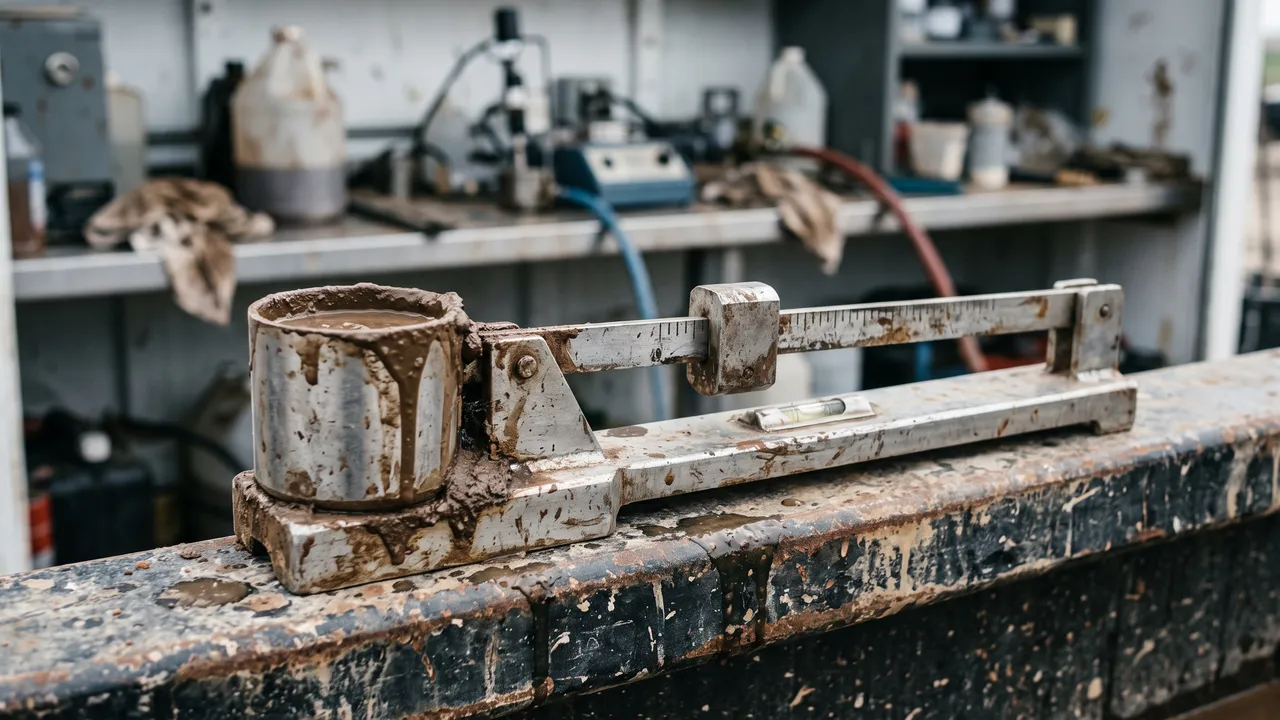
Mud weight is measured with a mud balance, a simple beam scale with a cup on one end and a sliding rider on the other. You fill the cup with mud, put the lid on so a little excess squeezes out the hole, wipe it clean, and slide the rider until the bubble level centers. The scale reads density directly.

A standard balance has a weakness. If the mud has tiny gas or air bubbles in it, the reading comes out light. That is why many rigs also use a pressurized mud balance, which squeezes the trapped air down to a negligible volume and gives a truer number.
Mud weight is usually checked at two places:
- The suction pit, which is the mud going into the hole ("mud weight in").
- The flowline or possum belly, which is the mud coming out ("mud weight out").
Comparing the two tells you a lot. Lighter mud coming out can mean gas cutting or water influx. Heavier mud coming out usually means cuttings loading. Watching that difference is part of normal drilling fluid circulation monitoring.
How Do Drillers Raise or Lower Mud Weight?
To raise mud weight, crews add a weighting material, almost always barite. Barite (barium sulfate) is a dense mineral with a specific gravity of about 4.2, so a little of it raises density quickly without adding too much volume. Hematite and calcium carbonate are used in some cases. Brines like calcium chloride also add weight while staying solids-free.
To lower mud weight, crews dilute the system with base fluid and run the solids control equipment harder to strip out drilled solids. Lowering weight is slower and more expensive than raising it, because you have to build new volume or throw some old mud away.
What Is the Mud Weight Window?
The mud weight window is the safe range between two limits. The lower limit is set by pore pressure (and sometimes by the weight needed to keep shale from caving in). The upper limit is set by the fracture gradient, the pressure at which the rock will split and start taking mud.
| If mud weight is... | What can happen |
|---|---|
| Below pore pressure | Formation fluid flows into the well (a kick) |
| Inside the window | The well is balanced and stable |
| Above fracture pressure | The rock cracks and mud is lost (lost circulation) |
In some wells, especially deepwater wells and depleted fields, that window can be narrow. That is one reason casing strings are set where they are. Each string of casing protects weaker rock above it so the next section can use heavier mud.
Is Static Mud Weight the Whole Story?
No. When the pumps are running, mud has to push its way up the annulus, and that friction adds pressure on bottom. Engineers express the total as equivalent circulating density (ECD), which is the mud weight the well "feels" while circulating. ECD is always higher than static mud weight.
Pipe movement matters too. Pulling pipe out quickly can swab the hole and lower bottom-hole pressure. Running in fast can surge it and push pressure up. A careful driller watches trip speed for exactly this reason. OSHA's well control eTool covers how these pressure swings tie into kick and blowout hazards.
What Is Mud Weight? The Number That Balances the Well
Mud weight is the density of the drilling fluid, and through the formula 0.052 × MW × TVD it becomes the hydrostatic pressure that holds the formation in check. Too light invites a kick. Too heavy risks fracturing the rock.
The practical takeaways are short. Use TVD, not measured depth. Measure weight in and weight out, and use a pressurized balance when gas might be present. Remember that circulating and tripping move the real bottom-hole pressure away from the static number.
If you can do the worked example above in your head, you already understand the most important calculation on a drilling rig.