Mud Pumps – How Triplex Pumps Move Drilling Fluid
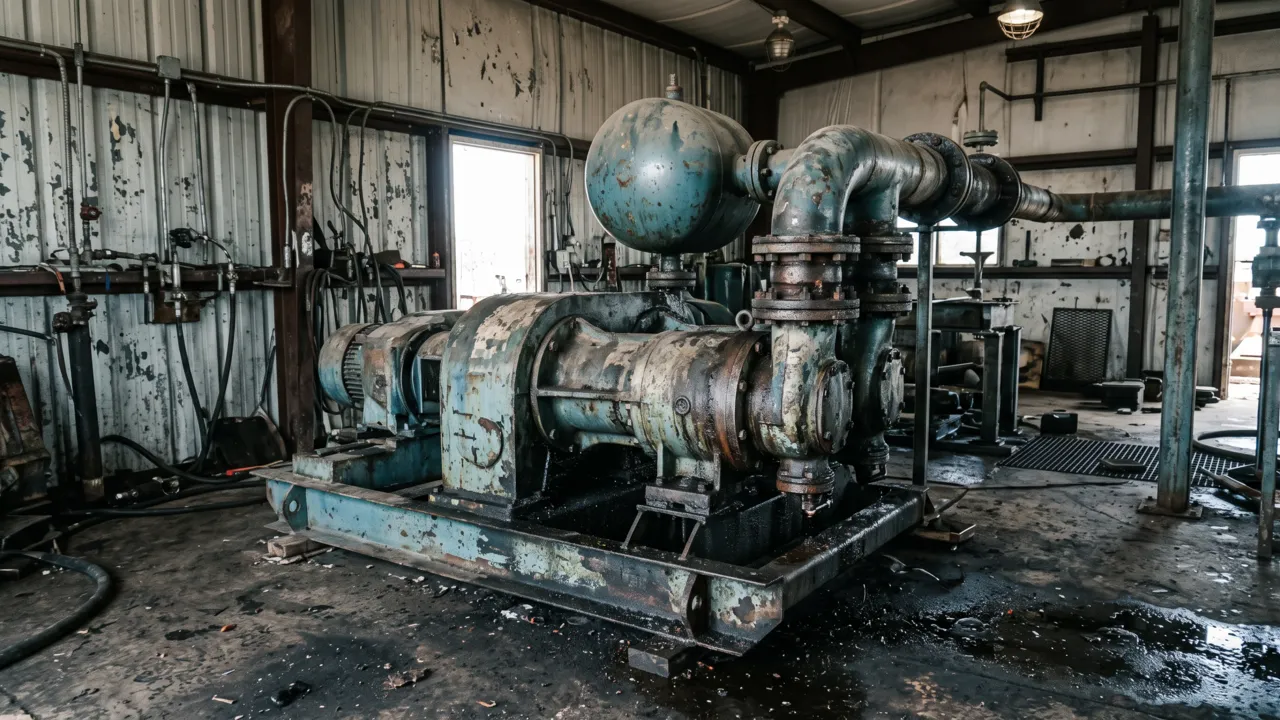
If drilling mud is the bloodstream of a well, something has to keep it moving. On a drilling rig, that job falls to a few big, loud machines usually parked near the mud tanks. They run around the clock, often at thousands of psi, and the whole operation slows to a crawl when one goes down. So what is a mud pump, and how does a triplex pump move drilling fluid down the hole?
A mud pump is a large reciprocating piston pump that pushes drilling fluid from the mud pits down the drill string and back up the hole at high pressure. Most modern rigs use triplex mud pumps, which have three single-acting pistons driven by a crankshaft, much like a car engine running in reverse. Each piston pulls mud into a cylinder (called a liner) on the back stroke and pushes it out through a discharge valve on the forward stroke. A pulsation dampener smooths the surges, and liner size sets the trade between flow and pressure. Big land rigs commonly run two or three pumps together.
How Does a Triplex Mud Pump Work?
A triplex mud pump works by turning rotary motion from an engine or electric motor into the back-and-forth motion of three pistons. The crankshaft spaces the three pistons evenly around its rotation, so one is always somewhere in its push stroke. That overlap is why a triplex delivers smoother flow than older two-cylinder designs.
Let's walk through one cylinder for one turn of the crankshaft:
- The piston pulls back inside the liner. Pressure in the cylinder drops.
- The suction valve below the cylinder opens, and mud flows in from the suction manifold.
- The piston reverses and pushes forward. Pressure rises fast.
- The suction valve slams shut, and the discharge valve above opens.
- Mud is forced out into the discharge manifold and on toward the standpipe.
Each piston only pumps on its forward stroke, which is why a triplex is called "single-acting." The older duplex pumps were double-acting, meaning each of their two pistons pumped on both strokes. Triplex pumps won out because they are lighter for the same power, run faster and produce less pulsation.
What Are the Main Mud Pump Parts?
Every mud pump has two halves. The power end turns rotation into straight-line motion. The fluid end is where the mud actually gets pressurized. Here's a quick map of the parts.
Power End
- Pinion shaft and bull gear: reduce motor speed and multiply torque.
- Crankshaft: turns the gear's rotation into three offset throws.
- Connecting rods: link the crankshaft to the crossheads.
- Crossheads: slide in guides and keep the motion straight.
- Pony rods (extension rods): pass through a seal that keeps mud out of the power end oil.
Fluid End
- Fluid end modules: the heavy steel blocks that hold the pressure.
- Liners: replaceable cylinders the pistons run inside.
- Pistons and piston rods: push the mud.
- Suction and discharge valves and seats: one-way check valves that control flow.
- Valve covers and cylinder heads: give access for repairs.
- Suction and discharge manifolds: the inlet and outlet piping.
Around the pump you will also find a charge pump feeding the suction side, a pulsation dampener on the discharge side, a pressure relief (pop-off) valve, and a liner wash system that sprays water or fluid onto the back of each liner to cool and flush it.
How Do Mud Pump Liners and Pistons Change Pressure and Flow?
Remember this trade-off: a pump has a fixed horsepower, and horsepower is pressure times flow. If you want more pressure, you have to give up some flow, and the other way around. Liners are how crews make that trade.
Liners come in a range of inside diameters for the same pump. A larger liner and piston move more mud per stroke but can't safely reach as high a pressure. A smaller liner moves less mud per stroke but lets the pump hit higher pressure before running out of horsepower or exceeding the fluid end's rating.
| Liner choice | Volume per stroke | Maximum pressure | Typical use |
|---|---|---|---|
| Larger liner | Higher | Lower | Shallow, large-diameter hole needing lots of flow |
| Smaller liner | Lower | Higher | Deep hole, long laterals, high bit and motor pressure |
For a triplex, the theoretical output per stroke in barrels is roughly 0.000243 × (liner diameter in inches)² × (stroke length in inches). For example, a 6-inch liner on a 12-inch stroke gives about 0.105 barrels per stroke. At 100 strokes per minute that is around 10.5 barrels per minute before you account for volumetric efficiency, which is always a bit less than 100 percent.
The manufacturer publishes a chart for each pump showing the pressure rating and output for every liner size. Crews choose a liner based on the well plan and change liners between hole sections when the needs shift.
What Does a Pulsation Dampener Do?
A pulsation dampener smooths out the pressure spikes a piston pump creates. Even with three pistons overlapping, the discharge pressure rises and falls with each stroke. Those surges shake piping, wear out valves and add noise to the pressure signals that MWD tools send through the mud.
The most common type is a steel bottle with a rubber bladder inside, precharged with nitrogen. When pressure spikes, mud pushes into the bottle and squeezes the gas. When pressure dips, the gas pushes back. It works a bit like a shock absorber on a truck.
The precharge has to be right for the operating pressure. If it is too low or the bladder fails, the dampener stops doing its job, and the crew will usually notice a rougher pressure gauge and more vibration in the lines. Checking the precharge is a routine maintenance item.
Which Mud Pump Parts Wear Out Most?
The fluid end is where the money goes. Mud is abrasive, especially when it carries sand and fine drilled solids, and it is moving at high pressure across rubber seals and steel seats. The main expendable parts are:

- Pistons: the rubber or urethane seal wears and starts to leak past the liner.
- Liners: the bore wears or scores, which then chews up new pistons.
- Valves and seats: sand cuts the sealing faces until they leak.
- Valve inserts and springs: rubber inserts tear and springs fatigue.
- Seals and gaskets on valve covers and liner retainers.
Signs of a worn part include a drop in pump pressure at the same stroke rate, a knocking sound, a leak at the back of a liner, or one module running hotter than the others. A washed valve can fool you into thinking something downhole changed, so crews check the pumps before chasing a downhole problem.
The cheapest way to extend parts life is clean mud. Every grain of sand the shakers and cones miss gets a ride through the pumps. That is one big reason rigs invest in good solids control equipment, because sand removed at the surface is sand that doesn't cut your valves.
Why Does a Mud Pump Need a Charge Pump?
A triplex pump runs fast, and its pistons can pull back faster than mud can fall into the cylinder on its own. When that happens, the cylinder doesn't fill completely. Pressure inside drops so low that small vapor pockets form and then collapse violently when the piston pushes forward. That is called cavitation, and it pounds the fluid end.
The fix is a centrifugal charge pump (also called a supercharging pump) mounted on the suction side. It keeps the suction manifold under positive pressure so each liner fills fully on every stroke. If a pump suddenly starts knocking and losing pressure, a failed charge pump or a plugged suction screen is one of the first things to check.
How Big Are Mud Pumps?
Mud pumps are rated by input horsepower. Large land and offshore rigs commonly run pumps in roughly the 1,000 to 2,200 horsepower class, and modern high-pressure fluid ends are built for pressures in the thousands of psi. Smaller rigs, workover units and water well rigs use much smaller pumps.
Many rigs run two or three pumps in parallel. That gives extra flow when it is needed and lets one pump go down for repairs while the others keep circulating. Keeping circulation going during a pump repair can matter a lot, since cuttings start to settle as soon as flow stops.
Why Does the Mud Pump Matter So Much?
The mud pump sets how fast mud moves and how much pressure is available at the bit, in the motor and in the annulus. That ties it to almost every drilling job: hole cleaning, rate of penetration, motor output and MWD signal quality. The hydraulic horsepower a pump delivers equals pressure times gallons per minute divided by 1,714, which is a handy formula for comparing setups.
The pumps are also part of well control. They are used to circulate out a kick through the choke manifold, so the slow pump rates and pressures for each pump are recorded on every tour. Drilling fluid has many jobs (the drilling fluid entry in the SLB Energy Glossary lists them), and the pump is what makes every one of them possible.
What Is a Mud Pump? The Heartbeat of Every Rig
A mud pump is a high-pressure piston pump that circulates drilling fluid through the well. On most rigs it is a triplex: three single-acting pistons, a crankshaft-driven power end, and a fluid end full of liners, pistons and valves that wear and get replaced on a schedule.
If you remember three things, make them these. Liner size trades pressure for flow. The pulsation dampener protects everything downstream. Clean mud is the best maintenance plan you can buy. Learn those, and you will understand why experienced hands listen to the pumps the way a doctor listens to a heartbeat.