Solids Control Equipment – Shakers, Cones and Centrifuges
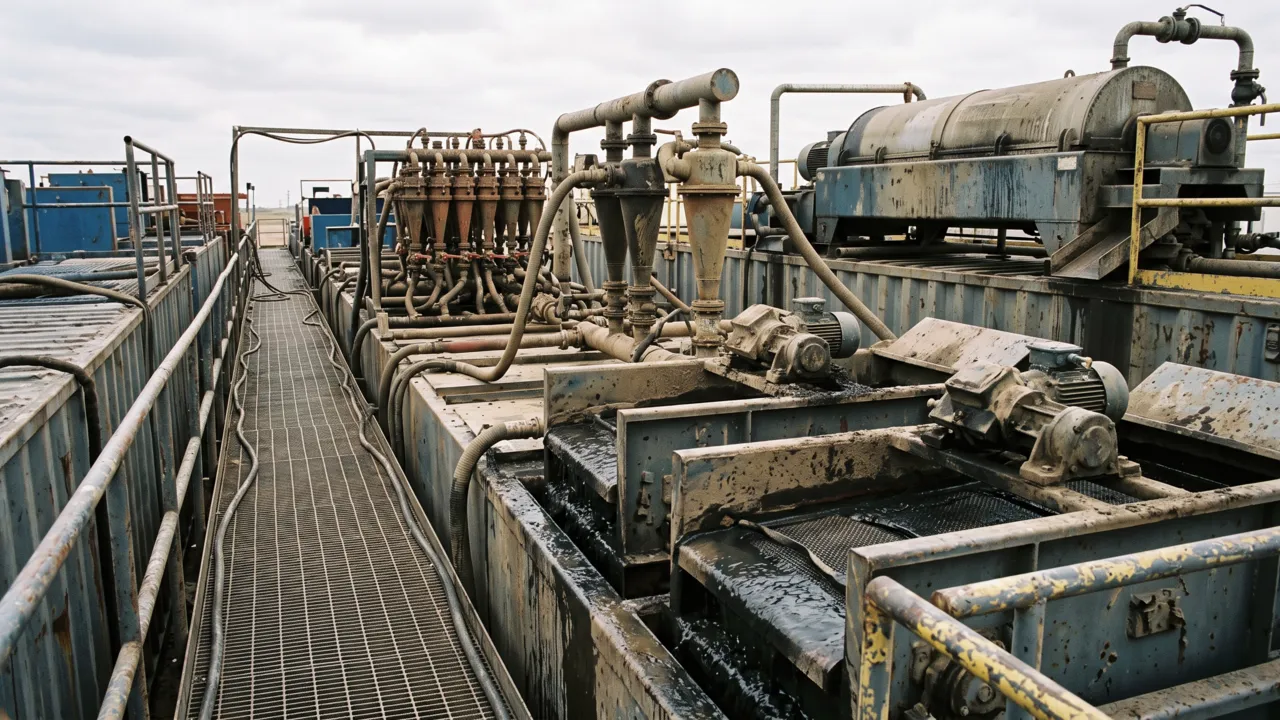
Every foot of hole a rig drills turns solid rock into chips, sand and dust, and all of it ends up in the mud. If those solids stay in the system, the mud gets heavier, thicker and more abrasive with every circulation. Pumps wear out, the bit slows down and the pipe gets stuck more easily. The rig's answer is a line of machines that clean the mud in stages. So what is solids control equipment, and how does each piece fit into the system?
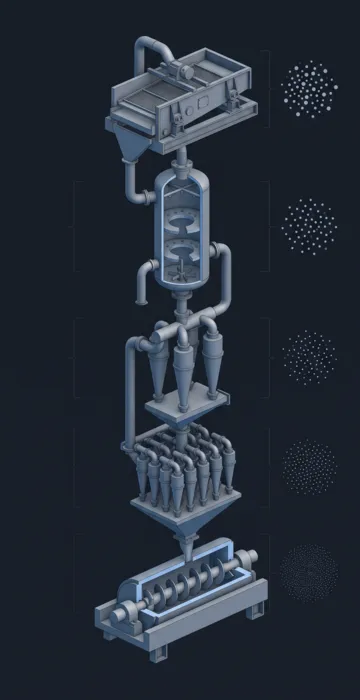
Solids control equipment is the series of machines on a drilling rig that removes drilled solids from the mud so the fluid can be reused. The mud flows through them from coarsest to finest: shale shakers first, then a degasser if needed, then desanders, desilters (or a mud cleaner), and finally centrifuges. Each unit removes a smaller range of particle sizes, from large cuttings on the shakers down to particles just a few microns across in the centrifuge. Each machine protects the next one from material it can't handle. A well-run solids control system cuts mud costs, protects equipment and helps the well drill faster.
Why Do Drilling Rigs Need a Solids Control System?
A rig needs a solids control system because drilled solids make mud worse in almost every way. Here's what happens as fine rock builds up:
- Mud weight creeps up, raising bottom-hole pressure and the risk of losses.
- Viscosity rises, so the pumps need more pressure to circulate.
- Filter cake gets thicker and stickier, raising the risk of differential sticking.
- Abrasive sand chews up pump liners, pistons, valves and downhole tools.
- Rate of penetration tends to drop as the mud gets "dirtier."
The alternative to removing solids is dilution: adding fresh base fluid and chemicals to water down the dirty mud. That works, but it is expensive and creates a lot of extra waste volume. Here's the part I always stress with new hands: every barrel of solids you remove mechanically is several barrels of new mud you don't have to build.
What Sizes of Solids Are We Removing?
Drilled solids are measured in microns. One micron is a thousandth of a millimeter. A human hair is somewhere around 50 to 100 microns thick, so many of the particles we care about are smaller than a hair is wide.
The industry groups particles into three size classes:
- Sand: larger than 74 microns.
- Silt: roughly 2 to 74 microns.
- Clay or colloidal size: smaller than about 2 microns.
The smaller a particle is, the harder it is to remove and the more damage it does to mud properties. Fine particles also have far more surface area per pound, so they soak up water and chemicals. That is why the goal is to remove cuttings while they are still large, before the bit and pumps grind them down.
What Is the Order of Equipment in a Solids Control System?
Let's follow the mud from the flowline to the active pits. Here is the typical train on a land rig:
- Possum belly (header box): slows the flow and spreads it evenly across the shakers.
- Shale shakers: vibrating screens that remove the coarse cuttings. Some rigs run a scalping shaker first to catch large or sticky clay.
- Degasser: pulls entrained gas out of the mud so the centrifugal pumps downstream can work properly.
- Desander: large hydrocyclones that remove sand-sized particles.
- Desilter: smaller hydrocyclones that remove silt-sized particles.
- Mud cleaner (optional): desilter cones that discharge onto a fine screen, used mostly with weighted mud.
- Centrifuge: a high-speed spinning bowl that removes very fine solids or recovers barite.
Each unit usually draws from one pit compartment and discharges clean mud into the next one downstream. That way, no machine processes mud that hasn't already been through the coarser steps.
What Does Each Piece of Solids Control Equipment Remove?
The table below shows the general range each machine handles. Exact cut points depend on the manufacturer, the screen or cone size, the mud and how well the equipment is tuned, so treat these as typical ranges rather than fixed numbers.
| Equipment | How it separates | Typical particles removed |
|---|---|---|
| Shale shaker | Vibrating screens | Down to roughly 75 microns or finer, set by screen mesh |
| Desander | Hydrocyclone, cones about 6 to 12 inches | Coarse silt and sand, roughly 40 microns and up |
| Desilter | Hydrocyclone, cones about 2 to 5 inches | Silt, roughly 15 to 25 microns and up |
| Mud cleaner | Desilter cones over a fine shaker screen | Drilled silt, while returning barite to the mud |
| Decanter centrifuge | Spinning bowl, hundreds to thousands of G | Fine silt down to a few microns |
One way to picture the train is a set of kitchen strainers stacked from coarse to fine. You would never pour pasta water straight through a coffee filter. The big stuff would clog it in seconds. Solids control works the same way.
How Do Shale Shakers Start the Process?
The shakers are the first and most important step. They handle the full flow of the well and remove the largest share of the solids by volume. If the shakers are dressed with the wrong screens, or screens are torn, everything downstream gets overloaded.
A shale shaker uses motors with offset weights to vibrate one or more screens. Mud and fine solids fall through, while cuttings ride along the screen and off the end into a cuttings chute or bin. Finer screens remove more but handle less flow, so screen choice is always a balance.
How Do Hydrocyclones Work?
Desanders and desilters are both hydrocyclones, and they have no moving parts. A centrifugal pump feeds mud into the side of a cone at high speed, so it spins in a tight vortex. Heavier, larger particles get flung to the wall and spiral down to a small opening at the bottom (the underflow, or apex). Cleaner mud moves up through the center and leaves out the top (the overflow).
Getting the feed pressure right is the main operating skill. Too little pressure and the cone doesn't spin hard enough to separate well. Too much and parts wear quickly. A healthy cone discharges a fine spray at the bottom. A thick "rope" discharge means the cone is overloaded and passing solids it should be removing.
SLB's glossary entry on the desander gives a concise technical definition if you want to compare terms.
What Is a Mud Cleaner?
A mud cleaner is a desilter mounted over a fine-mesh shaker screen. It exists to solve a specific problem: in weighted mud, barite particles fall in the same size range as drilled silt. A desilter alone would throw away expensive barite along with the drilled solids.
In a mud cleaner, the cone underflow lands on the screen instead of going to waste. Most of the barite is fine enough to pass through the screen and return to the mud. Drilled solids larger than the screen openings are discarded. It is a compromise tool, but a useful one when running heavier mud.
Where Does the Centrifuge Fit?
The decanter centrifuge sits at the end of the line and handles particles the cones can't reach. It spins a bowl fast enough to create forces hundreds to thousands of times stronger than gravity. A screw conveyor inside scrapes the settled solids out one end, while the liquid exits the other.
Centrifuges are usually run on part of the active system rather than the full flow. In unweighted mud they strip out fine drilled solids. In weighted mud they are often set up to recover barite and discard the fine, troublesome colloids instead.
Does Every Rig Run the Full Solids Control Train?
No. The equipment list changes with the mud and the well. A shallow well drilled with light water-based mud might run only shakers, a desander and a desilter. A deep well with heavy oil-based mud might skip the desander entirely, rely on a mud cleaner, and run two centrifuges side by side.
Mud weight is usually the deciding factor. In unweighted mud, every fine particle is a drilled solid you want gone, so the cones and centrifuge can work hard. In weighted mud, a lot of the fine material is barite you paid for, so the goal shifts to throwing away drilled solids while keeping the weighting material. The mud engineer and the rig crew set the equipment up together, and that setup can change from one hole section to the next.
How Does Solids Control Tie Into Drilling Waste Management?
Every solid removed has to go somewhere, which makes solids control the front end of drilling waste management. Cuttings from the shakers, cones and centrifuges are collected in bins, catch tanks or pits, depending on local rules and the mud type.
Many rigs now run a closed-loop system, which means no open reserve pit. Solids are dried and hauled off or treated, and liquids are recovered for reuse. With oil-based mud, cuttings dryers (vertical centrifugal dryers) are often added to squeeze more base oil off the cuttings before disposal. Less liquid on the cuttings means less waste to haul and less mud to replace.
What Makes a Solids Control System Work Well?
Most solids control problems come down to a few habits. If you are responsible for the equipment on tour, these are the ones I would focus on:
- Run the equipment in order and don't let any unit bypass the one before it.
- Keep shaker screens intact, and use the finest screens the flow allows.
- Check cone discharge patterns and feed pressure every tour.
- Size desander and desilter capacity to process a bit more than the full circulating rate.
- Track mud weight, solids content and dilution rates so you can see trends early.
Solids Control Equipment: Why the Mud Is Only as Good as Its Cleaning Line
Solids control equipment cleans drilling mud in stages, from shakers to hydrocyclones to centrifuges, removing smaller particles at each step. The order matters because each machine depends on the one before it to keep it from being overloaded.
The payoff is real: lower mud costs, longer pump and tool life, less waste and often faster drilling. If you are learning the system, start at the shakers. They do the most work, and when they are set up right, everything downstream gets easier.