Drilling Fluid Circulation – The Mud Path Through a Well
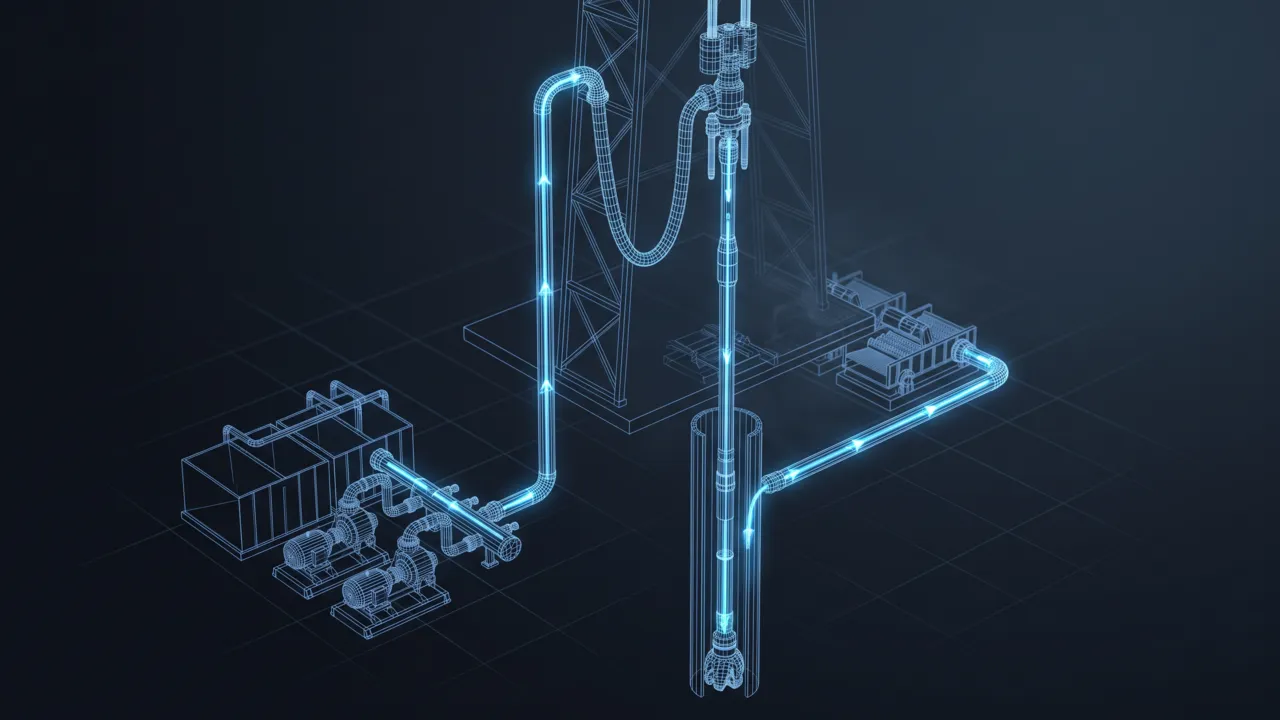
Drilling mud never sits still for long on a working rig. It leaves the pits, goes down thousands of feet of pipe, squeezes through the bit and climbs back up to the surface to be cleaned and sent down again. If you are new to rigs, the pipes and hoses can look like a plumbing puzzle. The good news is that it is really one big loop. So what path does drilling fluid circulation follow, from the pits to the bit and back?
Drilling fluid circulation is a closed loop: mud pumps pull fluid from the suction pit, push it up the standpipe and through the rotary hose and top drive, then down the inside of the drill string. The mud exits through nozzles in the bit, picks up cuttings and flows back up the annulus, the space between the drill string and the hole wall. At the surface it runs down the flowline, gets cleaned by the shakers and other solids control equipment, and returns to the pits to start again. A full lap can take anywhere from a few minutes in a shallow hole to hours in a deep one.
What Are the Steps in the Mud Circulation System?
I find it easiest to follow a single "drop" of mud around the loop. Here is the path in order:
- Suction pit: the mud waits in a steel tank, already cleaned and treated.
- Mud pumps: large piston pumps pull mud from the suction line and push it out at high pressure.
- Discharge line and standpipe manifold: steel piping carries the mud to a manifold of valves on or near the rig floor.
- Standpipe: a vertical pipe clamped to the derrick or mast carries the mud up toward the top of the rig.
- Rotary hose: a flexible, high-pressure hose (often called the kelly hose) connects the fixed standpipe to the moving top drive or swivel.
- Top drive or swivel: the mud passes through the gooseneck and a rotating seal into the drill string.
- Drill string: the mud travels down the drill pipe, heavyweight pipe and drill collars, and through tools like MWD and mud motors.
- Bit: the mud jets out through nozzles, cleaning the bit face and the bottom of the hole.
- Annulus: the mud carries cuttings up the space outside the pipe.
- Bell nipple and flowline: at the top of the BOP stack, the returns spill into the flowline, a sloped pipe that drains by gravity.
- Shale shakers: vibrating screens remove the larger cuttings.
- Degasser, hydrocyclones and centrifuges: these remove gas and finer solids.
- Active pits: the cleaned mud is treated and flows back to the suction pit.
If you remember one thing from this section, make it this: the trip down happens inside the pipe at high pressure, and the trip up happens outside the pipe at low velocity. Almost everything about circulation design comes back to those two halves.
Where Does the Mud Start? The Pits and the Pumps
The mud pits (or mud tanks) are a row of steel tanks that store, mix and treat the fluid. On most rigs they are divided into compartments: a suction compartment that feeds the pumps, mixing compartments where products are added, and compartments that receive mud from solids control equipment. Agitators keep the mud stirred so barite and solids don't settle.
The pumps are the heart of the system. Most modern rigs use triplex piston pumps, and many run two or three of them together. A small centrifugal charge pump usually feeds each main pump so the pistons never starve for fluid. Our article on the mud pump explains how the pistons, liners and valves turn engine power into flow.
What Does the Standpipe Manifold Do?
The standpipe manifold is a set of high-pressure valves that routes mud from the pumps to wherever the crew needs it. You can think of it like the switchboard of the circulating system. It usually sits on the rig floor or near the base of the standpipe.
A typical standpipe manifold lets the crew:
- Send pump output to one standpipe or another (many rigs have two for redundancy).
- Isolate one pump for repairs while the others keep circulating.
- Route fluid to the kill line during well control work.
- Bleed off trapped pressure safely before breaking a connection.
- Mount the standpipe pressure gauge and sensors the driller watches.
That standpipe pressure reading is one of the most useful numbers on the rig. It is the total pressure the pumps must overcome to push mud around the whole loop. Changes in it often warn of a problem before anything else does.
Why Is the Rotary Hose Needed?
The rotary hose solves a simple problem: the standpipe is fixed to the derrick, but the top drive moves up and down the full height of the mast. A rigid pipe can't do that. So the connection is a heavy, steel-reinforced rubber hose rated for full pump pressure.
Because it hangs high above the floor under high pressure, the rotary hose is secured with safety clamps and slings at both ends. If a hose fails, those restraints keep it from whipping. Crews inspect it regularly for damage, bulges and wear near the end fittings.
On older rigs with a kelly, the hose connects to a swivel, which hangs from the traveling block and lets the drill string turn while the hose stays still. On top-drive rigs, the same job happens inside the top drive.
What Happens to the Mud Downhole?
Inside the drill string, the mud loses pressure to friction the whole way down. Then it hits the bit nozzles, which are small openings that turn pressure into speed. The high-velocity jets blast cuttings off the rock face and cool the cutters. In many wells, a large share of the total pump pressure is used up right here at the bit, on purpose.
Along the way, the flow may also drive a mud motor (which turns the bit) and carry pressure pulses from the MWD tool back to the surface. So the mud is doing three things on the way down: carrying energy, carrying data and getting ready to carry rock.
Coming back up the annulus, the flow area is much larger, so the mud moves much more slowly. That slower speed is what lets mud carry cuttings without eroding the hole wall. It also means annular velocity has to be watched closely. If it drops too low, cuttings start to settle.
What Is the Flowline and Why Does It Matter?
The flowline is the large-diameter pipe that carries mud returns from the bell nipple, at the top of the BOP stack, to the shale shakers. It is sloped so gravity does the work. There is no pump on the return side of a normal drilling loop.
Most rigs have a flow sensor (often a paddle) in the flowline. If more mud is coming out than going in, something is pushing fluid into the well. That is one of the first signs of a kick. A flowline that suddenly carries less than it should can mean mud is being lost into the formation.
At the end of the flowline, the mud spills into a box called the possum belly (or header box), which spreads it evenly onto the shakers. This is also where the mud logger's gas trap usually sits, sampling gas coming out of the well.
How Is the Mud Cleaned Before It Goes Back Down?
The return side of the loop is a cleaning line. Each piece removes a smaller size of solids or a different contaminant:
| Equipment | Main job |
|---|---|
| Shale shakers | Remove larger cuttings on vibrating screens |
| Degasser | Pull entrained gas bubbles out of the mud |
| Desander | Remove sand-sized solids with large hydrocyclones |
| Desilter | Remove silt-sized solids with smaller hydrocyclones |
| Centrifuge | Remove very fine solids or recover barite |
Not every rig runs every piece every day. The setup depends on the mud type, mud weight and hole section. Once cleaned, the mud gets its chemistry and weight checked, products are added if needed, and it flows back to the suction pit.
What Is Bottoms Up and Lag Time?
"Bottoms up" is the time (or pump strokes) it takes mud at the bit to reach the surface. You calculate it by dividing the annular volume by the pump output. Crews circulate bottoms up before trips to clean the hole, and after drilling a break to see what the new rock looks like.
Lag time is the same idea seen from the mud logger's side. It tells the logger which depth a given sample of cuttings or gas came from. A full circulation, by contrast, includes the trip down the inside of the pipe plus the trip up the annulus.
Drilling Fluid Circulation: The Loop That Keeps Every Well Alive
Drilling fluid circulation follows one closed path: pits, pumps, standpipe manifold, standpipe, rotary hose, top drive, drill string, bit, annulus, flowline, shakers and cleaning equipment, then back to the pits. Each part has a simple job, and the loop only works when they all do it.
If you are learning a rig, walk the loop yourself (safely, with permission) and name each piece in order. Then watch the standpipe pressure and flow-out readings on the driller's screen. Once you can connect those numbers to the physical path, circulation stops being a puzzle.