Choke Manifold – Controlling Pressure During a Kick
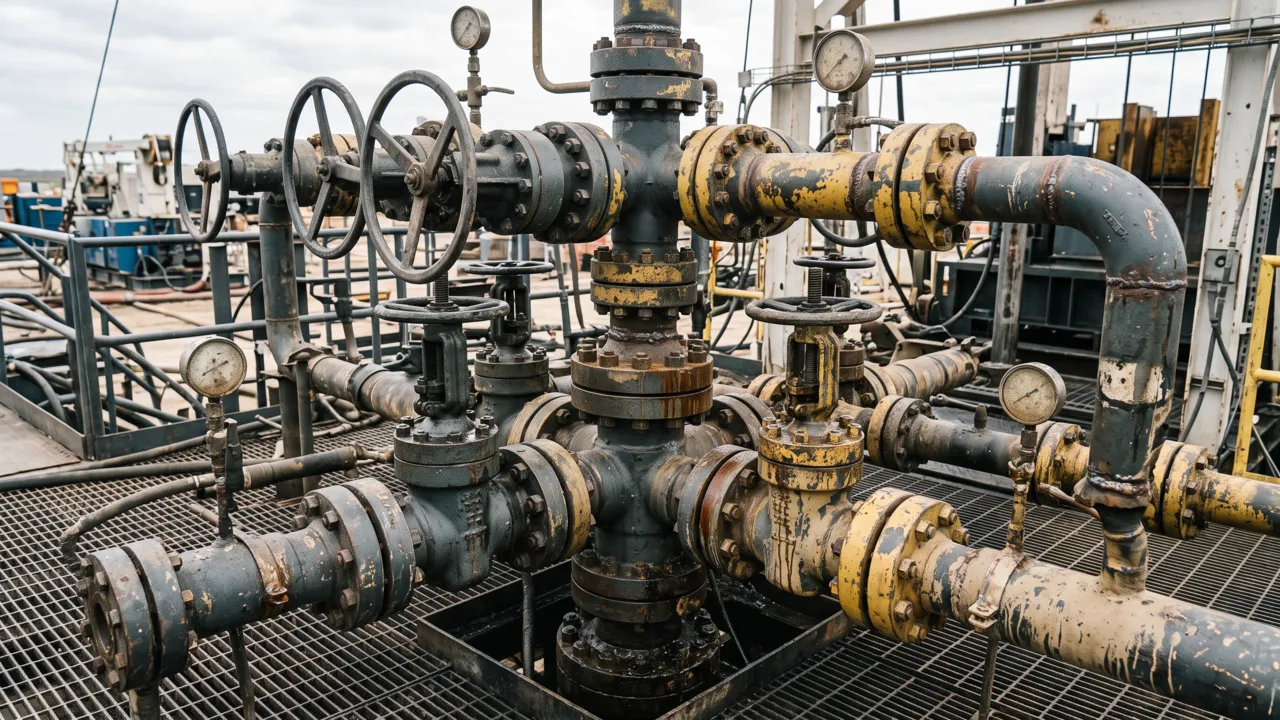
When a well is shut in after a kick, the rig goes quiet in a strange way. The pumps stop, the BOP is closed, and everyone's attention turns to a set of gauges and a small control panel. The kick is still in the well. Getting it out safely now depends on one piece of equipment and the steady hands of the person running it. What is a choke manifold, and how does it control pressure during a kick?
A choke manifold is an arrangement of high-pressure valves, pipes, gauges and adjustable chokes that controls flow coming out of the well when the BOP is closed. During a kick, returns from the annulus go through the choke line into the manifold instead of up the flowline. By opening or closing the adjustable choke, the operator adds or removes back pressure on the well. That back pressure keeps bottomhole pressure constant, slightly above formation pressure, while the influx is circulated out and heavier kill mud is pumped in. Without it, the crew could hold the well shut but could not safely circulate the kick out.
What Does a Choke Manifold Look Like?
On a land rig, the choke manifold usually sits near the substructure, a bundle of thick-walled pipe and big valve handwheels on a skid. Offshore, it is often in a dedicated area near the drill floor. It does not look like much, but every component is rated for the full pressure the well might throw at it.
The main parts include:
- Inlet from the choke line, which comes from an outlet on the BOP stack below a closed preventer.
- Gate valves that route flow down different paths.
- At least one adjustable choke, usually a hydraulically operated one controlled from a remote panel, plus a manual backup.
- Pressure gauges showing casing pressure, and sometimes drillpipe pressure, at the manifold.
- Outlets downstream to the mud gas separator, the flare line, the pits or a bypass line.
The SLB Energy Glossary describes it as a set of high-pressure valves and piping with at least two adjustable chokes, which is a good way to picture the redundancy built in.
What Is an Adjustable Choke?
An adjustable choke is a valve that can be opened or closed in small steps to restrict flow. Picture putting your thumb over the end of a garden hose. The tighter you press, the more pressure builds behind your thumb. The choke does the same thing to the flow coming out of the annulus.
Most rigs use a remotely operated hydraulic choke, controlled from a panel on or near the rig floor that shows pump strokes, drillpipe pressure and casing pressure. A manual choke on a separate path gives a backup if the remote choke fails or washes out. Fixed chokes, with a set opening, may also be installed for certain jobs.
How Does the Choke Manifold Hold Bottomhole Pressure?
The goal during any standard kill is to keep bottomhole pressure constant and just above formation pressure. Too low, and more influx comes in. Too high, and the crew risks fracturing the formation at the casing shoe and losing mud, or worse, an underground blowout.

The challenge is that bottomhole pressure changes as the kill goes on. Gas expands as it rises, kill mud fills the drillpipe, and the mix of fluids in the annulus keeps shifting. The choke operator compensates by adjusting back pressure at surface.
Because no one can read bottomhole pressure directly in most cases, the operator watches the drillpipe pressure gauge. The drillpipe is full of known mud, so its pressure reflects what is happening at the bottom. The kill sheet lists what drillpipe pressure should be at each stage, and the choke operator adjusts to match it.
Why Does the Choke Operator Need Patience?
A change at the choke takes time to show up on the drillpipe gauge. The pressure signal travels down the annulus and back up the drillpipe, so there is a delay of several seconds, longer in deep wells. An operator who chases the gauge with quick, large adjustments can overshoot and swing pressures up and down. Small moves, then wait, then read. That rhythm is hard to learn under stress, which is why simulator training matters.
What Are the Steps in Choke Manifold Operation During a Kill?
Specific steps come from the rig's well control procedures and the operator's kill plan. In broad terms, a standard circulating kill looks like this:
- With the well shut in, record stabilized shut-in drillpipe pressure, shut-in casing pressure and pit gain.
- Calculate kill mud weight and prepare the kill sheet.
- Bring the pumps up to the planned kill rate slowly while the choke operator holds casing pressure constant.
- Once at kill rate, switch to holding drillpipe pressure on the planned schedule.
- As kill mud moves down the drillpipe, follow the schedule as drillpipe pressure gradually falls toward the final circulating pressure.
- Route gas through the mud gas separator and watch casing pressure rise as gas nears surface.
- When kill mud returns at surface and the well is static, the kill is complete.
What Are the Common Well Kill Methods?
Several kill methods use the choke manifold, and the choice depends on the rig, the well and the operator's policy.
- Driller's Method: two circulations. The first removes the influx with the original mud, and the second replaces it with kill mud. It is simple and can start right away.
- Wait and Weight Method: one circulation with kill mud. It often results in lower casing pressures but requires mixing kill mud before starting.
- Volumetric Method: used when circulation is not possible, for example with the bit off bottom or plugged. Gas is allowed to migrate and expand in a controlled way by bleeding small amounts through the choke.
All three depend on accurate pressure readings and careful choke work. The manifold is the tool; the method is the plan.
What Can Go Wrong With a Choke Manifold?
Chokes take a beating. Gas, sand and high velocity can erode the choke trim, a problem called washout. A washed choke may not hold back pressure the way the operator expects. Chokes can also plug with cuttings or lost circulation material, causing a sudden pressure rise.
Gate valves and lines must stay rated, tested and correctly lined up. A valve left in the wrong position can send flow somewhere it was never meant to go. That is why choke manifolds are pressure tested along with the BOP, and why line-ups are checked during drills.
The manifold is also only part of the system. Flow reaches it through the choke line, and pumps can reach the well through the kill line. Understanding how the choke and kill lines work together helps make sense of the whole kill.
Choke Manifold: The Quiet Equipment That Brings a Kick Home Safely
A choke manifold is the set of valves, piping and adjustable chokes that controls returns from a shut-in well. By adjusting back pressure, the operator keeps bottomhole pressure constant while the kick is circulated out and kill mud takes its place.
It sounds simple, and in principle it is. In practice it takes calm, patient hands, a good kill sheet and equipment that has been tested and maintained.
If you get the chance to run a well control simulator, take it. Feeling the delay between the choke and the gauge is the best way to understand why this job rewards patience.