What Is a Blowout Preventer? – How a BOP Stack Works
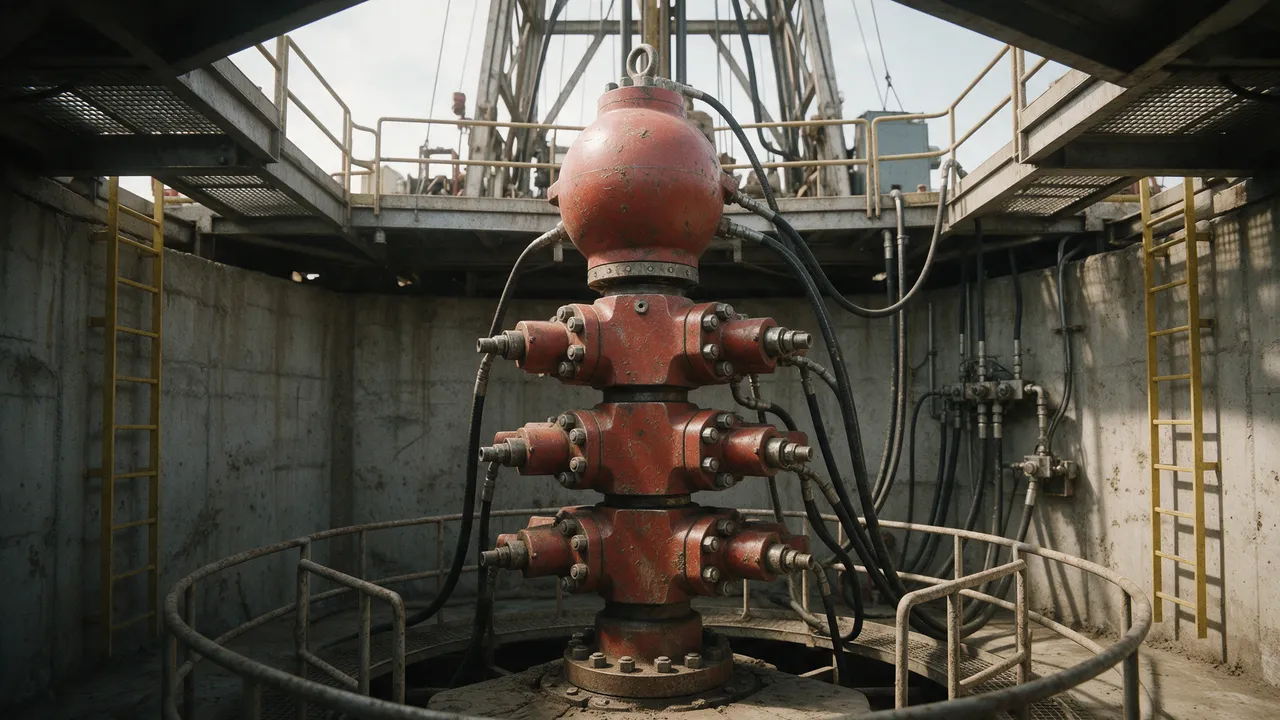
Under every drilling rig floor, bolted to the top of the well, sits a tall stack of steel that most visitors walk right past. It is painted, plumbed with hoses and usually a little muddy. It does nothing at all on most days. And yet everyone on that rig is counting on it to work perfectly on the one day it is needed. What is a blowout preventer, and how does a BOP stack actually work?
A blowout preventer (BOP) is a set of large, high-pressure valves installed on top of the wellhead that can seal the well and stop uncontrolled flow of oil, gas or water during drilling. A typical BOP stack combines one or two annular preventers, which seal around almost anything in the hole, with several ram preventers, which use steel blocks to close on pipe, seal an empty hole or cut through pipe. Side outlets connect the stack to the choke and kill lines so the crew can circulate a kick out under control. The preventers close with stored hydraulic pressure, so they work even if rig power fails.
What Does BOP Stand For?
BOP stands for blowout preventer. On a rig, you will hear it used for a single preventer and for the whole assembly, which is properly called the BOP stack. People say "close the BOP," "test the BOPs" and "the stack" more or less interchangeably.
The name says what it is for. A blowout is the uncontrolled release of well fluids at surface or underground. The BOP exists to stop a kick, an influx of formation fluid, from becoming a blowout. It is not the first line of defense. That job belongs to the weight of the mud. The BOP is the second line, and in many ways the last one that is fully under the crew's control.
Why Were Blowout Preventers Invented?
Old photographs from the early oil booms show gushers: towers of oil spraying above wooden derricks while crowds watch. Those pictures were celebrated at the time. Today, people in the industry look at them and see a well out of control, wasted oil, fire risk and men working right next to it with nothing to stop it.
Inventors in the early 20th century set out to change that. Ram-type preventers were developed in the early 1920s, and annular designs followed later. The American Oil & Gas Historical Society's history of ending oil gushers tells the story of how these devices turned the gusher from a symbol of success into a sign of failure. I find something moving in that shift. It was the industry deciding that the people on the floor mattered more than the spectacle.
What Are the BOP Stack Components, From Top to Bottom?
Stack arrangements vary by rig, by well and by regulation, but a typical land or surface stack, read from the top down, looks like this:
- Bell nipple and flowline: the top of the stack, where mud returns flow out to the shakers during normal drilling.
- Annular preventer: a large rubber packing element that squeezes closed around pipe, casing, a kelly or, in some cases, an open hole.
- Upper pipe rams: steel rams with half-circle cutouts that close around a specific pipe size.
- Blind or blind shear rams: rams that seal the hole when no pipe is across them, and in the shear version, cut through drillpipe and then seal.
- Drilling spool or ram side outlets: connections for the choke line and kill line.
- Lower pipe rams: another set of pipe rams, often a backup or a different size, sometimes variable bore rams.
- Wellhead and casing head: the base the stack bolts onto, tied into the casing cemented in the well.
The order is not random. Placing outlets below at least one set of pipe rams, for example, lets the crew circulate through the choke line with the rams closed. Each rig's arrangement is planned around the operations it will do and the regulations it works under.
How Does a BOP Work When a Kick Happens?
When a crew sees signs of a kick, such as a pit gain or flow with the pumps off, the driller picks up off bottom, stops the pumps and checks for flow. If the well is flowing, the driller shuts the well in by closing a preventer, often the annular first or a set of pipe rams, depending on the rig's procedure.
Closing is done from the driller's control panel. The panel sends a signal to the accumulator unit, which releases stored hydraulic fluid under pressure to the preventer's closing chamber. Pistons drive the annular element or the rams closed, and the well is sealed.
Once the well is shut in, the crew reads the pressures and plans the kill. The choke line carries flow from below the closed preventer to the choke manifold, where an adjustable choke holds back pressure while the kick is circulated out. The kill line lets the crew pump into the well from the side if needed.
What Is the Difference Between Annular and Ram Preventers?
The two main types seal in very different ways. An annular preventer uses a reinforced rubber element that closes like a drawstring around whatever is in the hole, which makes it flexible but usually lower in pressure rating. Ram preventers use pairs of steel blocks that close from opposite sides, giving a strong seal on a specific pipe size or an empty hole.
Most stacks use both, because their strengths complement each other. For a closer look at how each one seals, its limits and where the different ram types fit, see our comparison of annular and ram preventers.
What Controls the BOP?
A BOP is only as good as its control system. On a land rig or a platform, the main parts are:
- Accumulator unit (often called a Koomey unit after a well-known early maker): bottles precharged with nitrogen that store hydraulic fluid under pressure, plus pumps to recharge them.
- Driller's control panel: located near the driller's position so preventers can be closed in seconds.
- Remote control panel: located away from the rig floor, usually near an escape route, so the stack can be closed if the floor must be abandoned.
- Hydraulic lines and manifolds: carrying fluid from the accumulator to each preventer's open and close chambers.
The accumulator is sized so it can close the required preventers without any pumps running. That design choice exists for one reason: in a real blowout, rig power may be lost.
How Is a Subsea BOP Different?
Offshore floating rigs, such as drillships and semisubmersibles, use a subsea BOP stack that sits on the wellhead at the seafloor. It is much larger and heavier than a land stack and is connected to the rig by a marine riser.
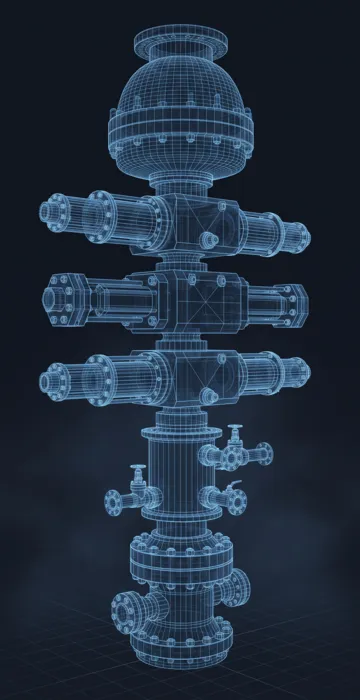
A subsea stack is usually split into two parts. The lower marine riser package (LMRP) contains annular preventers and the riser connection, and it can be disconnected so the rig can move away. The lower stack contains the ram preventers and connects to the wellhead.
Because no one can walk up and close a valve on the seafloor, subsea stacks use redundant control pods, often painted blue and yellow, plus emergency systems. These can include functions that automatically close shear rams if the rig loses connection, and ROV (remotely operated vehicle) panels that let a subsea robot close preventers directly. After the Deepwater Horizon disaster in 2010, the reliability of those backup systems received intense scrutiny from investigators and regulators.
How Big Is a BOP Stack, and What Pressure Can It Hold?
BOPs are described by two numbers: the bore size and the working pressure rating. The bore is the inside diameter of the stack, which has to be large enough for the bits, casing and tools that will pass through it. The working pressure rating is the maximum pressure the equipment is designed to hold.
Ratings come in standard steps, such as 3,000, 5,000, 10,000 and 15,000 psi, with higher ratings used on some deep, high-pressure wells. The well plan sets the minimum rating based on the highest surface pressure the crew could expect to see if the well filled with gas and was shut in.
Size and weight scale with those numbers. A small workover stack might fit on a trailer. A subsea stack for deepwater can stand several stories tall and weigh hundreds of tons. Whatever the size, the job is the same: hold the well when the mud alone cannot.
How Often Are Blowout Preventers Tested?
BOPs are pressure tested when they are first installed on a well and then on a regular schedule after that, along with function tests that open and close each preventer. Testing intervals and pressures are set by regulators, industry standards such as those from the American Petroleum Institute, and the operator's own policy. They differ between land and offshore operations and between countries.
A test typically means closing a preventer, pressuring up beneath it with a test plug or tool in place, and watching for leaks over a set time. It is tedious work, and it often happens at inconvenient hours. It is also the only way to know the barrier you are trusting will actually hold.
What Happens If a Blowout Preventer Fails?
If the BOP cannot seal the well, control moves to tertiary measures: capping stacks, relief wells and specialist well control teams. Those operations can take a long time, and while they go on, the well may be flowing.
BOP failures are rare compared to the number of wells drilled. When they happen, investigations usually find a combination of causes, such as maintenance gaps, pipe positioned where the shear rams could not cut it cleanly, control system faults or delayed activation. Each major incident has shaped the testing, maintenance and design rules that rigs follow today.
What Is a Blowout Preventer, and Why Does It Matter So Much?
A blowout preventer is a stack of high-pressure valves on top of the well that can seal it shut when the mud weight is not enough. Annular preventers seal around almost anything, ram preventers seal on pipe or an open hole or cut pipe, and outlets to the choke and kill lines let the crew circulate a kick out safely.
It is powered by stored hydraulic pressure, controlled from several places, and tested again and again. That might seem like a lot of effort for something that sits idle most of the time. But the BOP is built for the one day it is not idle.
If you are new to a rig, ask someone to walk you through your stack from top to bottom and show you both control panels. Knowing what each piece does, and where to go to close it, is basic respect for the well and for the people working above it.