Annular Preventer vs. Ram Preventer – How Each One Seals
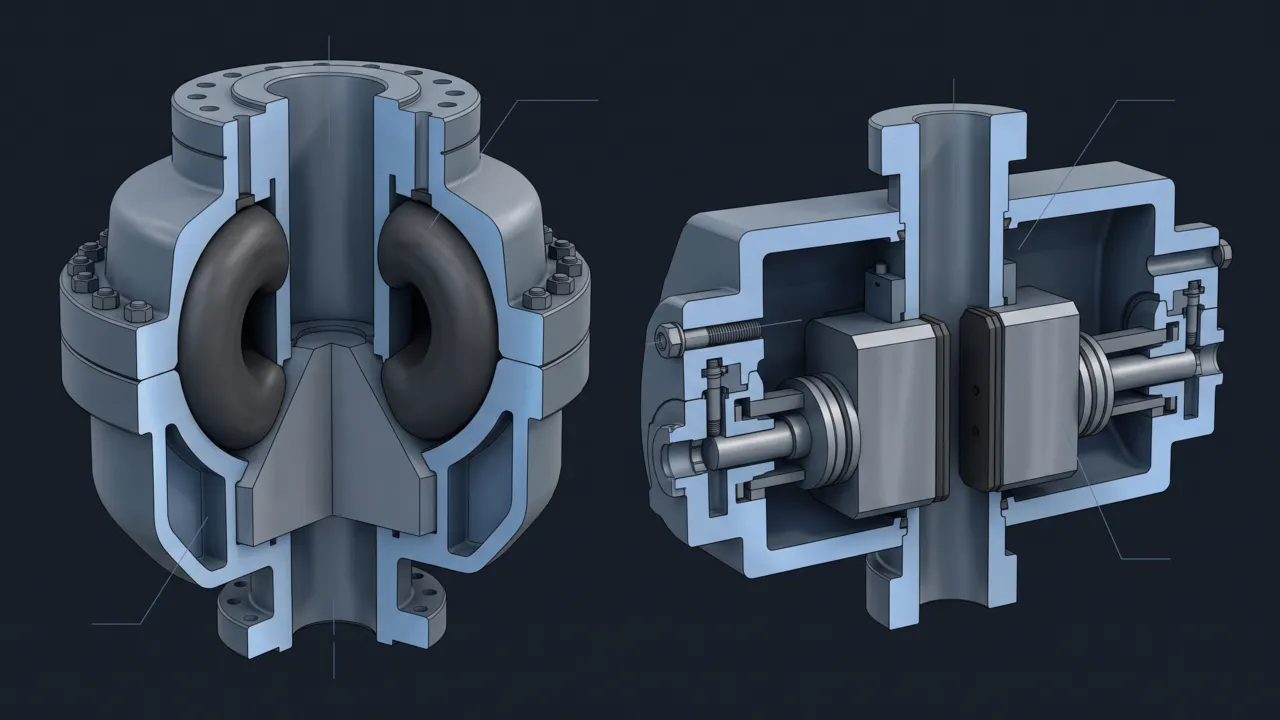
Look at a BOP stack and it seems like a column of identical steel boxes. It is not. Each piece seals the well in its own way, and the crew chooses which one to close based on what is in the hole and what the well is doing. That choice can make the difference between a calm shut-in and a hard day. How does an annular preventer seal compared to a ram preventer, and when is each one used?
An annular preventer seals with a large, reinforced rubber element that squeezes inward around whatever is in the hole, while a ram preventer seals with pairs of steel blocks (rams) that close from opposite sides. The annular is flexible and seals on nearly anything in the hole. Ram preventers are less flexible but stronger, and they usually carry a higher pressure rating. Pipe rams fit a specific pipe size, variable bore rams fit a range, blind rams seal an empty hole, and blind shear rams cut through pipe and then seal. Most stacks use both.
| Annular preventer | Ram preventer | |
|---|---|---|
| Sealing element | Doughnut-shaped rubber packing unit reinforced with steel | Steel ram blocks with rubber seals, closing from both sides |
| Seals on | Almost any shape or size of pipe, casing or kelly; some designs can close on an open hole | One pipe size (pipe rams), a range of sizes (variable bore rams), or open hole (blind rams) |
| Pressure rating | Usually lower than the rams in the same stack | Usually the highest-rated parts of the stack |
| Pipe movement | Allows stripping pipe in or out slowly while closed | Pipe should not be moved through closed rams, except in special stripping operations between two sets of rams |
| Can cut pipe? | No | Yes, with shear rams or blind shear rams |
| Typical use | Often first to close on a kick; stripping operations | Long-term shut-in, hanging off pipe, sealing open hole, emergency shearing |
How Does an Annular Preventer Work?
An annular preventer sits at the top of the stack. Inside it is a large, doughnut-shaped rubber packing unit with steel segments molded into it. Below the packer is a hydraulic piston. When the crew sends closing pressure, the piston pushes up and squeezes the packer inward, much like cinching a drawstring bag.
Because the rubber deforms to fit, the annular can seal around round drillpipe, larger tool joints, square or hexagonal kellys and casing. Some designs can even close on an open hole, though doing so wears the element hard and is usually avoided except in an emergency.
The big advantage is flexibility. If a kick happens with an odd-sized tool across the stack, the annular still has a chance to seal. It also allows stripping, which means carefully lowering or raising pipe through the closed element with reduced closing pressure and fluid volume tracked closely. That lets the crew get pipe back to bottom with the well shut in.
How Does a Ram Preventer Work?
A ram preventer has a body with a horizontal cavity on each side of the bore. Inside each cavity is a ram block, driven by a hydraulic piston. When closed, the two rams move toward the center and meet, sealing against each other and against the body.
Rams are designed so well pressure from below helps push the seals tighter. They also have locking systems, either manual screws or hydraulic locks, that hold the rams closed even if hydraulic pressure is lost. That makes rams the preferred choice for holding a well shut for a long time.
What Are the Different Types of Ram Preventers?
The body is the same; what changes is the ram block inside it. Common types include:

- Pipe rams: half-moon cutouts sized for one pipe diameter. They seal tight around that pipe and nothing else.
- Variable bore rams (VBRs): flexible inserts that seal around a range of pipe sizes, useful when a string has more than one diameter.
- Blind rams: flat faces with no cutout, used to seal the hole when no pipe is in it.
- Shear rams: hardened blades that cut through drillpipe.
- Blind shear rams: a combination that cuts the pipe and then seals the hole in one motion.
- Casing shear rams: heavier blades designed to cut casing, which may not seal on their own.
Pipe Rams vs. Variable Bore Rams: Which Is Better?
Neither is simply better. Pipe rams give a dependable seal on one size and are often rated to support the weight of the string if the crew hangs off on them, meaning a tool joint rests on the closed rams. They are simple and proven.
Variable bore rams trade a little of that simplicity for flexibility. On a well with a tapered string, such as larger pipe at the top and smaller pipe below, VBRs can seal on either size without changing rams. Many stacks use a mix: fixed pipe rams for the main pipe size and VBRs for coverage. The choice depends on the well plan and the contractor's equipment.
What Do Blind Shear Rams Do?
Blind shear rams are the last mechanical barrier in the stack. If the well cannot be controlled any other way, or the rig has to disconnect in an emergency, the crew closes them to cut the drillpipe and seal the well in one stroke.
They have real limits. Shear rams generally cannot cut through thick tool joints or drill collars. Pipe that is off-center, or under heavy compression, can be harder to shear and seal. Investigations after major offshore incidents have focused heavily on these limits, and modern rules and designs push for more shearing capacity and better pipe positioning.
What Powers the Annular and Ram Preventers?
Both types close with hydraulic pressure. That pressure is stored ahead of time in nitrogen-charged bottles, so the preventers can close even if rig power is gone. The BOP accumulator unit holds that stored energy and is sized to close the required preventers without its pumps running.
The SLB Energy Glossary entry on blowout preventers is a good short reference on how the whole system fits together.
Which Preventer Closes First During a Kick?
It depends on the rig's procedures and the situation. Many crews close the annular first because it will seal on whatever is across the stack, then close a set of pipe rams and transfer the seal to them for a long-term shut-in. Others go straight to pipe rams when the pipe is properly spaced out.
Spacing out matters either way. Before closing rams, the driller positions the pipe so a tool joint is not across the ram cavity. That ensures the rams close on the pipe body and, if needed, that the shear rams have something they can cut.
Annular or Ram Preventer: Why a Good Stack Needs Both
The annular preventer is the flexible one. It seals around nearly anything and lets the crew strip pipe, but it usually has a lower pressure rating. Ram preventers are strong, lockable and specialized, sealing on pipe, sealing an open hole or cutting pipe in an emergency.
Neither is a complete answer by itself. A stack with both gives the crew a quick, forgiving first seal and a strong, long-term one, plus a last resort if everything else fails.
If you are new on a rig, learn which ram is where in your stack and what is in each cavity. When the time comes to close one, there is no room for guessing.