Top Drive Systems – How They Work and Why They Replaced the Kelly

If you hired on a rig in the last couple of decades, odds are you've never made a connection with a kelly. The big machine riding up and down the mast on rails does the turning now. Old hands still talk about the kelly days, and most of us don't miss them. So what is that machine, and why did it take over nearly every rig floor? What is a top drive, and how does it work?
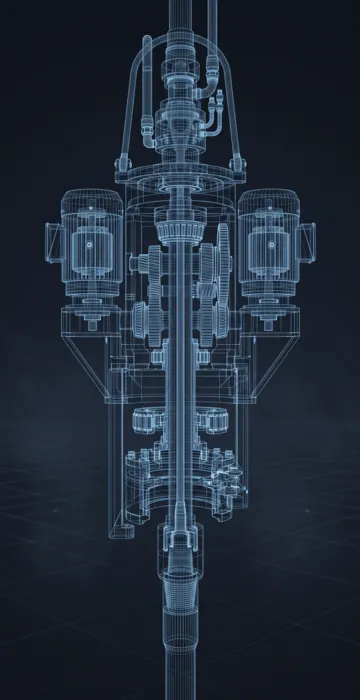
A top drive is a motor and gearbox that hangs from the traveling block and turns the drill string from the top, instead of from the rig floor. It rides up and down the mast on guide rails, screws directly into the top of the drill pipe and pumps drilling mud through itself into the string. Because it can drill with a full stand of pipe instead of a single joint, the crew makes fewer connections. It can also rotate and circulate while tripping, which helps get out of tight hole. That combination of speed and control is why the top drive replaced the kelly.
How Do Top Drive Systems Work?
Top drive systems work by putting the rotary power right at the top of the drill string. The motor turns a gearbox, the gearbox turns a hollow shaft called the quill, and the quill is threaded into the drill string. When the quill turns, the whole string turns, all the way down to the bit.
The top drive hangs from the traveling block, so the drawworks still does all the lifting and lowering. The top drive just adds rotation and a path for the mud. A torque track or guide rails along the mast keep it from spinning around when it's putting torque into the pipe.
Mud comes up the standpipe, through the rotary hose and into a gooseneck on the top drive. From there it flows through the washpipe, down the hollow quill and into the drill pipe. That's the same job the old swivel did, just built into one machine.
Rigzone has a good plain-language explainer on how a top drive works if you want a second take on it.
What Are the Main Parts of a Top Drive?
A top drive packs a lot of iron into one unit. Here are the pieces you'll hear about most:
- The drive motor or motors, usually AC electric on modern land rigs, with hydraulic units on some smaller rigs.
- The gearbox, which steps the motor speed down and the torque up.
- The quill, the hollow main shaft that turns the string and carries the mud.
- The gooseneck and washpipe, which carry mud from the stationary hose into the rotating quill.
- The inside blowout preventer valves (IBOPs), which can shut off flow up the string.
- The saver sub, a short replaceable sub between the quill and the drill pipe.
- The pipe handler, with the link tilt, elevators and a backup wrench for making and breaking connections.
- The guide dolly and rails, which keep the unit centered and take the reactive torque.
Each of those has its own maintenance needs. The three below cause the most phone calls.
What Is the Quill on a Top Drive?
The quill is the main rotating shaft of the top drive. It's hollow so mud can pass through it, and it's threaded on the bottom so it can connect to the string.
The quill carries the full drilling torque and, depending on the design, part of the hoisting load too. It runs on heavy bearings inside the gearbox housing. Those bearings and the lube oil system around them are a big part of top drive maintenance.
You'll rarely make up pipe directly to the quill threads. That's what the saver sub is for.
What Does the Top Drive Washpipe Do?
The top drive washpipe is the sealed connection that lets mud pass from the non-rotating gooseneck into the rotating quill. It's a short pipe with packing around it, and that packing is what keeps high-pressure mud from spraying out while the quill spins underneath it.
If you remember one thing about a top drive, make it this: the washpipe is a wear part, and it's one of the most common reasons a top drive gets shut down. The packing sees full pump pressure while rotating, all day long. When it starts to leak, you'll see mud weeping around the washpipe assembly.
A leaking washpipe needs to be changed out, following the rig's procedure, with the pumps off and pressure bled off. Don't wait until it lets go at full pressure. That's a mess at best and a safety problem at worst. Many crews keep a spare assembly ready to go on the rig floor for exactly that reason.
What Is a Saver Sub?
A saver sub is a short, replaceable threaded sub screwed onto the bottom of the quill. Every connection the crew makes is made into the saver sub, not the quill itself.
Here's the why. A top drive might make up and break out thousands of connections over a few wells. Each one wears the threads a little. When the saver sub threads wear out, you replace a cheap sub. If you were screwing directly into the quill, you'd be wearing out a very expensive shaft.
Saver subs get inspected regularly for thread wear, galling and shoulder damage. A worn saver sub can also damage the tool joints on your drill pipe, so a bad one costs you twice.
How Does a Top Drive Make a Connection?
When the stand is drilled down, the driller stops rotating, picks up off bottom, shuts down the pumps and sets the slips. The backup wrench on the pipe handler grips the top tool joint, and the top drive motor breaks the connection between the saver sub and the pipe. Then the top drive spins out.
From there, the block goes up the mast. The derrickman or a pipe handling system gets the next stand into the elevators, the stand is stabbed into the box sticking up out of the slips, and the floor crew or an iron roughneck makes up the bottom connection. The top drive then screws into the top of the new stand, using the saver sub, and makes up that connection with its own torque.
Pull the slips, bring the pumps back up, start rotating and ease back to bottom. A good crew on a well-run rig can do all that in a few minutes. It's a lot less wrestling than the kelly days, and it happens a third as often.
Top Drive vs Kelly: Why Did the Top Drive Win?
The top drive beat the kelly because it saves time on connections, lets the crew rotate and circulate during trips, and gives the driller far better control in trouble. Before top drives, the rig used a kelly drive, where a square or hex pipe turned by the rotary table drove the string from the floor.
| Kelly and rotary table | Top drive | |
|---|---|---|
| Pipe drilled per connection | One joint, about 30 feet | Usually a full stand, about 90 feet |
| Rotating while tripping | Not practical | Yes, can backream and ream down |
| Circulating while tripping | Only after picking up the kelly | Can screw in and circulate at any height |
| Rotary power location | Rig floor (rotary table) | Top of the string |
| Cost and complexity | Simpler, cheaper | More expensive, more maintenance |
Drilling with stands means about one connection every 90 feet instead of every 30. On a deep well, that adds up to a lot fewer connections and a lot less time spent with the pumps off.
The bigger deal, in my opinion, is what it does when the hole gets ugly. With a kelly, if you got tight while pulling out, you had a limited set of tools. With a top drive, you can screw into the string at almost any point in the derrick, start rotating and start circulating. That backreaming ability has saved a lot of stuck pipe jobs.
It also helps with well control. If the well kicks during a trip, you can make up to the string with the top drive and close the IBOP fast, instead of hunting for a safety valve.
Are There Downsides to a Top Drive?
Yes, a couple. A top drive is expensive to buy and maintain, it adds weight to the traveling equipment, and it needs a mast built to handle its rails and torque. Smaller rigs and some workover rigs still run a kelly or a power swivel because the job doesn't justify the cost.
A top drive also puts a heavy machine high over the crew's heads. Dropped objects are a real hazard. Every bolt, pin and keeper on it should be secured and checked, and nobody should stand under it longer than they have to.
Do All Rigs Use a Top Drive Now?
Most modern drilling rigs, land and offshore, use a top drive. You'll still find kellys on older rigs, some smaller rigs and some water well and workover setups. Offshore floaters and big land rigs pretty much all run top drives now.
Honestly, a top drive is the best thing that ever happened to the rig floor. It took a lot of the hardest, most dangerous handwork off the crew and made the job faster at the same time.
The Top Drive: Turning Pipe From the Top Down
A top drive turns the drill string from above, hanging from the traveling block and riding on rails up and down the mast. Its quill turns the pipe, its washpipe passes the mud, and its saver sub takes the thread wear so the quill doesn't have to.
It replaced the kelly because it drills with stands, rotates and circulates during trips, and gives the crew better control in trouble. If you're new on a top drive rig, learn the washpipe, the saver sub and the IBOPs first. Those are the parts you'll be working on, and they're the ones that keep the job safe.