Can Oil Rigs Move? – How Rigs Travel From Well to Well
Drive past a drilling rig on the highway one month, and the next month it's gone. The derrick is down, the pad is quiet, and there's nothing left but a wellhead and some gravel. So where did it go, and how does something that tall get anywhere? Can oil rigs move?
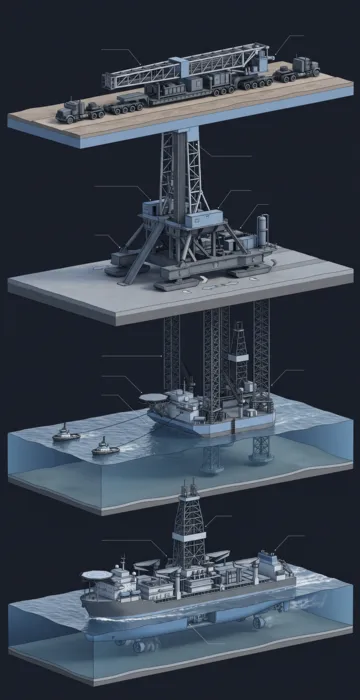
Yes, oil rigs move all the time, and moving is a normal part of the job, because a rig only earns its keep while it's drilling. Land rigs get broken down into loads and hauled by truck, or they walk or skid short distances between wells on the same pad. Offshore, jack-ups and semisubmersibles are usually towed by tugs, while drillships and many semisubs sail under their own power. The only rigs that don't really move are the big fixed production platforms, and even their drilling packages can be lifted off and reused. The method depends on rig type and distance.
Can Oil Rigs Move on Land?
They sure can, and most of them do it a few times a year. A land rig is built to come apart. The mast folds or lowers, the substructure breaks into sections, and every big piece is sized to fit on a trailer and travel down a public road.
Here's the part outsiders never see: a rig is not one machine. It's a crowd of machines. Mud pumps, tanks, generators, the drawworks, the doghouse, pipe racks, crew quarters, fuel tanks. Every one of those is its own load.
Here are the main ways rigs get from one hole to the next:
- Truck it. The rig is torn down and hauled in many truckloads with winch trucks, bed trucks and cranes. This is how rigs cover long distances.
- Walk or skid it. On multi-well pads, the rig stays standing and moves a few feet to the next well slot on hydraulic feet or rails.
- Tow it. Offshore jack-ups, barges and many semisubmersibles are pulled by tugboats or anchor-handling vessels.
- Sail it. Drillships, and semisubs with their own thrusters, move under their own power like any other ship.
How Are Oil Rigs Moved by Truck?
A conventional move starts with the rig down. The crew lays the derrick or mast over, unpins the substructure, disconnects every line and hose, and gets the loads ready. Then the trucking company shows up with the iron to haul it.
A small rig might move in a couple dozen loads. A big, deep-hole rig takes a whole lot more. Some of those loads are oversize and need permits, pilot cars and planned routes that avoid low bridges and weak culverts.
Once everything lands on the new location, the whole process runs backward. Set the mats, set the substructure, raise the mast, hook it all up. If you want the full picture of how that sequence gets planned, read about how a rig up and rig down actually works from start to finish.
A conventional move can take days, and on a big rig with a long haul it can take more than a week. Weather, road restrictions and how organized the crew is make a big difference. A sloppy rig down always shows up as a slow rig up.
What Are Walking Rigs and Skidding Rigs?
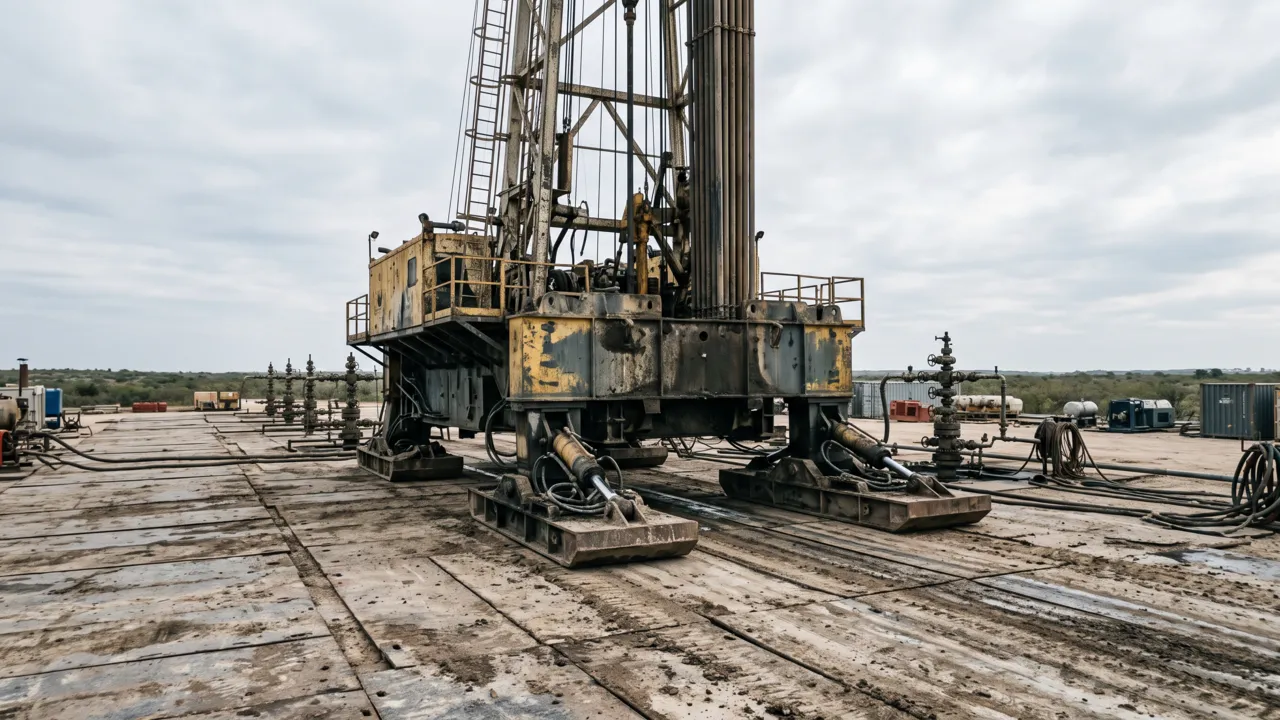
Walking and skidding rigs are built for pad drilling, where several wells sit in a row only a few yards apart. Instead of tearing down to move twenty or thirty feet, the rig just picks itself up and shifts over.
Walking Rigs
A walking rig has hydraulic "feet" under the substructure. The feet lift the rig, slide it a short step, set it down and reset. Repeat that enough times and the rig walks to the next well slot, mast standing and pipe often still racked in the derrick. Many walking systems can step sideways, forward or at an angle.
Skidding Rigs
A skidding rig rides on rails or beams. Hydraulic rams push or pull the substructure along the rails to the next slot. Offshore platform rigs have done this for a long time, sliding over a grid of well slots on the deck.
Honestly, walking rigs changed pad drilling. When you can move between wells in hours instead of days, the rig spends a lot more of its life making hole. The catch is that the move is short range only. Once the pad is done, that rig still gets torn down and trucked like any other.
How Do Offshore Rigs Move?
Offshore rigs move by water, and the method depends on how the rig sits on the well.
| Rig type | How it stands on location | How it moves |
|---|---|---|
| Jack-up | Legs jacked down to the seafloor, hull lifted out of the water | Legs jacked up, hull floats, towed by tugs (some are self-propelled) |
| Semisubmersible | Floats on pontoons, held by anchors or thrusters | Towed, or sails on its own thrusters; long trips sometimes on a heavy-lift ship |
| Drillship | Held over the well by dynamic positioning | Sails under its own power |
| Drilling barge | Sits on bottom in shallow water | Floated and towed |
A jack-up rig is a good example of how slow and careful an offshore move is. Before it can go anywhere, the crew has to jack the hull back down into the water and pull the legs out of the seabed. The tow itself waits on the weather, because a jack-up under tow with its legs sticking up in the air doesn't like rough seas.
Floaters are different. A semisub on anchors has to have those anchors pulled by anchor-handling boats first. A drillship on dynamic positioning just disconnects from the well, pulls its riser and sails off. That's one reason drillships are popular for work far from shore.
Can Offshore Platforms Move?
Most fixed production platforms don't move. They're built on steel jackets or concrete bases pinned to the seafloor, and they're meant to stay put for the life of the field.
The drilling equipment on top is another story. Many platforms use a modular rig that gets lifted on by a crane vessel, drills the wells, and then gets lifted off and taken somewhere else. Some floating production units, like spars and tension-leg platforms, can in theory be disconnected and moved, but that's a major project, not a routine trip.
Why Do Oil Rigs Have to Move So Often?
A drilling rig drills wells. It doesn't produce oil. Once a well hits total depth and gets cased, the rig's job there is done, and the completion crew and production equipment take over.
So the rig moves on. Here's the plain economics of it:
- A rig only gets paid its full day rate while it's working, and every day spent moving is a day not making hole.
- Operators often have a long list of wells to drill, sometimes many on one pad and many pads in one field.
- Contracts often end when the program ends, and the rig heads to the next operator's lease.
That's why so much engineering has gone into faster moves. Walking systems, quick-connect lines, fewer loads and better planning all exist because idle iron costs money.
Is Moving a Rig Dangerous?
Rig moves carry real risk, and I don't say that lightly. Raising and lowering the mast, rigging heavy loads, pinch points when you're pinning sections, trucks backing on a crowded location, and hands working at height all stack up during a move.
Good crews slow down when it matters. They hold a job safety meeting before the mast comes down, they keep people out of the line of fire under suspended loads, and they don't let schedule pressure push them past a step. If something feels wrong during a move, stop and talk about it. Nobody has ever regretted taking ten extra minutes before laying over a derrick.
So, Can Oil Rigs Move? They're Built to Go
Yes, oil rigs move, and they're designed with that in mind from day one. Land rigs break into truckloads for long hauls, and walking or skidding rigs shift short distances between wells on a pad. Offshore rigs get towed or sail themselves to the next location.
The method comes down to rig type, distance and conditions. The reason never changes: a rig earns money drilling, not sitting. So next time you see a rig gone from a pad, don't worry. It's out there making hole somewhere else.