Drill Bit Types – Roller Cone, PDC and Diamond Bits Compared
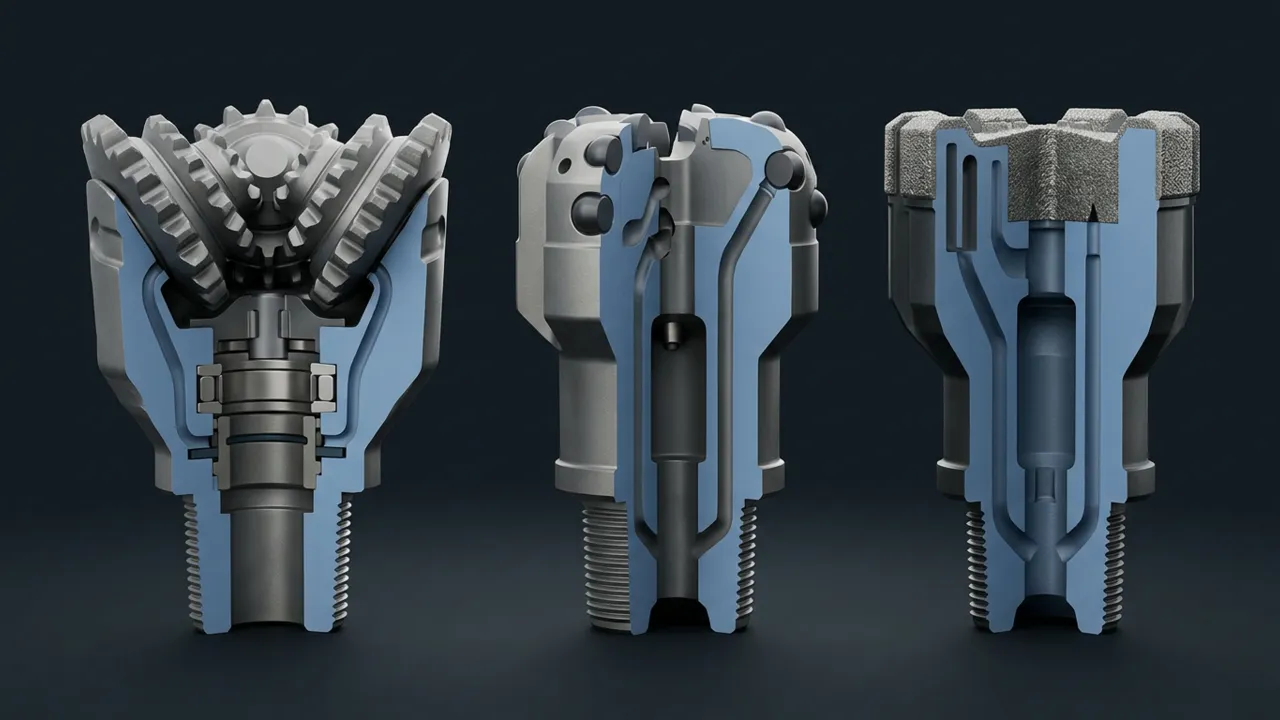
Everything on a drilling rig, from the derrick to the mud pumps, exists to help one small tool do its job. The bit is the only part of the whole operation that actually cuts rock. Pick the right one and the well drills fast and smooth. Pick the wrong one and you may be tripping pipe for a new bit long before you planned. So what are the main drill bit types, and how do roller cone, PDC and diamond bits compare?
The main drill bit types for oil and gas wells are roller cone bits, which crush and gouge rock with rotating cones, and fixed cutter bits, which include PDC bits that shear rock with diamond cutters and diamond-impregnated bits that grind very hard rock. Roller cone bits come in milled tooth versions for soft rock and tungsten carbide insert versions for harder rock. PDC bits drill most of the footage in many basins today because they cut fast and last a long time in suitable rock. Natural diamond and impregnated diamond bits handle very hard, abrasive formations where other bits wear out.
There's also a newer middle ground. Hybrid bits combine cones and PDC blades on one body to cover tougher, mixed rock.
How Do Oil Well Drill Bits Cut Rock?
Oil well drill bits cut rock in three basic ways: crushing, shearing and grinding. Understanding those three actions makes the rest of this article much easier.
- Crushing and gouging: teeth or inserts are pushed into the rock and break it into chips. Roller cone bits work this way.
- Shearing: a sharp cutter scrapes across the rock and peels off a layer, like a wood plane. PDC bits work this way.
- Grinding: tiny diamonds wear the rock away bit by bit, like sandpaper. Impregnated diamond bits work this way.
This is the part to remember. Shearing generally takes less energy than crushing, which is why PDC bits often drill faster. But shearing cutters can chip or wear quickly in very hard or broken rock, which is where crushing and grinding still earn their place. Rigzone's explainer on how a drill bit works covers these basics in plain language.
What Are Roller Cone Bits?
Roller cone bits have cones mounted on bearings that roll across the bottom of the hole as the bit turns. Most have three cones, which is why they're often called tricone bits. Each cone carries rows of teeth or inserts that crush and gouge the rock.
The SLB glossary describes the roller cone bit as a bit with cones that turn as the bit rotates. There are two main kinds:
Milled Tooth Bits
Milled tooth bits (also called steel tooth bits) have teeth machined right out of the cone steel. The teeth are long and spaced wide, which suits soft formations that need aggressive gouging. They're usually hardfaced to slow wear.
Tungsten Carbide Insert (TCI) Bits
TCI bits have very hard tungsten carbide inserts pressed into holes in the cones. The inserts can be shaped long and chisel-like for medium rock or short and rounded for hard rock. They outlast milled teeth in harder, more abrasive formations.
What Are Fixed Cutter Bits?
Fixed cutter bits have no moving parts. The body and cutters turn together as one piece, so there are no bearings to wear out. That's a big reason they can stay in the hole for long runs.
PDC Bits
PDC stands for polycrystalline diamond compact. A PDC bit has blades lined with small cylindrical cutters, each topped with a layer of man-made diamond bonded to a tungsten carbide base. The cutters shear the rock as the bit turns. If you want the full story of how these cutters work and why they took over, read our article on the PDC bit.
Natural Diamond Bits
Natural diamond bits have small natural diamonds set into the surface of a matrix body. They scrape and plow very hard rock. They've become less common as PDC and impregnated designs improved, but they still show up in some niche applications.
Impregnated Diamond Bits
Impregnated bits have fine diamond grit mixed right into the matrix material of the blades. As the matrix wears, fresh diamonds are exposed. They drill slowly but last a long time in very hard, abrasive rock, and they're often run with a turbine or high-speed motor.
Roller Cone vs. PDC: How Do the Main Drill Bit Types Compare?
This table compares the main drill bit types side by side. It's a general guide, since bit designs vary a lot within each type.
| Bit type | Cutting action | Best formations | Strengths | Weaknesses |
|---|---|---|---|---|
| Milled tooth roller cone | Gouging, crushing | Soft | Low cost, aggressive in soft rock | Teeth wear fast in hard rock |
| TCI roller cone | Crushing | Medium to hard | Handles hard and broken rock | Bearings limit run life |
| PDC | Shearing | Soft to medium-hard, many shales and sands | Fast, long runs, no bearings | Cutter damage in very hard or interbedded rock |
| Natural diamond | Plowing, grinding | Very hard | Durable | Slow, less common today |
| Impregnated diamond | Grinding | Very hard, abrasive | Very long life in tough rock | Low rate of penetration |
| Hybrid | Crushing plus shearing | Hard or mixed | Stable, handles interbeds | Higher cost, still has bearings |
What Is a Hybrid Bit?
A hybrid bit combines roller cones and PDC blades on one body. The cones crush and pre-fracture the rock while the PDC cutters shear it. The idea is to get some of the speed of a PDC bit with the toughness of a roller cone in hard or interbedded formations.
Hybrids also tend to drill with less torque fluctuation than a pure PDC bit in tough rock, which can mean less vibration. The trade-off is cost and the fact that you've brought bearings back into the picture.
Why Do Bit Nozzles Matter?
Every modern bit has nozzles (also called jets) that shoot drilling fluid at the bottom of the hole. They do two jobs. They clean cuttings away from the cutters so the bit isn't regrinding old rock, and they cool the cutters, which matters a great deal for PDC diamond.
Nozzles screw into the bit and come in many sizes, so engineers can choose them for each run. The combined opening is called the total flow area, or TFA. A smaller TFA makes the mud leave faster and hit harder, but it also takes more pump pressure. Engineers balance that against what the pumps, motor and MWD tool can handle.
Think of it like the nozzle on a garden hose. Narrow it down and you get a strong jet that cleans a sidewalk, but you need more pressure behind it to keep the same flow.
What Sizes Do Oil Well Drill Bits Come In?
Oil well drill bits come in a wide range of diameters, from a few inches for small holes and sidetracks up to very large bits for the surface sections of deep wells. Bit size is chosen to fit the casing program, with each hole section slightly larger than the casing that will be run in it.
That's why a single well often uses several bit sizes. A big bit drills the shallow section, casing goes in, and then a smaller bit that fits through that casing drills the next section. The pattern repeats down to total depth.
How Have Drill Bits Changed Over Time?
Early rotary drilling used simple fishtail and drag bits, which worked in soft ground but struggled in hard rock. The roller cone bit, developed in the early twentieth century, changed that by letting rigs drill through hard formations, and it dominated rotary drilling for decades.
PDC bits appeared in the 1970s and improved steadily as diamond cutter technology got tougher and more heat resistant. Today, in many basins, they drill the majority of the footage. Roller cone bits haven't disappeared, though. They still have a real place in hard, broken rock and certain hole sections.
How Do You Read IADC Bit Codes?
IADC bit codes are a standard way to classify bits so engineers can compare them across manufacturers. They're set up by the International Association of Drilling Contractors.

Roller Cone Codes
Roller cone bits use a three-digit code, sometimes followed by a letter for extra features:
- First digit (series): 1 to 3 are milled tooth bits from soft to hard. 4 to 8 are TCI bits from soft to very hard.
- Second digit (type): a finer hardness step within that series, from 1 (softest) to 4 (hardest).
- Third digit (features): the bearing and gauge design, such as open roller bearings, sealed roller bearings or sealed journal bearings, with or without gauge protection.
So a bit coded 517 is an insert bit for softer formations with sealed journal bearings and gauge protection.
Fixed Cutter Codes
Fixed cutter bits use a four-character code. It describes the body material (steel or matrix), the cutter density, the cutter size or type, and the bit profile. It's less about formation hardness directly and more about the bit's physical design, which you then match to the rock.
How Do Engineers Choose a Drill Bit?
Engineers choose a drill bit by matching it to the rock, the hole section and the drilling system. The main questions are:
- How hard and abrasive is the formation, and is it interbedded?
- Is the section vertical, curved or horizontal, and what steering tool is being used?
- What did bits do in nearby offset wells?
- How much does rig time cost compared with the bit itself?
That last question matters a lot. The usual yardstick is cost per foot, which adds the bit cost to the rig cost for drilling and tripping time, then divides by the footage drilled. An expensive bit that drills twice as far often wins easily, because the rig time saved is worth more than the bit.
What Does a Dull Bit Tell You?
A dull bit is a report card for the run. When a bit comes out of the hole, the crew grades it using the IADC dull grading system. It records cutter wear on the inner and outer rows, the main type of damage, where it happened, bearing condition, gauge wear and why the bit was pulled.
Those grades feed the next bit choice. Chipped PDC cutters might point to vibration or hard stringers. Worn gauge might mean the next bit needs better gauge protection. Over a few wells, dull grading is how a team learns what really works in its field.
Drill Bit Types: Which One Belongs on Your Next Run?
The main drill bit types are roller cone bits, which crush rock with turning cones, and fixed cutter bits, which shear or grind it. PDC bits handle much of today's footage, TCI and hybrid bits take on harder and mixed rock, and impregnated diamond bits handle the very hard, abrasive stuff.
When you choose, start with the rock and the steering system, then check the offset well dulls and run the cost per foot numbers. The bit that looks expensive on paper is often the one that saves the most money once rig time is counted.