What Are Downhole Tools? – Types and What Each One Does
When people picture an oil rig, they usually picture the tall derrick and the busy rig floor. But the real work happens out of sight, sometimes miles below the surface. That's where a whole family of specialized equipment cuts the rock, steers the hole, measures what's there and gets the crew out of trouble. So what are downhole tools, and what does each type actually do?
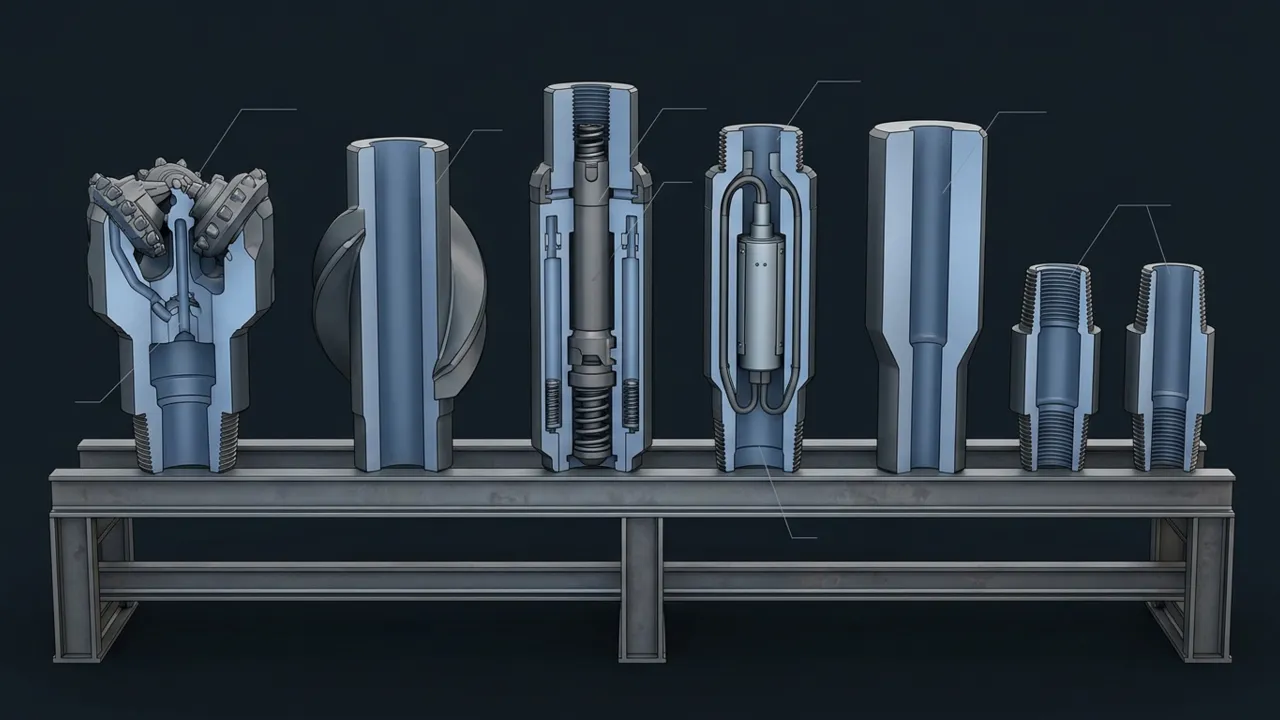
Downhole tools are any equipment run into a wellbore to drill, measure, steer, complete, repair or retrieve something below the surface. During drilling, most of them sit in the bottomhole assembly (BHA), the heavy lower section of the drill string just above the bit. The main drilling types are bits and hole enlargers, drill collars and heavyweight pipe, stabilizers and reamers, mud motors and rotary steerables, MWD and LWD sensors, jars and shock tools, and connecting subs. Beyond drilling, the term also covers fishing tools for recovering lost equipment and completion tools such as packers, plugs and perforating guns.
What Is a Downhole Tool, Exactly?
A downhole tool is simply equipment designed to work inside the well rather than at surface. "Downhole" means anywhere below the rig floor, from a few feet to tens of thousands of feet deep.
These tools have to survive conditions that would wreck ordinary machinery. Think high pressure, high temperature, abrasive mud, heavy vibration and constant bending as the string turns. That's why most downhole tools are thick-walled steel bodies with threaded connections on each end, so they can screw into the drill string like links in a chain.
Here's a helpful way to picture it. The drill pipe is the long rope that reaches down to the work. The downhole tools are the specialized hand tools tied to the end of that rope.
Downhole Tools vs. Surface Equipment
It helps to draw a clear line. Surface equipment, such as the drawworks, top drive, mud pumps and blowout preventers, stays on or near the rig. Downhole tools go into the hole and come back out on every trip. If a piece of equipment gets screwed into the string or lowered on a line, it's downhole.
Where Do Downhole Tools Sit in the Drill String?
Most drilling tools sit in the bottomhole assembly, the lowest few hundred feet of the string. The SLB glossary defines the bottomhole assembly as the lower part of the drill string, from the bit up to the drill pipe.
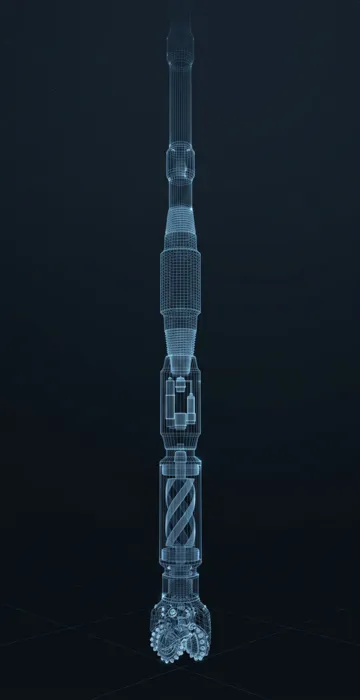
A typical directional BHA, from the bottom up, might look like this:
- Bit
- Mud motor or rotary steerable system
- Near-bit stabilizer (sometimes on the motor itself)
- MWD and LWD tools in nonmagnetic collars
- Additional stabilizers and drill collars
- Drilling jar
- Heavyweight drill pipe
- Drill pipe running back to surface
Crossover subs sit wherever two connection types meet. The exact order changes with the well, but this pattern shows up again and again. If you want the full top-to-bottom picture, our article on drill string components covers the pipe, collars and connections in more detail.
What Are the Main Types of Downhole Drilling Tools?
Here's a quick-reference table of the main groups. The sections that follow explain each one.
| Tool group | Examples | Main job |
|---|---|---|
| Cutting tools | Roller cone bits, PDC bits, hole openers, underreamers | Make hole or enlarge it |
| Weight tools | Drill collars, heavyweight drill pipe | Put weight on the bit and stiffen the string |
| Stabilization tools | Stabilizers, roller reamers | Center the string and control direction |
| Steering and power tools | Mud motors, rotary steerables, turbines | Turn the bit and steer the well |
| Measurement tools | MWD, LWD, memory gauges | Report position and formation data |
| Problem-solving tools | Jars, accelerators, shock subs, circulating subs | Free stuck pipe, damp vibration, manage flow |
| Connecting tools | Crossover subs, bit subs, float subs | Join different threads and hold valves |
Cutting Tools
The bit is the only tool that actually touches fresh rock. Roller cone bits crush and gouge with rolling cones, while PDC bits shear the rock with fixed diamond cutters, much like a plane shaving wood. Diamond-impregnated bits grind very hard, abrasive rock slowly. Hole openers and underreamers enlarge a hole that's already been drilled, which helps when casing needs extra clearance.
Weight and Stiffness Tools
Drill collars are thick-walled steel tubes that provide the weight on bit. The trick is this: we push on the bit with gravity acting on heavy collars, not by shoving down on thin drill pipe, which would buckle. Heavyweight drill pipe sits above the collars as a transition, so the string doesn't go from very stiff to very flexible all at once.
Stabilization Tools
A stabilizer is a short sub with blades that nearly fill the hole. It's a lot like the fletching on an arrow, keeping the assembly pointed where it should go. Where you place stabilizers controls whether the hole builds angle, drops angle or holds steady. Roller reamers do a similar job with rolling cutters that also smooth the hole wall.
Which Downhole Tools Steer and Measure the Well?
Steering tools change the direction of the hole, and measurement tools tell you whether it worked. They almost always travel together.
Mud Motors and Rotary Steerables
A mud motor uses the flow of drilling fluid to spin the bit. With a small bend in its housing, it can steer by "sliding," where the string is held still and the bit drills in the direction the bend is pointing. A rotary steerable system steers while the whole string keeps turning, using pads or an internal bias to push or point the bit. Turbines are a related tool that spin very fast and are used in some hard-rock applications.
MWD and LWD
Measurement while drilling (MWD) tools measure inclination, azimuth and toolface, so the directional driller knows where the bit is and which way it's facing. Logging while drilling (LWD) tools measure rock properties such as resistivity and density. Both send key data to surface as pressure pulses in the mud column.
Which Tools Help When Things Go Wrong?
Some downhole tools are there mostly as insurance. You hope you won't need them, but you're very glad they're in the string when you do.
- Drilling jars store energy as the string is stretched or compressed, then release it as a sharp hammer blow to free stuck pipe.
- Accelerators sit above the jar and boost the impact by storing extra energy.
- Shock subs use springs or elastomers to absorb vibration from the bit, protecting the rest of the BHA.
- Circulating subs can open side ports to pump at higher rates or spot lost-circulation material without passing it through sensitive tools.
- Float valves let mud flow down but stop flow from coming back up the pipe, which helps with well control and keeps cuttings out of the string.
The SLB glossary's description of a jar is a good short explanation of how stored energy becomes an impact.
What Are Fishing Tools?
Fishing tools are downhole tools designed to recover something that's been lost or stuck in the well. In oilfield language, that lost item is called the "fish," and any loose debris is called junk.
Common fishing tools include:
- Overshots, which slide over the outside of a fish and grip it.
- Spears, which go inside a fish and grip it from within.
- Junk baskets and magnets, which catch small loose pieces like bit cones or hand tools.
- Mills, which grind up a fish that can't be pulled out whole.
- Washover pipe, which cleans out around a stuck fish so it can be freed.
Fishing is a specialty of its own, and the tool choice depends on the fish's shape, size and how firmly it's stuck.
Are Completion Tools Also Downhole Tools?
Yes. Once the well is drilled and cased, a different set of downhole tools prepares it to produce. These usually run on tubing, wireline or coiled tubing rather than on the drill string.
- Packers seal the space between tubing and casing to isolate zones.
- Bridge plugs and frac plugs block the wellbore at a set depth.
- Perforating guns shoot holes through casing and cement into the reservoir.
- Sliding sleeves open or close flow paths between zones.
- Subsurface safety valves shut the well in automatically if something goes wrong at surface.
The same basic rule applies here as in drilling. Each tool does one job, and the completion design strings them together in the right order.
How Are Downhole Tools Connected Together?
Most drilling tools connect with rotary shouldered connections. That's a tapered thread with a flat shoulder that seals and carries load when the joint is tightened. One end is a "pin" (male thread) and the other is a "box" (female thread).
Each connection has to be made up to a specified torque. Too loose, and the shoulders can separate and leak, which lets mud cut a washout through the steel. Too tight, and you can stretch the pin or split the box. The driller and floor crew use tongs or an iron roughneck to hit the right number, and the tool supplier's data sheet tells you what that number is.
When two tools have different thread types or sizes, a crossover sub joins them. You'll find several crossovers in almost every BHA.
How Long Do Downhole Tools Last?
It depends on the tool and how hard the well treats it. A bit may be worn out after a single run in hard rock, while a drill collar can last for many wells. Tools with moving parts or electronics, such as motors, jars and MWD tools, are tracked by circulating hours and serviced on a schedule.
After a run, tools are usually sent back to a shop for inspection. Technicians check threads, look for cracks with methods like magnetic particle inspection, and measure wear on blades and bodies. Then the tool is repaired, or "redressed," and goes back out. Many downhole tools are rented from service companies for exactly this reason: the company can inspect and maintain them between jobs.
Keeping good records matters. A jar or motor that's past its recommended hours is a tool you don't want to rely on when the well gets difficult.
How Do Engineers Choose Which Downhole Tools to Run?
Engineers start with the goals for the hole section, then pick tools that meet them with the least risk and cost. The questions usually go something like this:
- What is the hole size and depth, and what kind of rock are we drilling?
- Does the well need to build, hold or drop angle, or turn?
- What data do the geologists and directional drillers need in real time?
- What has gone wrong in nearby wells, such as stuck pipe or vibration?
- What are the temperature, pressure and mud type limits for each tool?
Offset well data is gold here. If the neighboring wells had trouble with stick-slip or differential sticking, you'll see shock tools, extra stabilization or a carefully placed jar in the next plan.
What Are Downhole Tools, and Why Do They Matter?
Downhole tools are the working end of every well: the bits, collars, stabilizers, motors, sensors, jars and subs that do the job far below the rig. On top of that come the fishing and completion tools that rescue lost equipment and get the well ready to produce.
The simplest way to learn them is by job. Ask what cuts, what adds weight, what steers, what measures and what saves you when things go wrong. Once you can sort a BHA into those groups, you'll be able to read almost any drilling program and understand why each tool is there.