Drill String Components – Pipe, Collars, HWDP and the BHA

From the rig floor, the drill string looks like nothing more than a long column of steel pipe disappearing into the ground. But that column is carefully built from different pieces, each with its own job. Some carry torque, some carry weight, some carry sensors, and all of them carry mud. If you've ever wondered why it isn't just one kind of pipe all the way down, you're asking the right question. What are the drill string components, and what does each one do?
The main drill string components, from top to bottom, are drill pipe, heavyweight drill pipe (HWDP), drill collars and the bottomhole assembly (BHA) tools, ending at the bit. Drill pipe makes up most of the length and transmits rotation and mud from surface. Heavyweight drill pipe forms a transition zone between the flexible pipe and the stiff collars. Drill collars provide the weight on bit, and the BHA adds stabilizers, steering tools, measurement tools, jars and subs. Every joint is connected by threaded tool joints or connections, so the whole string acts like one long, hollow driveshaft.
What Is a Drill String?
A drill string is the full assembly of pipe and tools that connects the rig's rotating equipment to the bit at the bottom of the hole. It hangs from the top drive (or kelly on older rigs) and reaches all the way down to the rock being drilled.
The drill string has four jobs, and it helps to keep them in mind as we go through the parts:
- Transmit rotation and torque from surface to the bit.
- Carry drilling fluid down to the bit, where it cleans and cools.
- Put controlled weight on the bit.
- Carry tools in and out of the hole on every trip.
A good analogy is a long garden hose with a spinning nozzle at the end. The hose must carry water, twist without kinking and stay strong enough to pull back out. The drill string does all of that under far harsher conditions.
What Are the Drill String Parts From Top to Bottom?
Here's the order you'd typically see on a conventional string. Directional wells may add or rearrange tools, but the basic pattern holds.
| Position | Component | Main job |
|---|---|---|
| Top | Saver sub (on the top drive) | Takes thread wear so the top drive's own threads don't |
| Upper string | Drill pipe | Length, torque and mud flow |
| Transition | Heavyweight drill pipe | Gradual change in stiffness, some extra weight |
| Lower string | Drilling jar | Delivers impact to free stuck pipe |
| BHA | Drill collars | Weight on bit and stiffness |
| BHA | Stabilizers | Center the string and control hole direction |
| BHA | MWD and LWD tools | Survey and formation data |
| BHA | Mud motor or rotary steerable | Turn and steer the bit |
| Bottom | Bit sub and bit | Connect and cut the rock |
Crossover subs appear wherever two different connection types meet.
What Does Drill Pipe Do?
Drill pipe is the long, relatively light steel tubing that makes up most of the drill string's length. Its job is to transmit torque and carry mud while staying in tension, hanging from the rig. The SLB glossary describes drillpipe as the tubular that joins the rig's surface equipment with the BHA and bit.
Drill pipe comes in standard outside diameters, with 5-inch pipe being one of the most common sizes on land rigs. It's also made in different steel grades. You'll hear them called by letter and number, such as E-75, X-95, G-105 and S-135, where the number reflects minimum yield strength in thousands of psi. Higher grades are stronger, which matters in deep wells where the top joints carry the weight of everything below.
Each joint is roughly 30 feet long in the most common length range. Many land rigs stand pipe back in the derrick as stands of three joints, so you'll hear people talk about tripping "stands" rather than joints.
Why Should Drill Pipe Stay in Tension?
The logic is simple. Drill pipe is long and slender, so it handles pulling much better than pushing. Put it in compression while rotating and it can buckle and fatigue quickly. That's why we use heavy collars at the bottom to supply weight on bit, and keep the drill pipe above them in tension. The point where the string changes from compression to tension is called the neutral point, and good designs keep it down in the collars or heavyweight pipe.
What Are Tool Joints?
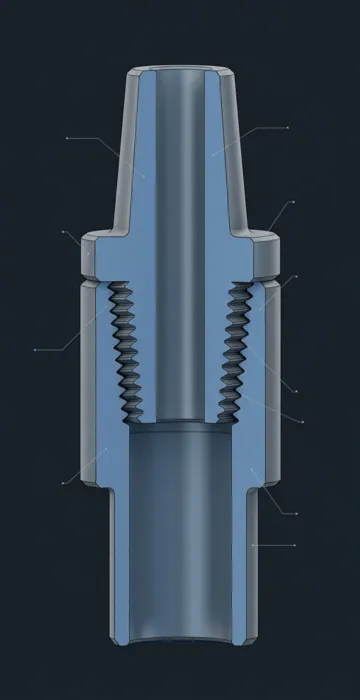
Tool joints are the thick, threaded ends welded onto each joint of drill pipe. One end has a pin (male thread) and the other a box (female thread). The SLB glossary entry for the tool joint describes these as the enlarged, threaded ends of a drillpipe joint.
Tool joints are thicker than the pipe body because threads cut away metal, and the connection still has to carry full tension and torque. Many tool joints also have hardbanding, a layer of very hard metal welded around the outside. It takes the wear from rubbing against casing and the hole wall, which protects the joint and the casing.
These connections are rotary shouldered connections. The tapered thread pulls the pin shoulder tight against the box shoulder, and that shoulder contact forms the seal. Thread compound, often called pipe dope, is brushed on before make-up to lubricate and help prevent galling.
Where Does Heavyweight Drill Pipe Fit in the String?
Heavyweight drill pipe (HWDP) is a thick-walled pipe that sits between the drill collars and regular drill pipe. It looks like drill pipe from a distance, but it has a heavier wall, longer tool joints and usually a thick wear pad, or center upset, in the middle of each joint.
Its main job is to act as a stiffness transition. Going straight from a very stiff collar to flexible drill pipe concentrates bending stress at that junction, and fatigue cracks tend to start there. HWDP spreads that stress out. In high-angle and horizontal wells, it's also used to provide weight because it bends more easily than collars and causes less drag.
What Do Drill Collars Do?
Drill collars are heavy, thick-walled steel tubes at the bottom of the string that supply weight on bit. Unlike drill pipe, they don't have separate welded tool joints. The threads are cut right into the collar body.
Collars also make the lower string stiff, which helps keep the hole straight and gives stabilizers something solid to work with. Some collars have spiral grooves cut into the outside to reduce contact with the hole wall, which lowers the risk of differential sticking. Nonmagnetic collars made from special alloys house the MWD tool so its compass sensors aren't fooled by nearby steel.
What Belongs in the Bottomhole Assembly?
The bottomhole assembly is everything from the bit up through the collars, and sometimes the HWDP. It's where most of the drill string's specialized tools live:
- The bit, which cuts the rock.
- Mud motors or rotary steerable systems, which turn and steer the bit.
- Stabilizers, which center the string and control whether the hole builds, drops or holds angle.
- MWD and LWD tools, which send survey and formation data to surface.
- Jars and shock subs, which help with stuck pipe and vibration.
- Float subs, bit subs and crossover subs, which hold valves and connect everything.
Putting these in the right order for the job is an engineering task of its own. If you want to see how engineers choose stabilizer spacing and collar lengths, our article on bottomhole assembly design explains the classic setups.
How Are Drill String Connections Made Up?
Every time the driller adds pipe or puts the string together, connections have to be made up correctly. On a modern rig, the process for a connection while drilling usually goes like this:
- Stop rotating, pick up off bottom and set the slips to hold the string.
- Break the connection between the top drive and the string.
- Pick up the next stand and stab its pin into the box held in the slips.
- Spin it in, then torque it to the specified make-up torque with tongs or an iron roughneck.
- Connect the top drive, pull the slips, start the pumps and return to bottom.
Make-up torque matters. Under-torqued connections can open up downhole, leak and wash out. Over-torqued connections can damage the threads or stretch the pin.
What Are the Most Common Drill String Failures?
Most drill string failures start as fatigue. Every rotation in a bent section of hole flexes the pipe back and forth, and over thousands of cycles tiny cracks can grow, usually near a connection or a change in stiffness.
Here are the failures crews watch for most:
- Washout: a crack or leaky connection lets high-pressure mud cut a hole through the steel. The first sign is often a slow, unexplained drop in pump pressure.
- Twist-off: the string parts completely, leaving the lower section in the hole as a fish.
- Thread damage: galled, stretched or worn threads from poor make-up or dirty connections.
- Wear: tool joints and pipe bodies lose outside diameter from rubbing on casing and rock.
That's why drill pipe and BHA components are inspected on a regular schedule, with checks of wall thickness, thread condition and cracks. A pressure drop that nobody can explain is worth taking seriously, since catching a washout early is far cheaper than fishing for a twisted-off string.
What Are the Drill String Components, and Why Use So Many?
The drill string is drill pipe on top, heavyweight drill pipe in the middle and drill collars plus BHA tools at the bottom, all joined by threaded connections and ending at the bit. Each piece exists because no single type of pipe can carry torque, supply weight, resist buckling and host tools all at once.
If you're learning the string, start with the simple rule: weight at the bottom, tension at the top, and a smooth transition between them. Once that makes sense, every other component starts to look like a sensible answer to a specific problem.