Why Do Fracking and Horizontal Drilling Work Together?
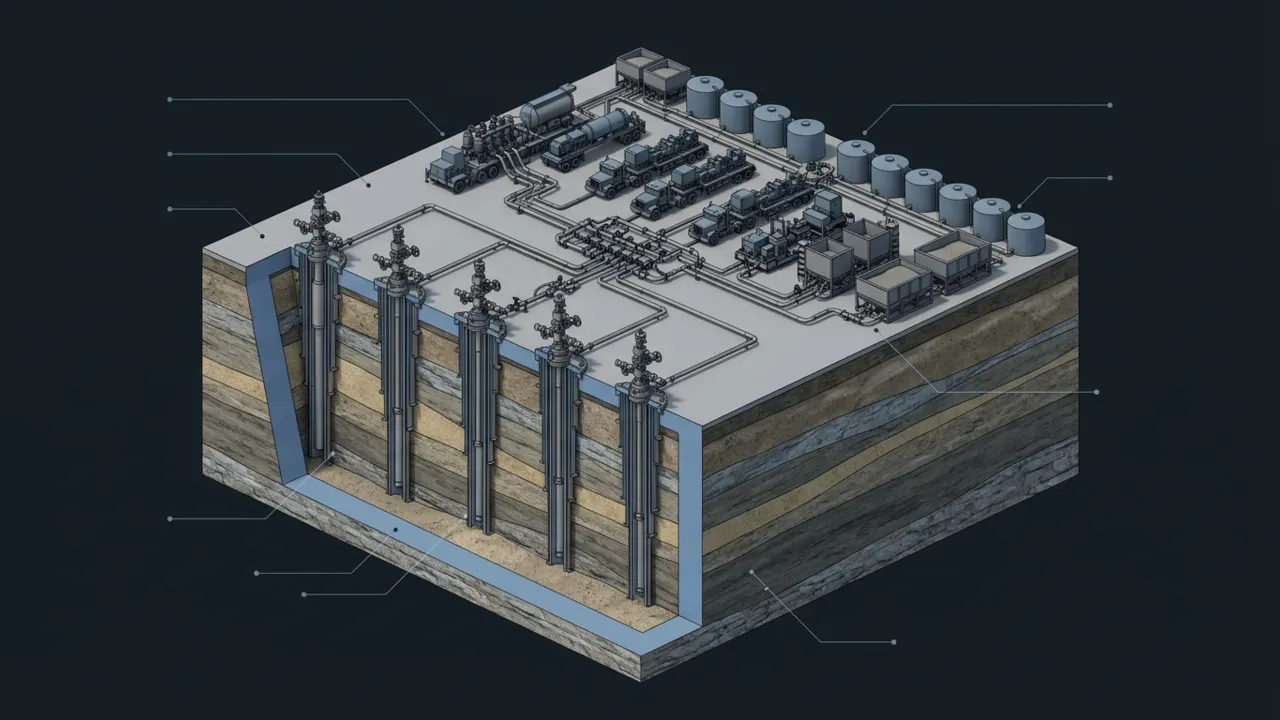
Neither idea was new when the shale boom took off. Horizontal wells had been drilled for decades, and hydraulic fracturing was older still. What changed was putting them together, at scale, in rock that most geologists had written off as source rock only. So why did that pairing matter so much? And why does nearly every shale well today use both? Put simply, why do hydraulic fracturing and horizontal drilling work together?
Hydraulic fracturing and horizontal drilling work together because the horizontal well exposes a long stretch of thin, tight rock, and fracturing makes that rock able to flow into the well. A vertical well only touches the shale over its thickness, often a few hundred feet at most. A horizontal lateral can run a mile or more inside that same layer. Shale is so tight that contact alone is not enough, so the lateral is fractured in many stages, each one creating propped pathways into fresh rock. In shale, one without the other is rarely economic.
Why Isn't a Vertical Well Enough in Shale?
A vertical well crosses the shale layer the short way. If the target zone is 150 feet thick, the well touches 150 feet of rock. Even if you fracture it, the fractures can only reach so far into rock that barely lets fluid move.
That was the problem for decades. Operators knew shale held huge amounts of gas and oil. Some vertical wells in shale did produce, especially where natural fractures helped. But most could not produce fast enough to pay for themselves.
A horizontal well changes the geometry. Drill down to the shale, turn, and run along it. Now the well is inside the target for thousands of feet instead of a few hundred.
What Does Horizontal Drilling Add?
Horizontal drilling adds reservoir contact. The well bends from vertical to horizontal through a curve, then drills a lateral that stays within the target zone. Directional tools and downhole sensors let the crew steer it, and geologists watch the data to keep it in the best rock. The SLB Energy Glossary entry on directional drilling gives a clean definition of the steering side.
Laterals in U.S. shale plays commonly run one to two miles, and some operators now drill three miles or longer. Longer laterals mean more rock contact per well and fewer surface locations. They also mean harder drilling, more friction and more risk, so longer is not automatically better.
Horizontal drilling also lets operators drill several wells from one pad. The surface footprint shrinks compared with a field of vertical wells reaching the same rock.
What Does Hydraulic Fracturing Add?
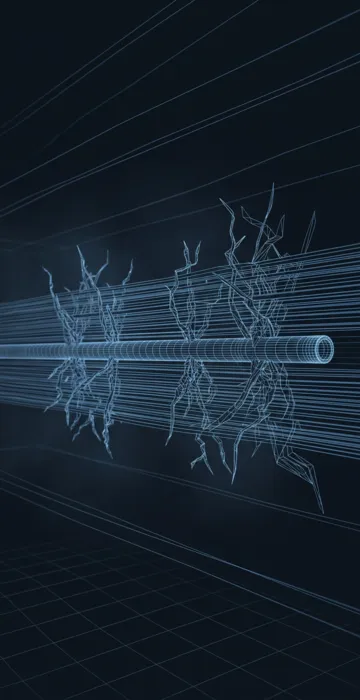
Hydraulic fracturing adds flow. Shale permeability is so low that even a long lateral would produce poorly on its own. Fracturing creates propped pathways that reach out from the wellbore into the rock, so fluids only have to travel a short distance through the tight matrix before they hit a fracture.
In a horizontal well, the frac is pumped in stages along the lateral rather than all at once. Each stage targets a short section, usually with several perforation clusters. That way the fractures spread along the whole lateral instead of all the fluid going into one weak spot.
How Do Lateral Length and Frac Stages Work Together?
Lateral length and frac stages are tied directly. A longer lateral needs more stages to stimulate it evenly. More stages mean more water, more sand, more plugs and more time on location.
The most common method in U.S. shale is plug-and-perf:
- Wireline pumps a perforating gun and a frac plug down the lateral.
- The plug is set to isolate the stage below.
- The gun fires, shooting holes through the casing in several clusters.
- The frac crew pumps that stage.
- The process repeats, working from the toe back toward the heel.
- After the last stage, coiled tubing or a workover rig drills out the plugs.
A long lateral can have dozens of stages. Operators keep adjusting stage length, cluster spacing and sand volume, because the best answer differs from basin to basin and sometimes from pad to pad.
Is Longer Always Better?
No. Longer laterals usually lower cost per foot of rock contacted, but returns per foot can fall off at the far end if the frac is not delivered as well there. Friction makes it harder to get tools and fluid to the toe. I think the industry's push toward longer laterals has mostly paid off, but it is an engineering trade-off, not a law of nature.
Which Way Is the Lateral Drilled, and Why?
Laterals are usually drilled in the direction of the minimum horizontal stress. That sounds technical, but the reason is practical. Fractures grow perpendicular to the minimum stress, so a lateral pointed that way gets fractures that cut across it, like rungs on a ladder.
Each rung reaches into fresh rock on both sides of the wellbore. If the lateral were drilled the other way, fractures would tend to run along the well and overlap, draining the same rock twice. Geologists and engineers work out the stress direction from logs, offset data and regional studies before the well is planned.
How Close Can Wells Be Spaced?
This became one of the big questions of the shale era. Operators drill several laterals side by side from one pad, sometimes stacked in different layers. Put them too far apart and rock between them never gets drained. Put them too close and their fractures overlap and compete.
A related issue is the "parent-child" effect. When a new well (the child) is drilled next to an older producing well (the parent), the depleted rock around the parent can draw the child's fractures toward it. The child often underperforms, and the parent can be hit by a frac stage from the new well. Operators now plan spacing, timing and sometimes protective pressure for parent wells with this in mind. There is no universal spacing rule, which is why you see so much testing.
How Did the Shale Revolution Bring Them Together?
The shale revolution came from combining tools that already existed, then refining them. In the 1990s, Mitchell Energy kept working the Barnett Shale in North Texas and eventually found that slickwater fracs could work at much lower cost than gel. In the early 2000s, the Barnett saw those fracs paired with horizontal wells, and results improved sharply.
From there, the approach spread to other shale plays. Better downhole steering, multi-stage completions and pad drilling all made it cheaper and faster. Our article on the history of hydraulic fracturing covers the earlier steps, going back to the first experimental frac in the 1940s.
The impact on U.S. production was large, and it is well documented. The EIA explains how shale became the main source of U.S. natural gas on its page about where our natural gas comes from.
Are Fracking and Horizontal Drilling the Same Thing?
No, though people often use "fracking" to mean the whole process. Horizontal drilling is a way of steering the wellbore. Hydraulic fracturing is a way of stimulating the rock after the well is drilled and cased. Different crews and equipment handle each one.
You can have one without the other. Many vertical wells are fractured, and many horizontal wells in conventional reservoirs are never fractured. It is in tight rock that the two became nearly inseparable.
What Are the Downsides of the Pairing?
Being even-handed means naming the costs too. Horizontal multi-stage wells are expensive. They use a lot of water and sand per well. They decline fast, so operators must keep drilling to hold production flat.
There are surface impacts as well: truck traffic, water handling and disposal of produced water. On the other hand, pad drilling concentrates many wells on one site, which can mean less total land disturbance than the same number of vertical wells spread across a field. Whether the balance tips good or bad depends on how well a specific operation is run and regulated.
Why Do Hydraulic Fracturing and Horizontal Drilling Work Together So Well?
Because each fixes the other's weakness. Horizontal drilling solves the contact problem by putting a mile or more of wellbore in the target. Hydraulic fracturing solves the flow problem by giving that tight rock conductive pathways to the well.
If you are trying to understand a shale well's performance, look at lateral length, stage count and how much sand went in per foot. Those three numbers tell you most of what the operator was going for.