LWD vs. Wireline Logging – Which Data Do You Need?
Every well is drilled to answer one big question: what's down there, and is it worth producing? Well logs are how we answer it. But there are two very different ways to record them, and choosing between them affects rig time, risk and the quality of the data you end up with. Should the sensors ride in the drill string, or go down on a cable after the hole is drilled? In short, LWD vs. wireline logging: which data do you actually need?
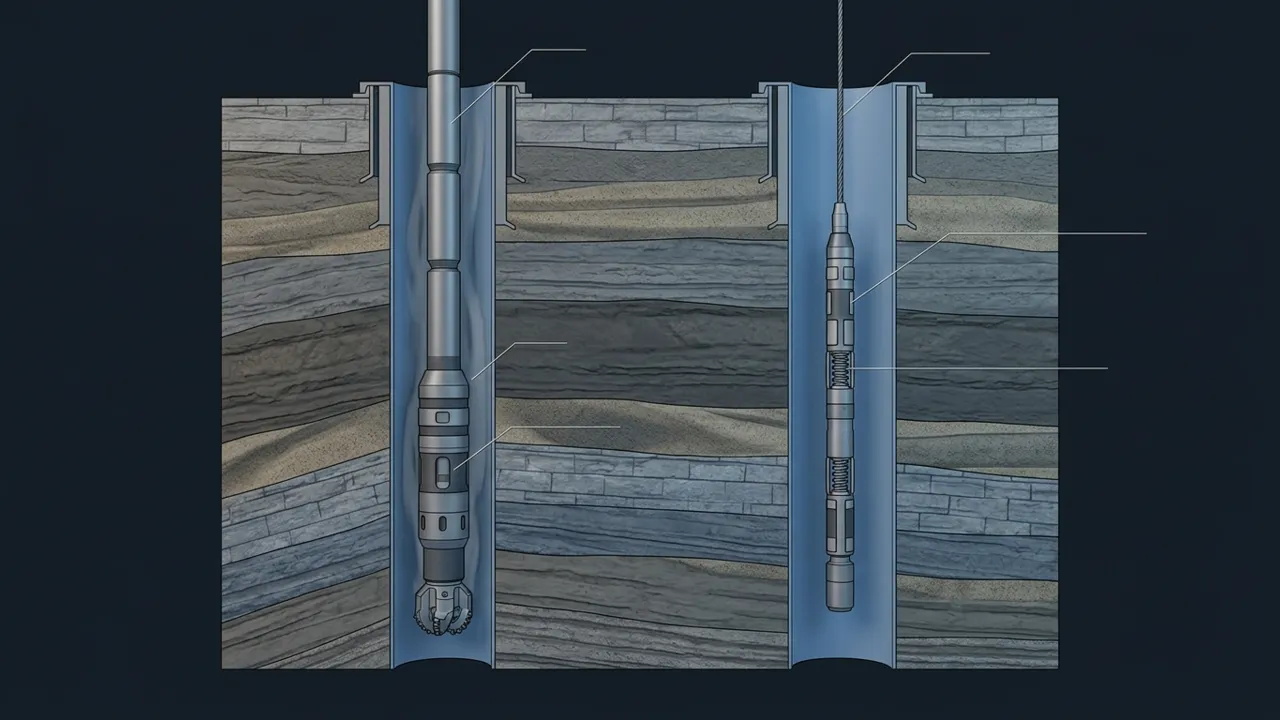
Logging while drilling (LWD) records formation data with sensors built into the drill string, while wireline logging lowers tools on an electrical cable after a section is drilled. LWD gives you data in real time, before drilling fluid has soaked far into the rock, and it works in high-angle and horizontal wells where a cable can't easily go. Wireline usually offers the widest menu of tools and very high data quality, and it's the standard for things like sidewall cores and detailed fluid sampling. Many operators use both: LWD for steering and early decisions, then wireline in key wells for the most detailed evaluation.
What Is Logging While Drilling?
Logging while drilling means measuring rock and fluid properties with tools placed in the bottomhole assembly, a short distance behind the bit. The sensors sit inside heavy, drill-collar-sized housings, so they turn and vibrate along with everything else.
Common LWD measurements include gamma ray, resistivity, density, neutron porosity, sonic and borehole images. Some of that data is pulsed to surface right away through the MWD telemetry system, and the full-resolution record is stored in tool memory. For the formal definition, see the SLB glossary entry for logging-while-drilling.
Here's a simple way to keep the terms straight. MWD tells you where the bit is. LWD tells you what the bit is drilling through.
What Is Wireline Logging?
Wireline logging means running measurement tools into the well on an armored electrical cable after drilling stops. The cable carries power down and sends data up at high speed, and the tools are usually logged while being pulled slowly upward.
Because the tools don't have to survive drilling, they can be more delicate and specialized. Wireline also covers jobs that go beyond logs: pressure testing at many depths, pulling fluid samples, cutting sidewall cores, and in cased holes, running cement evaluation tools and perforating guns.
What Do the Common Well Logs Tell You?
Before comparing the two methods, it helps to know what the basic logs measure. Both LWD and wireline can record all of these, so this list applies either way.
- Gamma ray: natural radioactivity. Shales usually read high, clean sands and carbonates usually read low.
- Resistivity: how well the rock resists electric current. Hydrocarbons resist current, salty water conducts it.
- Density: the bulk density of the rock, which helps estimate porosity.
- Neutron porosity: a response tied to hydrogen in the pore space. Paired with density, it can flag gas.
- Sonic: how fast sound travels through the rock, used for porosity and to tie into seismic data.
Put a few of these side by side and a log analyst can estimate where the reservoir is, how porous it is and what's likely filling the pores.
How Do LWD and Wireline Compare?
This table sums up the main trade-offs. Treat it as a starting point, since every well and every service package is a little different.
| Factor | Logging while drilling | Wireline logging |
|---|---|---|
| Timing | Real time, minutes to hours after the bit cuts the rock | After the section is drilled, often days later |
| Rig time | Little or none added | Extra trip and logging time, sometimes many hours |
| Cost drivers | Daily tool rental and lost-in-hole risk | Rig time plus the logging run itself |
| High-angle and horizontal wells | Works naturally | Needs pipe-conveyed logging or tractors |
| Mud invasion | Minimal, rock is close to its original state | More invasion, which can affect some readings |
| Data resolution | Good, limited by drilling speed and telemetry | Generally the highest, with controlled logging speed |
| Tool menu | Broad and growing | Broadest, including sidewall cores and advanced sampling |
| Geosteering | Yes | No |
When Is LWD the Better Choice?
LWD is the better choice when the data has to change what you do while the bit is still in the hole. That's the key idea. If a decision depends on the logs, and waiting costs money or risk, LWD wins.
Typical cases include:
- Geosteering a horizontal well to stay inside a thin target zone.
- Picking a casing point or coring point based on formation tops.
- High-angle and extended-reach wells where getting a cable to bottom is hard.
- Unstable holes where you'd rather not leave the well open for an extra logging trip.
- Offshore wells, where rig time is so expensive that saving a logging trip pays off quickly.
When Does Wireline Still Make More Sense?
Wireline makes more sense when you need the most detailed, most complete picture of the rock, and the hole is stable enough to log it. Exploration and appraisal wells often fall into this group, because the whole point of the well is to learn as much as possible.
Wireline also shines for:
- Pressure profiles and fluid samples at many depths.
- Sidewall cores to put real rock in a geologist's hands.
- Specialized tools, such as some advanced nuclear magnetic resonance and imaging services.
- Cased-hole work, including cement bond logs and production logs later in the well's life.
The equipment and the formal meaning of the term are covered well in the SLB glossary entry for wireline.
Why Does Mud Invasion Matter for Well Logs?
Mud invasion matters because logs measure the rock near the wellbore, and that's exactly where drilling fluid has been pushing in. Mud filtrate replaces some of the original fluid in the pores, which can change readings such as resistivity.
LWD reads the rock soon after it's drilled, so less filtrate has moved in. Wireline reads it later, after invasion has had time to spread. Log analysts correct for this, and both methods can give good answers, but timing is a real factor in how you interpret the data.
Can You Use Both on the Same Well?
Yes, and many wells do. A common approach is to run LWD for gamma and resistivity while drilling, then run a wireline suite across the reservoir section once the hole is at total depth.
Another approach is to log the pilot hole on wireline and drill the lateral with LWD alone. The idea is to spend the most detailed (and often most expensive) data where it answers the biggest questions. If you want to see where logging fits in the full sequence of making hole, casing and completing, our overview of the drilling process lays out each step.
How Should You Decide Which Data You Need?
Start with the decision, not the tool. Ask these questions in order:
- What decision will these logs drive, and when must it be made?
- Is the hole high-angle, unstable or expensive to keep open?
- Do we need samples, cores or pressures that only wireline can provide?
- Is this an exploration well, or the twentieth well in a known field?
If the answers point to real-time decisions and a tricky hole, lean toward LWD. If they point to detailed evaluation and a stable hole, plan wireline. Many programs end up with a mix, and that's perfectly normal.
LWD vs. Wireline: Which Data Do You Need Today?
Logging while drilling gives you fast, fresh data in the well you're drilling right now, with almost no added rig time. Wireline gives you the deepest toolbox and the most controlled measurements, at the cost of an extra trip.
Choose based on the decision you need to make and how risky the hole is. When the data needs to steer the bit, use LWD. When the data needs to answer every question about a reservoir, plan for wireline, and don't be surprised if the best answer is both.