Measurement While Drilling (MWD) – How Downhole Data Reaches Surface
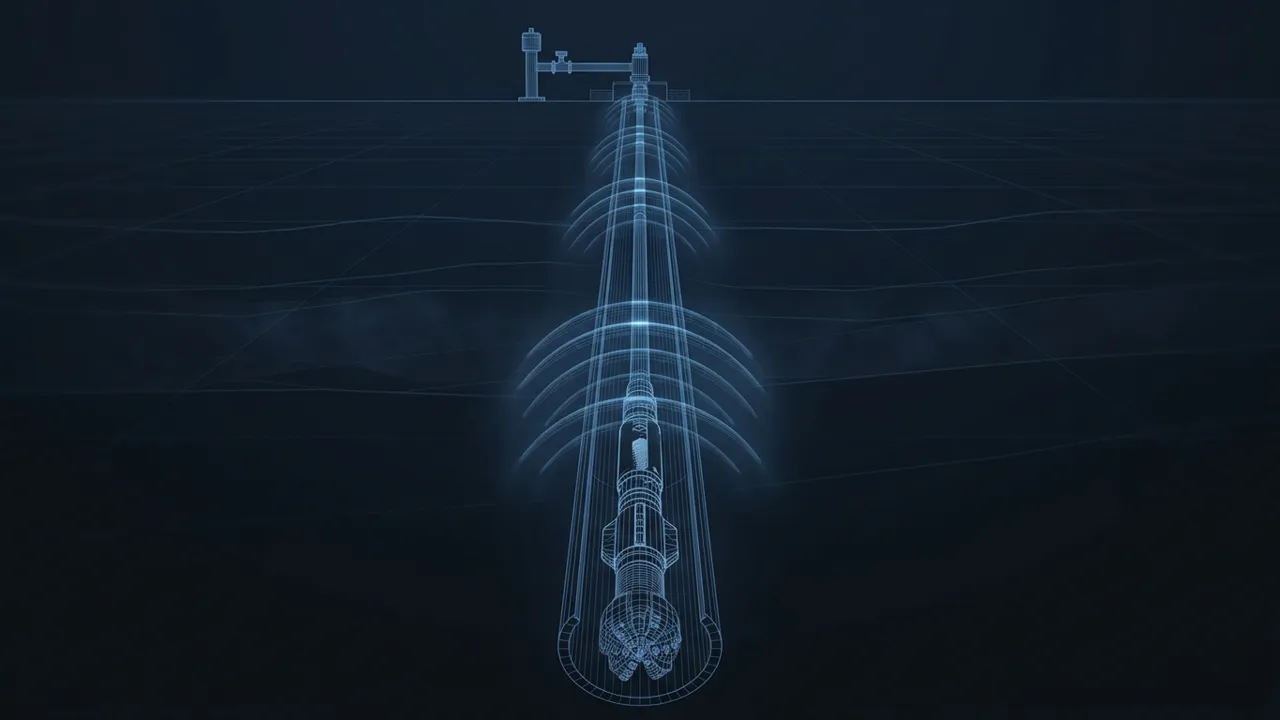
A wellbore can bend, drift and wander as it goes down, and nobody can look down the hole to check. Yet directional drillers routinely land a well inside a target zone only a few feet thick, miles from the rig. How do they know where the bit is pointing right now? The answer is a set of sensors riding just above the bit, plus a clever way of talking to the surface. So what is measurement while drilling, and how does its data get from the bottom of the hole to the driller?
Measurement while drilling (MWD) is a system of downhole sensors in the bottomhole assembly that measures the well's direction and drilling conditions and sends that data to surface while drilling continues. Its core job is surveying: measuring inclination (how far the hole is tilted from vertical) and azimuth (its compass direction), plus toolface, which tells the driller which way a steering tool is pointing. Most MWD tools also report gamma ray, temperature, vibration and downhole pressure. The data usually travels up as pressure pulses in the mud column, called mud pulse telemetry, which a sensor on the standpipe picks up and a computer decodes.
What Does an MWD Tool Measure?
An MWD tool measures where the hole is going and how the drilling is going. Think of it as the dashboard for a car you can't see, driving underground.
The sensors break down into two groups:
- Direction and position: inclination, azimuth and toolface, from accelerometers (which sense gravity) and magnetometers (which sense the earth's magnetic field).
- Drilling conditions: gamma ray (natural radioactivity of the rock), downhole temperature, annular pressure, and shock and vibration levels.
The survey itself is clever. Three accelerometers set at right angles tell the tool which way is down, so it can work out tilt. Three magnetometers tell it which way magnetic north is, so it can work out direction. Combine those with the measured depth of pipe in the hole, and you can calculate the bit's position.
The SLB definition of measurements-while-drilling is a good one-paragraph reference if you want the formal version.
How Does Mud Pulse Telemetry Work?
Mud pulse telemetry sends data by making small, controlled changes in mud pressure that the surface can read. It's a bit like Morse code tapped into a garden hose. The tool can't send a wire up, but it can briefly squeeze or open the flow path, and that pressure change travels up the fluid column inside the drill pipe.
There are three common ways to make those pulses:
| Pulse type | How it works |
|---|---|
| Positive pulse | A valve briefly restricts flow, raising pressure in the drill pipe. |
| Negative pulse | A valve briefly vents mud into the annulus, dropping pressure. |
| Continuous wave | A rotating valve (a "siren") creates a steady pressure wave and encodes data by shifting its phase or frequency. |
At surface, a pressure transducer on the standpipe records the signal. Software filters out noise from the pumps and decodes the pattern back into numbers.
Why Is MWD Data So Slow?
Pressure pulses through thousands of feet of mud are slow, and the pumps add a lot of noise. Mud pulse data rates are measured in bits per second, not megabits. That's plenty for survey numbers and a gamma reading, but it means the tool has to be choosy about what it sends. The rest gets stored in memory and downloaded when the tool comes back to surface.
What Other Telemetry Options Exist?
Mud pulse is the workhorse, but it isn't the only way to get data up the hole.
- Electromagnetic (EM) telemetry sends low-frequency signals through the rock to an antenna stake at surface. It works without circulation and is faster in many cases, but deep wells and some formations weaken the signal.
- Wired drill pipe has a data cable built into each joint, with connections at every tool joint. It's very fast but costs more and needs special pipe.
- Mud pulse remains the most common choice because it works in most wells and needs no special pipe.
How Is an MWD Survey Taken?
A survey is usually taken when the string is still, often at a connection when the driller stops to add a stand of pipe. Here's the typical sequence:
- The driller stops rotating and holds the string steady.
- The tool senses the quiet period and takes accelerometer and magnetometer readings.
- When the pumps come back on, the tool pulses the survey to surface.
- The directional driller logs the survey and calculates the new bit position.
Between surveys, while drilling, the tool keeps sending toolface so the driller can steer a mud motor or confirm what a rotary steerable is doing.
Why Do MWD Tools Need Nonmagnetic Collars?
The magnetometers need a clean view of the earth's magnetic field. Steel drill collars and the motor nearby would distort it. So the MWD tool is placed inside nonmagnetic drill collars made of special alloys, with enough spacing above and below to keep the steel's influence small.
How Is the Tool Powered?
An MWD tool is powered by batteries, a turbine alternator, or both. Lithium battery packs are simple and work without flow. A turbine spins in the mud stream and generates power whenever the pumps are on, which is handy on long runs. Many tools carry batteries as backup so they can still take a survey with the pumps off.
What Can Go Wrong With an MWD Tool?
MWD tools are packed with electronics, and they live in one of the harshest places you could put a circuit board. Heat, shock and abrasive mud all work against them. When something goes wrong, it usually falls into one of these buckets:
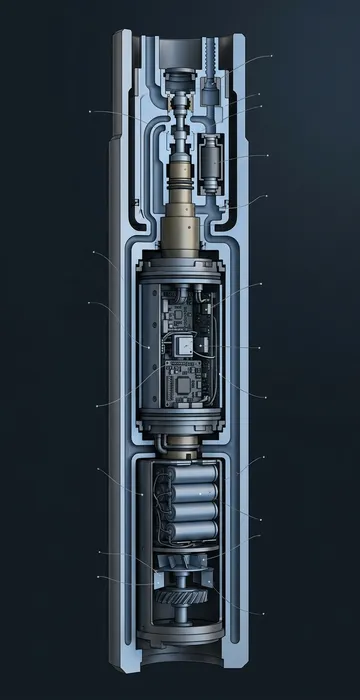
- Lost signal: the surface can't decode pulses, often because of pump noise, aerated mud or a weak pulse at depth.
- Plugged pulser: lost circulation material or debris can jam the valve that makes the pulses.
- Vibration damage: severe lateral shock or stick-slip can crack boards and loosen connections.
- Bad surveys: nearby steel, an old cased well or magnetic storms can throw off the magnetometer readings.
- Heat: very hot wells push electronics and batteries past their rating.
Most of these have a fix short of tripping out. The MWD hand can change the pulse settings or decode settings, the driller can adjust flow, and survey corrections can account for some magnetic error. If the tool truly dies, though, the crew usually has to pull it, because steering blind is not an option.
Who Runs the MWD Tool on a Rig?
An MWD operator, often employed by a service company, sets up and programs the tool, watches the decoded data and keeps the surface system running. They work closely with the directional driller, who decides how to steer. The driller on the brake also relies on the toolface display when sliding.
MWD vs. LWD: What's the Difference?
MWD and LWD use the same telemetry and live in the same part of the string, so people often blur them. The difference is what they're measuring.
| MWD | LWD | |
|---|---|---|
| Main purpose | Where is the bit, and how is drilling going? | What kind of rock and fluids are we drilling through? |
| Typical data | Inclination, azimuth, toolface, vibration, pressure, gamma | Resistivity, density, neutron porosity, sonic, imaging |
| Main user | Directional driller | Geologist and petrophysicist |
Gamma ray sits on the line between them, since it helps both steering and rock identification. If you want the formation evaluation side, our article on logging while drilling compares it with wireline logs.
Measurement While Drilling: The Bit's Voice at Surface
MWD is how the bottom of the hole talks to the people steering it. Sensors measure tilt, direction and toolface, and mud pulses carry that data up the drill pipe a few bits at a time.
If you're new to directional work, start by learning to read a survey: inclination, azimuth and measured depth. Once those three numbers make sense to you, the rest of MWD falls into place quickly.