What Is Directional Drilling? – Why Wells Don't Go Straight Down
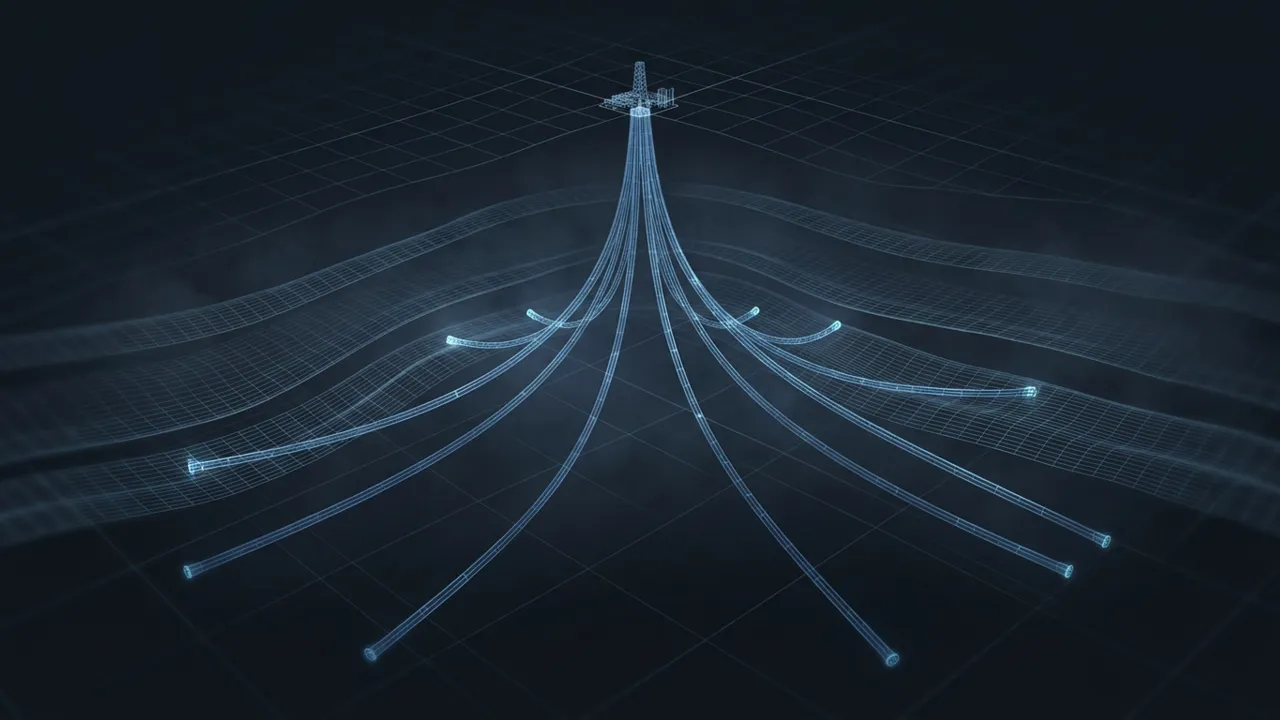
Most folks think an oil well is a straight hole going down. A lot of them aren't. Plenty of wells start straight, then bend, then run off at an angle or flat sideways toward a target that might be a mile or more from the rig. And the crew is steering that bit the whole way, from thousands of feet up. So what is directional drilling, and why don't wells just go straight down?
Directional drilling is the practice of deliberately steering a wellbore along a planned path, at an angle or even horizontal, to reach a target that isn't directly below the rig. Crews use it to reach oil under towns, lakes or coastlines, drill many wells from a single pad or platform, sidetrack around stuck tools, drill relief wells to kill a blowout and follow a reservoir sideways for more production. The well usually goes straight down to a kickoff point, then builds angle at a planned build rate until it's headed toward the target. Mud motors or rotary steerable systems do the steering, guided by surveys from tools near the bit.
Why Do Wells Need Directional Drilling?
Because the oil isn't always where you can put a rig. And even when it is, a straight hole isn't always the best way to get it. Here are the main reasons:
- Reach targets you can't drill over. Oil under a town, a river, a lake or a protected area can be reached from a rig set off to the side.
- Drill multiple wells from one location. One pad onshore or one platform offshore can drill dozens of wells fanning out in different directions.
- Sidetrack. If a fish is stuck in the hole or the well missed its target, the crew can kick off and drill a new path around it.
- Relief wells. If a well blows out, a relief well can be steered to intersect it deep underground so it can be killed with heavy fluid.
- Get more of the reservoir. Horizontal wells put far more hole in the pay zone than a vertical well can.
- Avoid trouble. Wells can be steered around faults, salt domes or other hazards.
Offshore, this is a big deal. Platforms are expensive, so drilling many wells from one platform out to different parts of a field saves a fortune.
How Does Directional Drilling Work?
Directional drilling works by tilting the bit slightly in the direction you want the hole to go, then measuring where the hole actually went and correcting as needed.
Here's the basic loop:
- The well plan sets a path from the surface location to the target, with a kickoff point and planned angles.
- The directional driller sets up the bottomhole assembly with a steering tool.
- The crew drills ahead while the steering tool pushes or points the bit in the planned direction.
- MWD tools take surveys measuring the hole's angle and direction.
- The directional driller compares the actual path with the plan and adjusts.
Rigzone has a solid plain-language explainer on how directional drilling works if you want another angle on it.
What Is a Kickoff Point?
The kickoff point, or KOP, is the depth where the well stops going straight down and starts to build angle. Above it, the hole is drilled vertical. Below it, the directional driller starts steering.
The KOP is picked in the well plan. Engineers look at the target's depth and distance, the rock where the turn will happen and any casing points. A shallow KOP gives more room to build angle gradually. A deep KOP keeps more of the well vertical but needs a sharper turn later.
What Is Build Rate?
Build rate is how fast the well gains angle, usually given in degrees per 100 feet drilled. A build rate of a few degrees per 100 feet is a gentle curve. Higher build rates make a tighter curve.
A related term you'll hear is dogleg severity. That's how sharply the hole bends in any direction, also measured in degrees per 100 feet. Too much dogleg is trouble. Sharp bends wear on drill pipe, make casing hard to run and can create keyseats that trap the string on the way out.
So the directional driller has to balance it. Turn fast enough to hit the target, but smooth enough that the hole stays easy to work in.
What Are the Common Well Profiles?
Directional wells come in a few basic shapes:
| Profile | Shape | Typical use |
|---|---|---|
| Build and hold (J-type or slant) | Vertical, build angle, hold a straight tangent to target | Reaching a target offset from the rig |
| S-type | Build, hold, then drop back toward vertical | Entering the reservoir near vertical, or avoiding other wells |
| Horizontal | Vertical, curve to about 90 degrees, then a long lateral | Shale and thin reservoirs |
| Extended reach | Long, high-angle section reaching far out | Targets far from the surface location |
What Are the Main Directional Drilling Methods?
Directional drilling methods have come a long way. Here are the main ones, old and new.

Whipstocks
A whipstock is a long steel wedge set in the hole that deflects the bit to one side. It's one of the oldest methods. Today it's mostly used for sidetracking out of existing casing, where a mill cuts a window along the wedge.
Mud Motors With a Bent Housing
A mud motor turns the bit using the flow of drilling mud. When the motor has a slight bend in its housing, the crew can point that bend in the direction they want and drill without rotating the string. That's called sliding. When they want to hold the course, they rotate the whole string, and the bend just drills a slightly bigger straight hole.
Sliding works, but it's slower, and hole cleaning suffers when the pipe isn't turning. Anybody who has spent a long night trying to slide in a long lateral knows how frustrating it gets when the string hangs up.
Rotary Steerable Systems
A rotary steerable system steers while the string keeps rotating. It uses pads that push against the hole wall or an internal mechanism that points the bit. Continuous rotation means better hole cleaning, smoother holes and faster drilling. They cost more to run, but on tough wells they often pay for themselves.
How Do Drillers Know Where the Bit Is?
They use measurement-while-drilling tools, or MWD, built into the BHA near the bit. MWD measures inclination, which is the angle from vertical, and azimuth, which is the compass direction. It sends that data to the surface, often as pressure pulses in the mud column.
Surveys are usually taken at regular intervals, often at each connection. The directional driller plugs them into software that calculates where the well is in three dimensions. On a pad full of wells, they also check the planned path against nearby wells, because nobody wants to drill into a neighbor.
What Makes Directional Drilling Harder Than Vertical Drilling?
A bent hole fights you in ways a straight one doesn't. Here's what changes once the well starts building angle:
- Hole cleaning. Cuttings settle on the low side of an angled hole and form beds. If they build up, the pipe can pack off and get stuck.
- Torque and drag. The pipe lies against the wall, so it takes more power to turn it and more pull to move it.
- Weight transfer. In a high-angle hole, getting weight to the bit gets harder, and the pipe can buckle.
- Casing runs. Bends and ledges make it harder to get casing to bottom, and centralizers matter more.
- Well control math. Pressures depend on true vertical depth, while volumes and pipe depend on measured depth. The crew has to keep both straight.
None of that makes directional drilling a bad idea. It just means the plan, the mud and the crew all have to be sharper. I'd rather drill a well that bends on purpose and is planned right than a "straight" well nobody's watching.
How Long Has Directional Drilling Been Around?
Longer than most people think. Early drillers noticed that "straight" holes wandered, and by the 1920s and 1930s, crews were deliberately deflecting wells with whipstocks and similar tools. Relief wells drilled at an angle to reach a blowing well were one of the early uses that proved the idea.
The big leaps came later. Downhole mud motors, MWD tools and then rotary steerable systems turned directional drilling from a rough art into precise, routine work. Today, a good directional crew can land a bit in a thin target thousands of feet down and miles away. That still impresses me.
Who Does the Directional Drilling?
The directional driller is usually a service company hand who works with the rig crew. They plan the slides, set the motor or steering tool, read the surveys and tell the driller what to do. An MWD hand runs the measurement tools and keeps data flowing.
The rig's driller still runs the rig. A good working relationship between the driller and the directional driller makes a big difference. When they trust each other, the hole stays on plan, and everybody has a quieter night.
Is Directional Drilling the Same as Horizontal Drilling?
Not quite. Horizontal drilling is a type of directional drilling where the well turns all the way to roughly horizontal and runs sideways through the reservoir. All horizontal wells are directional wells, but not all directional wells are horizontal. If you want to see how the vertical section, curve and lateral fit together, read about horizontal drilling.
So, What Is Directional Drilling? Steering the Hole Where the Oil Is
Directional drilling is steering a well along a planned path to reach a target that isn't straight below the rig. It starts at a kickoff point, builds angle at a planned rate, and uses mud motors or rotary steerable systems guided by MWD surveys to stay on course.
It's how crews reach oil under towns and water, drill many wells from one pad, sidetrack around trouble and drill the horizontal wells that changed the industry. Next time you see a rig set off to the side of a field, don't assume it's drilling straight down. It might be reaching a mile away.