Artificial Lift Systems – Choosing the Right Lift for a Well
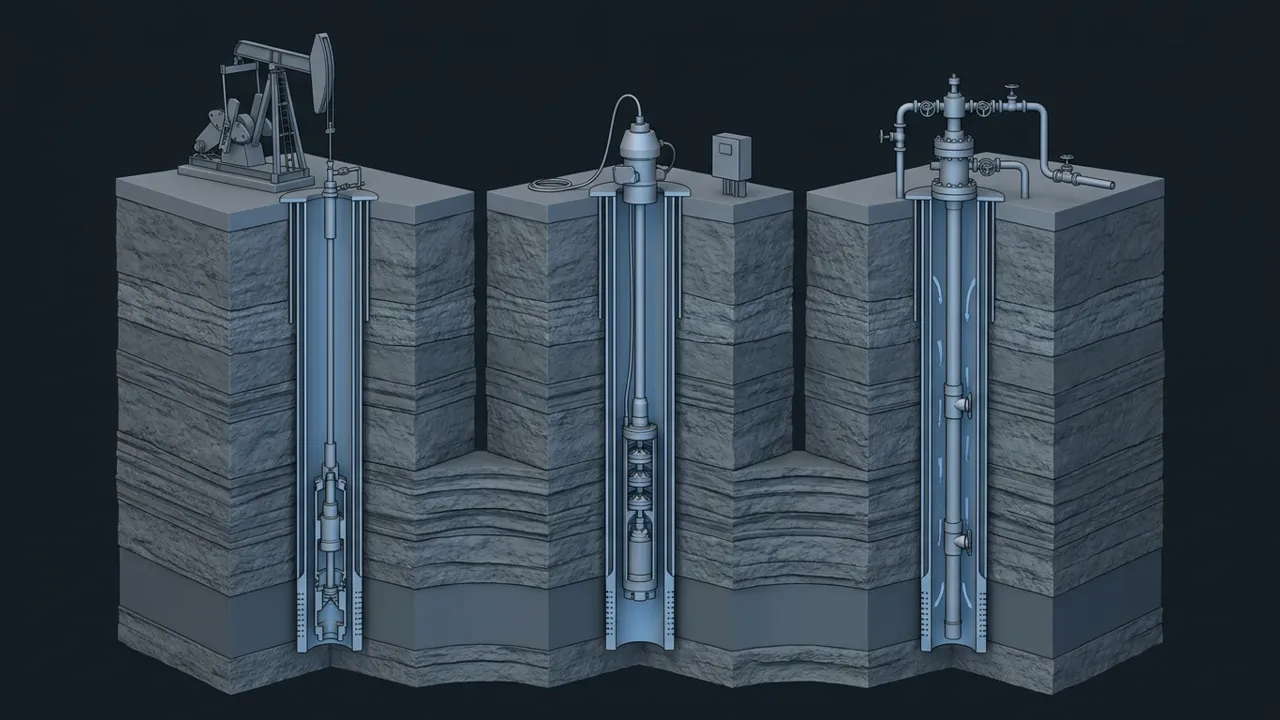
Every well slows down eventually. The pressure that pushed oil to surface on day one drops, water comes in, and one morning the well that used to flow on its own is barely making anything. It just needs help getting up the hole. Artificial lift systems provide that help. The question is which one, because the wrong choice costs money every single day. How do you choose the right artificial lift system for a well?
You choose an artificial lift system by matching the well's rate, depth, gas, sand, fluid type and deviation to the lift method that handles those conditions best at the lowest long-term cost. Rod pumps (pump jacks) suit low to moderate rates in shallower, fairly straight wells. Electric submersible pumps move large volumes of fluid but don't like gas or sand. Gas lift handles gas, sand and deviated wells well, as long as there's a gas supply and compression.
Progressing cavity pumps handle heavy, sandy oil, jet pumps have no moving parts downhole, and plunger lift keeps gas wells from loading up with liquid. Most wells change lift types over their life as rates fall.
When Is Artificial Lift Needed?
Artificial lift is needed when reservoir pressure can no longer push fluid to surface at a useful rate. That happens to almost every oil well sooner or later, and to many gas wells too.
Here are the signs a well is heading that way:
- Flowing tubing pressure keeps dropping.
- Production comes in heads or slugs instead of a steady stream.
- Water cut is rising, making the fluid column heavier.
- The well dies after a shut-in and won't come back on its own.
- Gas wells start loading up, with liquid building in the tubing and choking off gas flow.
Some wells need lift from day one. Shallow, low-pressure oil fields and heavy oil wells often never flow naturally at all. Many shale wells flow hard at first and need lift within months, as the early flush production falls off.
What Are the Types of Artificial Lift?
There are two big families. Pumps add energy to the fluid with mechanical or electric power. Gas-based methods lighten the fluid column so reservoir pressure can push it up. Here are the main types of artificial lift side by side.
| Lift type | How it works | Strong points | Weak points |
|---|---|---|---|
| Rod pump (beam pump) | Surface unit strokes a rod string that drives a plunger pump downhole | Simple, well understood, efficient at low rates, can pump wells down to low pressure | Limited by depth and rate, rod wear in deviated wells, gas interference |
| Electric submersible pump (ESP) | Downhole electric motor drives a multi-stage centrifugal pump | Very high volume, works in deep wells | Sensitive to gas, sand and heat; costly to pull and replace |
| Gas lift | High-pressure gas injected into the tubing lightens the fluid | Handles sand, gas and deviated wells; few moving parts downhole | Needs a gas supply and compression; can't pump wells down as low |
| Progressing cavity pump (PCP) | Rotating helical rotor inside a rubber stator moves fluid up | Good with heavy oil and sand, efficient | Stator rubber limited by heat and some chemicals |
| Hydraulic jet pump | Power fluid pumped down speeds through a nozzle and drags well fluid up | No moving downhole parts, handles deviated wells, easy to swap | Lower efficiency, needs surface power fluid system |
| Plunger lift | A free plunger travels up and down the tubing, carrying liquid slugs up using the well's own gas | Very low cost, no outside power, great for liquid-loaded gas wells | Only works with enough gas; low liquid volumes |
The SLB glossary has short entries on sucker rod pumps and the other methods if you want formal definitions.
Why Are Rod Pumps So Common?
Rod pumps are the classic oilfield picture: a walking beam nodding up and down out in a pasture. They're everywhere onshore because they're simple, tough and cheap to keep running. A good pumper can diagnose a lot of problems from a dynamometer card and the sound of the unit.
A rod pump can also pump a well down to a very low fluid level, which means it pulls the most oil out of low-pressure reservoirs. That's a big reason older fields still run them.
The limits show up in deep wells, high-rate wells and wells with a lot of bends, where rods rub and wear the tubing. If you want the step-by-step on how the unit and downhole pump work together, the pump jack article walks through it.
When Does an ESP Make Sense?
An electric submersible pump makes sense when the well can deliver a lot of fluid and you need to move it fast. High-rate oil wells and wells with very high water cut are classic ESP candidates.
The catch is that ESPs are fussy. Free gas causes the pump to lose efficiency or gas lock. Sand erodes the stages. Heat breaks down the motor and cable insulation over time. And when an ESP fails, a rig has to pull the whole string, which is expensive.
Gas separators, sand-handling stages and variable speed drives help a lot. Still, an ESP is only as good as the well data it was designed from.
Why Choose Gas Lift?
Gas lift wins when the well has gas, sand or a tricky wellbore. Injection gas goes down the annulus and enters the tubing through valves, lightening the fluid so the reservoir can push it up.
The downhole hardware has very few moving parts, and the valves can be changed with slickline. That makes gas lift a favorite offshore and on deviated wells. The trade-off is surface infrastructure: you need a gas source and compression, which is only worth it when several wells share the system.
Where Do PCPs, Jet Pumps and Plunger Lift Fit?
These three get less press than rod pumps and ESPs, but each one solves a problem the big names struggle with.

Progressing cavity pumps
A PCP has a steel rotor shaped like a twisted corkscrew turning inside a rubber stator. As it turns, sealed cavities form and move upward, carrying fluid with them. It's usually driven by a rod string turned by a motor at surface, though bottom-drive versions with downhole motors exist.
PCPs shine in heavy, viscous oil and sandy wells, where a plunger pump would stick or wear out. Their weak spot is the stator rubber. High heat, aromatic crude and some treatment chemicals can swell or crack it, so the elastomer has to be matched to the fluid.
Hydraulic jet pumps
A jet pump uses a surface pump to send power fluid (often produced oil or water) down the tubing. The fluid speeds through a nozzle, creates low pressure and drags well fluid along with it into a throat and up the annulus or a return path.
With no moving parts downhole, jet pumps tolerate sand, gas and crooked holes well. Many designs can be circulated in and out without a rig. They're less efficient than other pumps, so they often show up as a flexible solution during flowback or testing.
Plunger lift
Plunger lift is for gas wells that are loading up with liquid. The well is shut in so pressure builds, then opened so the plunger rises and pushes a slug of liquid ahead of it. When flow drops, the plunger falls back and the cycle repeats. It runs on the well's own energy, with a small controller at surface timing the cycles.
How Do You Pick the Right Lift for a Well?
Think of it as a checklist. Answer these questions about the well, and most options sort themselves out:
- What rate do you need? Low rates point to rod pumps, PCPs or plunger lift. High rates point to ESPs or gas lift.
- How deep is it? Very deep wells push rod pumps to their limits.
- How much gas is there? Gassy wells favor gas lift or plunger lift. They give ESPs and rod pumps trouble.
- Is there sand? Sand favors PCPs, gas lift or jet pumps.
- Is the oil heavy? Heavy, viscous oil favors PCPs and rod pumps.
- How crooked is the wellbore? Deviated and horizontal wells are hard on rods.
- What's on location? Power lines, gas supply, space and access all matter.
- Who will run it? Simple systems are easier to keep up in remote fields.
Then look at total cost over the life of the well, not just the install price. A cheap system that fails every few months is not cheap.
Do Artificial Lift Systems Change Over a Well's Life?
Yes, and that's normal. A typical shale oil well might flow naturally at first, go to gas lift or an ESP while rates are high, then switch to a rod pump when rates drop. Some gas wells end their lives on plunger lift.
Planning for that path saves money. Choosing a casing size and completion design that leaves room for future lift equipment avoids a lot of headaches later.
How Do You Know the Lift System Is Working?
You watch the data, and you watch it often. Modern lift systems feed a lot of information to the field office, and the problems usually show up there before they show up as lost production.
- Rod pumps: dynamometer cards show how the pump is filling and whether rods, valves or gas are acting up.
- ESPs: motor amps, intake pressure and temperature tell you if the pump is gassing, pumping off or wearing.
- Gas lift: injection pressure and rate, plus tubing pressure, show which valve is working and whether gas is being wasted.
- All wells: fluid level shots and well tests confirm the lift is pulling the well down as far as it should.
A sudden change is your cue to dig in. A slow drift deserves a look too, because it's often the first sign of wear.
What Are Common Artificial Lift Problems?
Here's the troubleshooter's short list. Each one has its own fix, and your production engineer or lease operator decides the plan.
- Gas interference or gas locking. The pump fills with gas instead of liquid. Look at gas separators, pump setting depth and venting the annulus.
- Sand and solids. Erosion and stuck pumps. Consider sand screens, sand-tolerant pumps or a change in lift method.
- Scale, paraffin and corrosion. Buildup or metal loss that chokes flow and wears parts. Chemical treatment programs help.
- Pumped-off conditions. The pump runs faster than the well can feed it. Pump-off controllers and variable speed drives fix this.
- Rod and tubing wear. Common in crooked wells. Rod guides and better spacing help.
- Power and surface failures. Motors, drives, compressors and belts. Routine checks catch most of them.
A classic mistake: replacing a failed pump with the same pump without asking why it failed. Pull it, inspect it and find the cause. Otherwise you'll be back in a few months doing the same job.
Which Artificial Lift System Is Right for Your Well?
The right artificial lift system is the one that matches your well's rate, depth, gas, sand and wellbore shape at the lowest total cost. Rod pumps rule low-rate onshore wells, ESPs move big volumes, gas lift handles gas and crooked holes, PCPs handle heavy oil, jet pumps keep downhole parts simple and plunger lift rescues loaded gas wells.
No method is perfect, and most wells use more than one over their life. Good well data and an honest look at operating costs make the decision easier.
If you're looking at a well that's slowing down, start by gathering the numbers: rates, pressures, fluid levels, gas and sand. The right choice usually follows from there.