What Is Coiled Tubing? – CT Units, Snubbing and CT Drilling

Picture a giant spool of steel pipe on a trailer, thousands of feet of it, feeding straight down into a well without a single threaded connection. That is coiled tubing, and it has quietly become one of the most useful tools in the oilfield. It shows up after frac jobs, on old wells that need cleaning and even on some drilling jobs. So what is coiled tubing, and what do coiled tubing units actually do?
Coiled tubing is a long, continuous length of steel pipe wound on a large reel, and coiled tubing units are the trailer- or skid-mounted rigs that run it into and out of wells. Because the pipe has no joints, a unit can run it into a live, pressured well quickly without stopping to make connections. Crews use it to clean out sand and fill, pump acid and nitrogen, mill out frac plugs, run logging tools, fish small objects and sometimes drill. Coiled tubing is often faster and cheaper than a workover rig for jobs that can be done through existing tubing.
How Do Coiled Tubing Units Work?
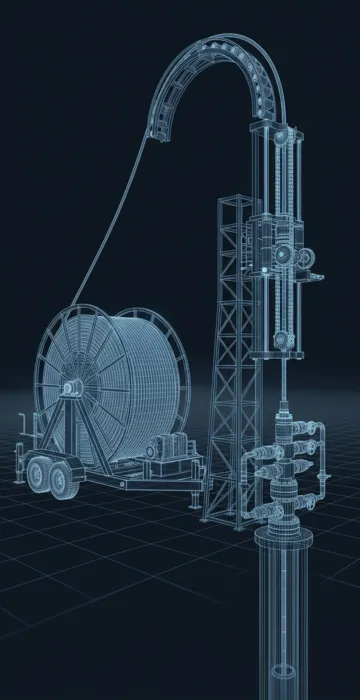
Coiled tubing units work by uncoiling the pipe off a reel, straightening it over a curved guide and pushing it down through a set of seals into the well. The injector head does the pushing and pulling. It uses opposing chains fitted with gripper blocks that clamp the tubing and move it up or down.
The main components are:
- Reel: stores the tubing and feeds it out or spools it back.
- Gooseneck or guide arch: bends the tubing from the reel into a straight line over the well.
- Injector head: grips and drives the tubing in or out of the well.
- Stripper (pack-off): seals around the moving tubing to hold well pressure.
- BOP stack: rams that can grip, seal, cut or close around the tubing in an emergency.
- Control cab: where the operator runs the unit and watches weight, depth and pressure.
- Power pack: a diesel-driven hydraulic system that powers everything.
Fluid can be pumped down the inside of the tubing the whole time. That is one of coiled tubing's big advantages. You can circulate while running in, which is ideal for cleanouts and treatments.
For a short technical definition, the SLB Energy Glossary entry on coiled tubing is reliable.
What Sizes Does Coiled Tubing Come In?
Coiled tubing is commonly made in outside diameters from around 1 inch to a little under 3 inches, with larger sizes available for some jobs. Wall thickness and steel grade vary depending on the pressure and load the job needs.
Larger diameters pump more fluid and push harder, but they are heavier, need bigger reels and wear faster when bent. Very long horizontal wells have pushed the industry toward larger and stronger strings, because the tubing has to reach the toe of a long lateral without buckling up against the wellbore.
What Is Coiled Tubing Used For?
Coiled tubing is used for a long list of well intervention jobs. The most common include:
- Drilling out frac plugs after plug-and-perf completions.
- Cleaning out sand, proppant and debris from the wellbore.
- Nitrogen lifting to unload fluid and kick off a well that will not flow on its own.
- Pumping acid or other treatments at a specific depth.
- Running logging tools in horizontal wells where wireline cannot go by gravity.
- Setting plugs and packers.
- Fishing for small items or light junk.
- Cementing, including setting cement plugs during abandonment.
In shale plays, drilling out plugs after the frac is a huge share of the work. A long lateral can have dozens of plugs to mill, and coiled tubing does it without having to kill the well.
How Does a Typical Coiled Tubing Job Go?
Take a plug drill-out after a frac as an example. The details change by company and well, but the outline is similar.
- Rig up the unit, crane, pump and pressure control stack on the wellhead.
- Pressure test the stack and lines before the well is opened.
- Make up the bottomhole assembly, usually a motor and mill, plus check valves and a disconnect.
- Run in hole while pumping, watching weight and pressure for signs of trouble.
- Tag each plug, mill it up and circulate the debris out to surface.
- Make wiper trips as needed to sweep cuttings and sand out of the lateral.
- Pull out of hole, rig down and hand the well over to flowback.
The operator watches the weight indicator closely the whole time. A sudden loss of weight can mean the tubing is buckling or stuck. Catching that early is the difference between a routine job and a fishing job.
What Is Coiled Tubing Drilling?
Coiled tubing drilling uses the coiled string in place of jointed drill pipe. A downhole mud motor turns the bit, since the coiled tubing itself cannot rotate. Directional tools at the bottom steer the hole.
It has some real advantages. Because there are no connections to make, crews can trip quickly and keep circulating. Coiled tubing also handles underbalanced drilling well, where the well is kept at lower pressure than the formation to limit damage to the rock. And it shines for re-entry work, like drilling short sidetracks out of existing wells.
It has limits, too. Coiled tubing cannot rotate, has less weight and torque capacity than drill pipe and is limited in hole size. The way I see it, CT drilling is an excellent specialty tool, not a replacement for a drilling rig on most new wells.
What Is Snubbing, and How Is It Different?
Snubbing is running jointed pipe into or out of a well while it is under pressure. A snubbing unit uses hydraulic jacks and slips to force pipe in against the well pressure that wants to push it out. Seals and BOPs hold the pressure while each joint is handled.
A hydraulic workover unit is closely related. It uses the same hydraulic jacking system for workover jobs, whether the well is live or dead. Many people use "snubbing unit" and "hydraulic workover unit" almost interchangeably.
Coiled Tubing vs Snubbing: When Does Each Fit?
| Factor | Coiled tubing | Snubbing / hydraulic workover |
|---|---|---|
| Pipe | Continuous, no connections | Jointed pipe |
| Speed | Fast trips | Slower, joint by joint |
| Rotation | No (uses mud motor) | Yes, with rotary or power swivel |
| Strength | Lower pull and push limits | Higher pull, push and torque |
| Live well work | Yes | Yes |
If the job needs heavy pulling, rotation or larger pipe in a live well, snubbing often wins. If the job needs speed and continuous circulation, coiled tubing usually does.
What Are the Limits of Coiled Tubing?
The biggest limit is fatigue. Every time tubing goes on and off the reel and over the gooseneck, it bends past its elastic limit. That adds up. Operators track each string's fatigue life with software and retire or cut sections before they fail.
Other limits include:
- Reach in long laterals, where friction can cause the tubing to buckle and lock up before reaching the toe.
- Pressure ratings, which depend on tubing size and wall thickness.
- Limited pull strength compared with jointed pipe.
- Transport, since a full reel can be very heavy and some roads limit what can be hauled.
Engineers use friction reducers, extended-reach tools and larger tubing to stretch reach. Even so, some very long laterals push the limits of what coiled tubing can do.
Is Coiled Tubing Work Dangerous?
Like all well intervention, coiled tubing work involves high pressure, heavy equipment and flammable fluids. A tubing failure at surface can release pressure and whip the pipe. Crews keep a careful exclusion zone and follow procedures for pressure testing and well control.
The pressure control stack is the key safety barrier. It is pressure tested before every job, and the crew knows exactly which rams to close in an emergency.
Where Does Coiled Tubing Fit in a Well's Life?
Coiled tubing shows up at almost every stage after drilling. It helps finish completions by milling plugs and cleaning out. It keeps wells producing with cleanouts, acid jobs and nitrogen lifts. At the end, it can help with well abandonment by setting cement plugs through existing tubing in some wells.
What Is Coiled Tubing Good For?
Coiled tubing is a continuous steel pipe on a reel, and coiled tubing units let crews run it into live wells fast. It is the go-to tool for plug drill-outs, cleanouts, nitrogen lifts, acid jobs and logging horizontal wells. CT drilling and snubbing fill niches where its strengths or weaknesses matter.
If you are choosing between coiled tubing, snubbing and a workover rig, start with the job. Ask whether it needs rotation, heavy pull or tubing removed. If not, coiled tubing is often the quickest path.