HDD vs. Oilfield Directional Drilling – What's the Difference?
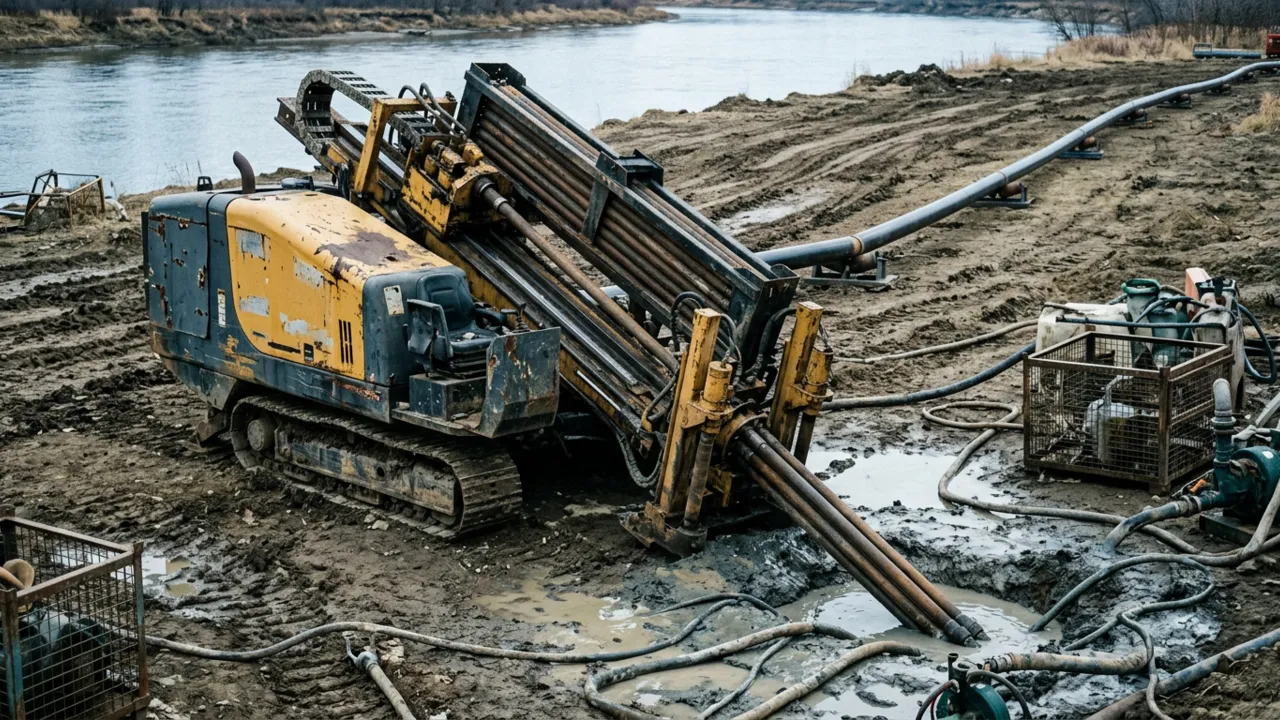
Search for "directional drilling" and you'll get two very different pictures. One shows a compact rig on a tilted frame, boring under a highway to pull a pipeline through. The other shows a tall drilling rig steering a well two miles down and sideways into an oil reservoir. Both use the word "directional," and both steer a bit underground, so people mix them up all the time. What's the difference between horizontal directional drilling and oilfield directional drilling?
Horizontal directional drilling (HDD) is a trenchless construction method that bores a shallow, curved path under an obstacle like a river or road and then pulls pipe or cable back through it, while oilfield directional drilling steers a deep well away from vertical to reach an oil or gas target. An HDD bore starts at the surface on one side and comes back out at the surface on the other. An oil well ends deep underground, often thousands of feet down, while HDD usually works within a few hundred feet of the surface. They share some tools, but they are separate industries with different rigs and goals.
What Is HDD?
HDD is a way to install underground pipe, conduit or cable without digging an open trench. It's used heavily for pipeline and utility boring, especially where a trench would be impossible or harmful, such as under rivers, wetlands, highways, railroads and busy city streets.
An HDD job usually happens in three stages:
- Pilot hole: a small-diameter bore is steered along a planned curve from the entry point to the exit point.
- Reaming: one or more reamers enlarge the hole, usually by pulling them back through the pilot hole.
- Pullback: the product pipe, often welded steel or fused plastic, is attached behind a reamer and pulled back through the finished hole.
The cleanest way to say it: in HDD, the hole is a tunnel with two ends. In oilfield drilling, the hole is a well with one end.
What Does an HDD Rig Look Like?
An HDD rig is laid out nearly flat on the ground rather than standing up tall. The drill pipe is pushed in at a shallow entry angle, often somewhere around 8 to 20 degrees from horizontal. The rig has a carriage that slides along a ramp, pushing and rotating the pipe going in and pulling hard during pullback.
HDD rigs are often rated by thrust and pullback force. They range from small units that bore short utility crossings for fiber or water lines up to very large rigs that pull big-diameter pipelines under major rivers. Each job also needs a mud mixing and recycling system, because HDD relies on drilling fluid just like oil wells do.
How Is an HDD Bore Steered?
For short, shallow bores, a common setup uses a slanted or "duck-bill" bit with a transmitter behind it. A crew member walks the surface with a locator that reads the tool's depth, pitch and direction. To steer, the operator stops rotating, points the slanted face in the needed direction and pushes. To go straight, the bit is rotated continuously.
For longer and deeper crossings, where a walkover locator can't reach or the surface is a river, HDD crews use wire-line or other steering tools that send survey data back to the rig, sometimes with a surface coil grid to improve accuracy. In hard rock, they often add a mud motor to turn the bit, which is the same basic tool used in oil wells.
How Is Oilfield Directional Drilling Different?
Oilfield directional drilling is the deliberate steering of an oil or gas well along a planned path. The rig stands vertically over the well, and the hole usually starts straight down. At a planned kickoff point, the directional driller begins building angle, then may hold angle, turn, or go fully horizontal through the reservoir.
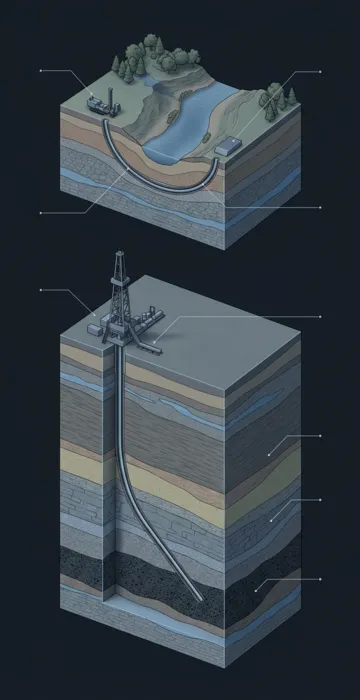
The goals are different from HDD. Oil wells are steered to:
- Stay inside a thin reservoir layer for thousands of feet (horizontal wells).
- Reach targets that are offset from the surface location, such as under a town or offshore from land.
- Drill many wells from one pad or platform.
- Sidetrack around stuck pipe or junk.
- Intersect another well, as with a relief well.
Steering downhole relies on measurement-while-drilling (MWD) tools that send surveys up through the mud, plus either a bent-housing mud motor or a rotary steerable system. If you want to see how those two steering tools compare, our article on rotary steerable systems versus mud motors walks through the trade-offs.
HDD vs Oilfield Directional Drilling at a Glance
| Feature | HDD | Oilfield directional drilling |
|---|---|---|
| Purpose | Install pipe, conduit or cable under an obstacle | Reach oil or gas reservoirs |
| Path | Surface to surface, shallow curve | Surface to underground target |
| Typical depth | Tens to a few hundred feet | Thousands of feet |
| Rig position | Inclined, near ground level | Vertical mast or derrick |
| Final product | Pipe pulled back through the bore | Casing cemented in a well |
| Steering | Walkover locator or wire-line guidance; slanted bit or motor | MWD with mud motor or rotary steerable |
| Pressure control | Low formation pressures; no BOP in most jobs | Well control and BOPs required |
| Industry | Construction, utilities, pipelines | Oil and gas exploration and production |
Is Horizontal Drilling the Same as HDD?
No, and this is the most common mix-up. In the oil industry, "horizontal drilling" means an oil or gas well that turns sideways to run along a reservoir, often a shale layer, for a long distance. It's a type of oilfield directional drilling. HDD is a construction method. The overlap in names is mostly an accident of language.
One quick way to tell them apart in conversation is to ask where the hole ends. If it pops back out of the ground, it's HDD. If it ends in a reservoir and gets cased, cemented and completed, it's an oil or gas well.
Do HDD and Oilfield Drilling Share Anything?
Quite a bit, actually. Both use drill pipe, drilling fluid to carry cuttings and stabilize the hole, and downhole steering. Both plan curves using radius of curvature and both watch closely for the hole getting off line. Some HDD tools, especially mud motors and survey tools, came over from the oil patch. People with oilfield experience often find HDD work familiar, and the reverse is partly true too.
Horizontal Directional Drilling vs Oilfield Directional: Two Holes, Two Goals
Horizontal directional drilling is a trenchless way to put pipe under something, boring a shallow curve from one side to the other and pulling pipe back through. Oilfield directional drilling steers a deep well to a target in the rock. They share tools and ideas, but not purpose, depth or equipment.
So next time you see "directional drilling" in a job post or a news story, check whether the hole comes back to the surface. That one detail tells you which world you're reading about.