How Are Oil and Gas Formed?
Hold a jar of crude oil up to the light and it looks like nothing special: dark, thick and a little greenish at the edges. But what is in that jar started as living things in ancient seas, long before there were people to wonder about it. Ask kids in oil country how oil and gas are formed, and plenty will tell you dinosaurs. The real story is stranger and, I think, more beautiful. How are oil and gas formed?
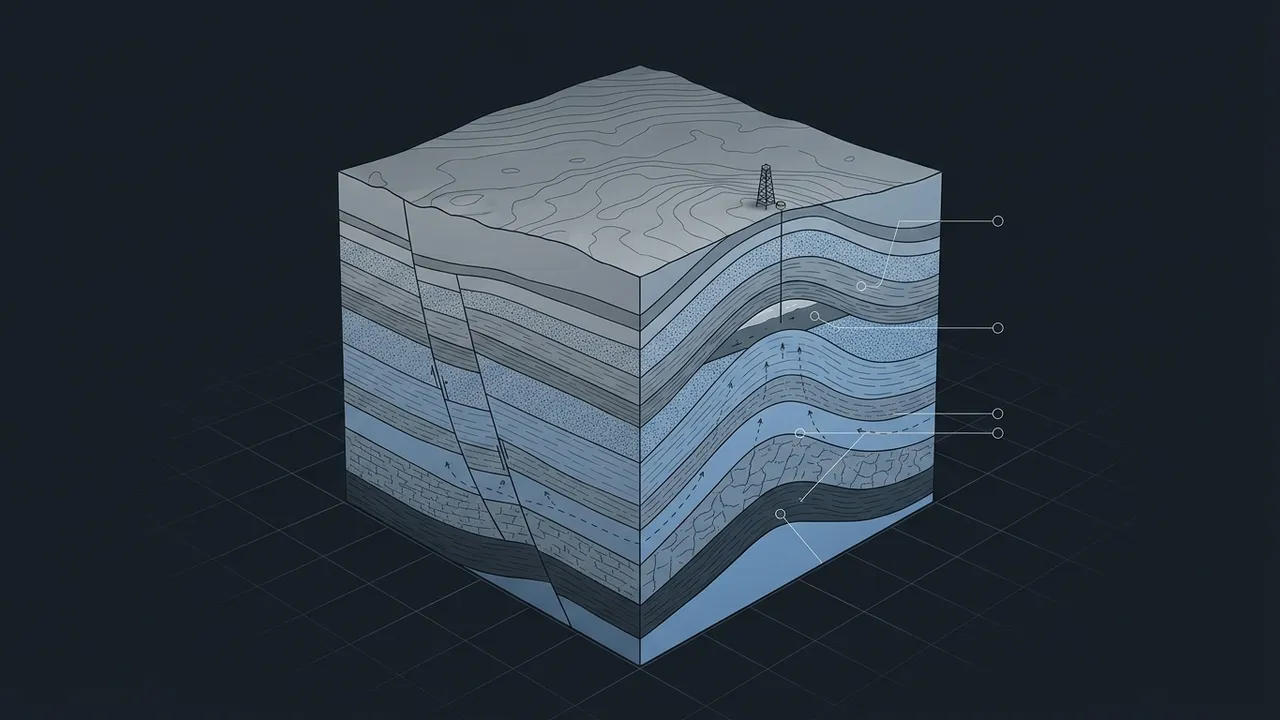
Oil and gas are formed from the remains of tiny ancient organisms, mostly plankton and algae, that were buried in low-oxygen mud and slowly changed by heat and pressure over millions of years. As sediment piled up, the organic material turned into a waxy substance called kerogen inside fine-grained source rocks. When the source rock got deep and hot enough, the kerogen "cooked" into oil and, at higher temperatures, natural gas. The fluids then migrated upward until an impermeable seal stopped them, collecting in reservoir rock within a trap. Source, reservoir, seal and trap: that is what explorers look for.
Does Oil Really Come From Dinosaurs?
Mostly, no. It is a popular idea, helped along by cartoon dinosaurs on gas station signs, but the bulk of the world's oil comes from microscopic marine life. Plankton and algae lived in vast numbers in ancient oceans and lakes, and when they died, their remains drifted to the bottom.
Land plants also contribute, especially to natural gas and coal. Dinosaurs and other large animals made up a tiny share of buried organic matter. They are part of the same deep time, but they are not the main ingredient.
How Oil and Gas Are Formed, Step by Step
The process takes place over millions of years, but it follows a clear sequence.
- Organic matter accumulates. Plankton, algae and other organisms die and settle on the floor of a sea or lake.
- It is buried quickly in low-oxygen conditions. Fine mud covers it before it can fully decay. Low oxygen is key, because oxygen lets bacteria break organic matter down completely.
- Kerogen forms. As more sediment piles on, the mud turns into rock, usually shale, and the organic matter becomes kerogen.
- Heat cooks the kerogen. With deeper burial, temperatures rise. In the right range, kerogen breaks down into liquid oil. Hotter still, it breaks down into natural gas.
- Oil and gas migrate. Because they are lighter than the water in the rock, they move upward through cracks and porous layers.
- They are trapped. If they meet a seal, such as a layer of tight shale or salt, they collect in porous rock beneath it, forming a reservoir.
If any step fails, there is no oil field. The organic matter might decay, the rock might never get hot enough, or the oil might leak all the way to the surface.
What Is a Source Rock?
A source rock is the rock where oil and gas are born. It is usually a dark, fine-grained shale or limestone that contains enough organic material to generate hydrocarbons when heated.
Not all source rocks are equal. Rocks rich in marine algae and plankton tend to generate oil. Rocks rich in woody land plant material tend to generate gas. Geologists measure how much organic carbon a rock holds and how "mature" it is, meaning how far it has been cooked.
Shale oil and shale gas plays, like those in the Permian Basin or the Marcellus, are often wells drilled directly into source rock. Instead of waiting for the oil to migrate, operators use horizontal drilling and hydraulic fracturing to produce it from where it formed.
What Is the Oil Window?
The oil window is the temperature range where kerogen turns mainly into oil. It is often described as roughly 60 to 120 degrees Celsius (about 140 to 250 degrees Fahrenheit), though the exact range depends on the type of kerogen and how long the rock stays at that temperature.
Above the oil window is the gas window, where heat breaks down kerogen and any remaining oil into natural gas. Rocks that are buried too deep or for too long can become "overcooked," leaving mostly gas or nothing useful at all.
Some natural gas forms a different way. Near the surface, microbes break down organic matter and produce methane. This biogenic gas is found in shallow sediments, landfills and swamps.
How Long Does Oil Take to Form?
Oil takes millions of years to form, and many of the world's oil fields come from source rocks that are tens of millions to hundreds of millions of years old. Burial, heating, generation and migration all happen slowly, on geological timescales.
That is why oil and gas are called nonrenewable. New oil is likely still forming in some basins today, but far too slowly to replace what people use. On a human timescale, the oil in the ground is all there is.
I find that humbling. Every tank of gas holds sunlight captured by tiny organisms long before anyone walked the earth.
What Are Reservoir Rock and a Trap?
Oil and gas only become useful when they collect in one place in large amounts. That takes three things working together.

Reservoir Rock
A reservoir rock has pore spaces to hold oil and gas (porosity) and connected pores that let fluids flow (permeability). Sandstones and carbonates such as limestone and dolomite are the most common reservoir rocks.
Seal or Cap Rock
A seal is an impermeable layer above the reservoir that keeps oil and gas from escaping upward. Shale, tight limestone and salt are common seals.
Trap
A trap is the shape or arrangement of rocks that lets oil and gas collect. Common types include:
- Anticlines: rock layers folded into an arch, where oil and gas rise to the top.
- Fault traps: where a fault moves rock layers so a reservoir is sealed against tight rock.
- Salt domes: where rising salt pushes up and seals surrounding layers. Spindletop in Texas was a famous salt dome field.
- Stratigraphic traps: where the reservoir rock itself changes or pinches out into tighter rock.
Inside a trap, the fluids separate by density. Gas sits on top, oil in the middle and water at the bottom.
Why Doesn't All Oil Stay Underground?
A large share of the oil and gas ever generated never ends up in a reservoir. Some is lost along migration paths, some is destroyed by heat or bacteria, and some reaches the surface. Natural oil seeps, where oil leaks onto land or into the sea, have been known for thousands of years. Early oil explorers often looked for seeps as a sign of what lay below.
That is part of why finding oil is difficult. A basin needs the right source rock, the right burial history, the right reservoir and seal, and the right timing, with the trap forming before the oil migrates past. Modern oil and gas exploration uses seismic surveys, well data and computer models to judge whether all those pieces came together.
For more on the chemistry and origin of petroleum, the Britannica entry on petroleum is a reliable reference.
How Are Oil and Gas Formed? A Story Millions of Years Long
Oil and gas form from tiny ancient organisms buried in low-oxygen mud, turned into kerogen in source rocks, and cooked by heat into oil and gas over millions of years. Those fluids migrate upward until a seal stops them in a reservoir rock inside a trap.
Every working oil field is the result of all those steps lining up. That is why exploration is part science and part patience, and why each discovery feels like a small miracle to the people who make it.
Next time you see a pumpjack nodding in a pasture, think about where that oil started. It is a story much older than the field, the town or any of us.