Marine Drilling Riser – How It Connects the Rig to the Well
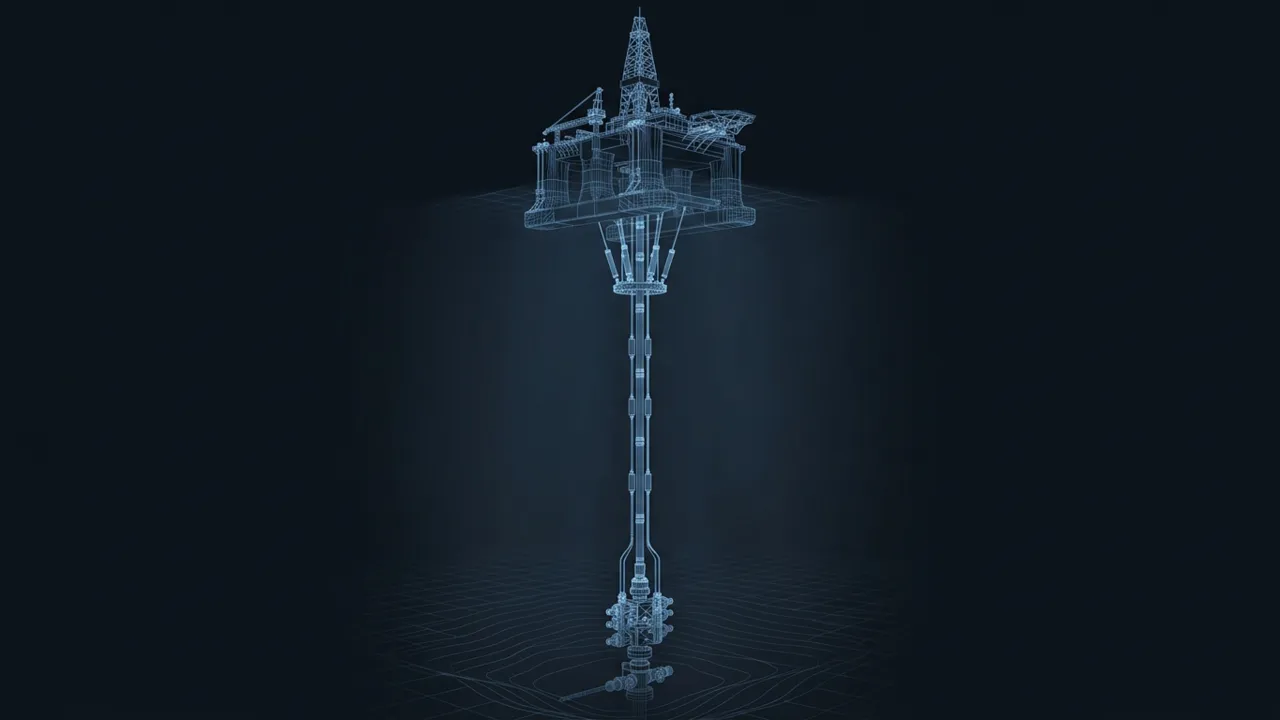
On a floating rig, there's a gap between the drill floor and the well that can be a few hundred feet or a couple of miles of open water. Something has to bridge it. Mud has to come back up, tools have to go down, and the whole thing has to cope with a rig that never stops moving. That something is the marine riser. So what is a marine riser, and how does it connect the rig to the well?
A marine riser is a large-diameter pipe that runs from the subsea blowout preventer on the seafloor up to a floating drilling rig, giving drilling mud a return path and guiding the drill string to the well. It's built from heavy steel joints coupled end to end, usually wrapped in buoyancy modules to cut its weight in water. At the bottom, it connects to the BOP through the lower marine riser package, or LMRP. At the top, tensioners hold it up and a slip joint lets the rig heave without pulling on the stack. Choke and kill lines run along the outside.
What Does a Drilling Riser Actually Do?
A drilling riser does three main jobs. Everything else about its design supports one of these.
- It carries returning mud and cuttings from the well back up to the rig for cleaning and reuse.
- It guides the drill string, casing and tools down into the BOP and wellhead.
- It carries the external lines needed to control the well and operate the stack.
Without a riser, a floating rig can still drill the shallow top-hole sections, with returns spilling onto the seafloor. That's normal practice. But once the well needs weighted mud and a BOP, the riser has to be in place.
Rigzone has a clear overview of how drilling and production risers work if you want more background.
What Are the Main Parts of a Marine Riser?
Working from the seafloor up, here are the major components of a typical drilling riser system.
LMRP (Lower Marine Riser Package)
The LMRP sits on top of the lower BOP stack. It usually includes one or more annular preventers, the subsea control pods, a hydraulic connector that latches to the lower stack, and a flex joint. The key feature is that the LMRP can disconnect from the lower stack. In an emergency, the rig can unlatch and leave the lower BOP shutting in the well.
Lower Flex Joint
The flex joint lets the riser angle slightly where it meets the stack. Without it, rig movement would put huge bending loads on the wellhead. Crews watch the angle at this joint closely.
Riser Joints
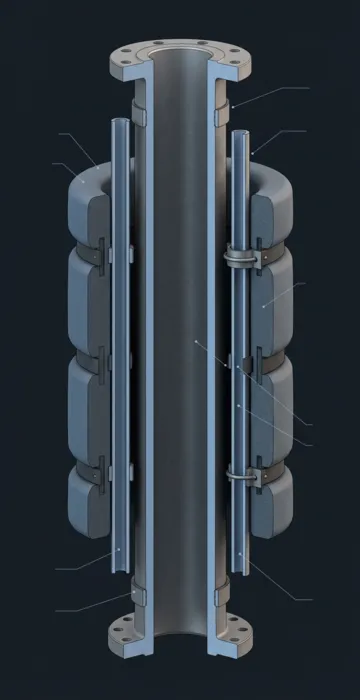
The riser string itself is made of individual joints, each a long section of heavy steel pipe with couplings at both ends. Many joints carry buoyancy modules made of syntactic foam, which make the riser much lighter in water. Some joints are left bare where currents or handling needs call for it.
Choke, Kill and Auxiliary Lines
Smaller pipes run along the outside of each joint. Choke and kill lines connect to the BOP for circulating out a kick. A booster line lets the rig pump extra mud into the bottom of the riser to help lift cuttings. Hydraulic lines may supply the BOP controls.
Telescopic (Slip) Joint
Near the top, a telescopic joint works like two pipes sliding inside each other. It lets the rig heave up and down with the swell while the riser below stays fixed in length.
Tensioners and Diverter
Riser tensioners on the rig hold a steady upward pull on the riser so it doesn't buckle under its own weight. At the very top, under the drill floor, a diverter can route gas away from the rig if it ever reaches the surface through the riser.
How Do Riser Tensioners Work?
Riser tensioners keep the riser in tension no matter how the rig moves. A riser in compression would bend and could fail, so tension is not optional.
Traditional systems use wire ropes running over sheaves to hydraulic cylinders backed by high-pressure air. As the rig heaves, the cylinders stroke in and out and the pull on the riser stays nearly constant. Newer rigs often use direct-acting tensioners, where cylinders connect straight to a tension ring on the riser.
How much tension is enough depends on water depth, mud weight, currents and the riser's own weight. Engineers run riser analysis before a well to set those numbers.
How Is a Marine Riser Run?
Running the riser means lowering the BOP stack to the seafloor while adding riser joints one at a time. The rig picks up a joint, makes up the coupling, tests the lines as required, and lowers the string another joint length.
In deep water, this takes days. Once the stack is near the wellhead, an ROV helps guide it into place, and the connector latches on. Then the BOP is tested before drilling continues.
Pulling the riser reverses the process. Weather windows matter, especially in areas with strong currents or hurricanes.
What Are the Biggest Riser Challenges?
A riser is a long, flexible column hanging in moving water. That brings a few persistent problems.
- Currents push the riser sideways and can cause vortex-induced vibration, which leads to fatigue. Fairings or strakes are sometimes added to reduce it.
- Rig offset increases the riser angle. Past set limits, operations stop, and at the extreme, the rig disconnects.
- Gas in the riser is a serious well control hazard because it expands fast as it rises.
- Wear and fatigue in joints and couplings require regular inspection.
Honestly, the riser doesn't get the attention the BOP does, but on a floating rig it's where a lot of the real engineering effort goes.
Drilling Riser vs Production Riser: What's the Difference?
A drilling riser is temporary. It connects a drilling rig to a subsea BOP while a well is drilled, then it's pulled and moved to the next well.
A production riser is long-term. It carries oil and gas from the seafloor up to a platform or floating production vessel, often for decades. Production risers can be rigid steel, flexible pipe or a hybrid, and they're part of the wider family of subsea production systems that move hydrocarbons from wells to the surface.
What Is a Marine Riser? The Rig's Lifeline to the Seafloor
A marine riser is the pipe that connects a floating rig to the subsea BOP. It carries mud back up, guides tools down, and holds the choke and kill lines that make well control possible.
It works because of a few clever pieces: buoyancy to cut weight, tensioners to keep it from buckling, a slip joint for heave, a flex joint for angle, and an LMRP that can disconnect when it has to.
If you're learning offshore systems, the next step is seeing what happens after drilling, when risers and subsea equipment start carrying production instead of mud.