Subsea Production Systems – Trees, Manifolds and Umbilicals
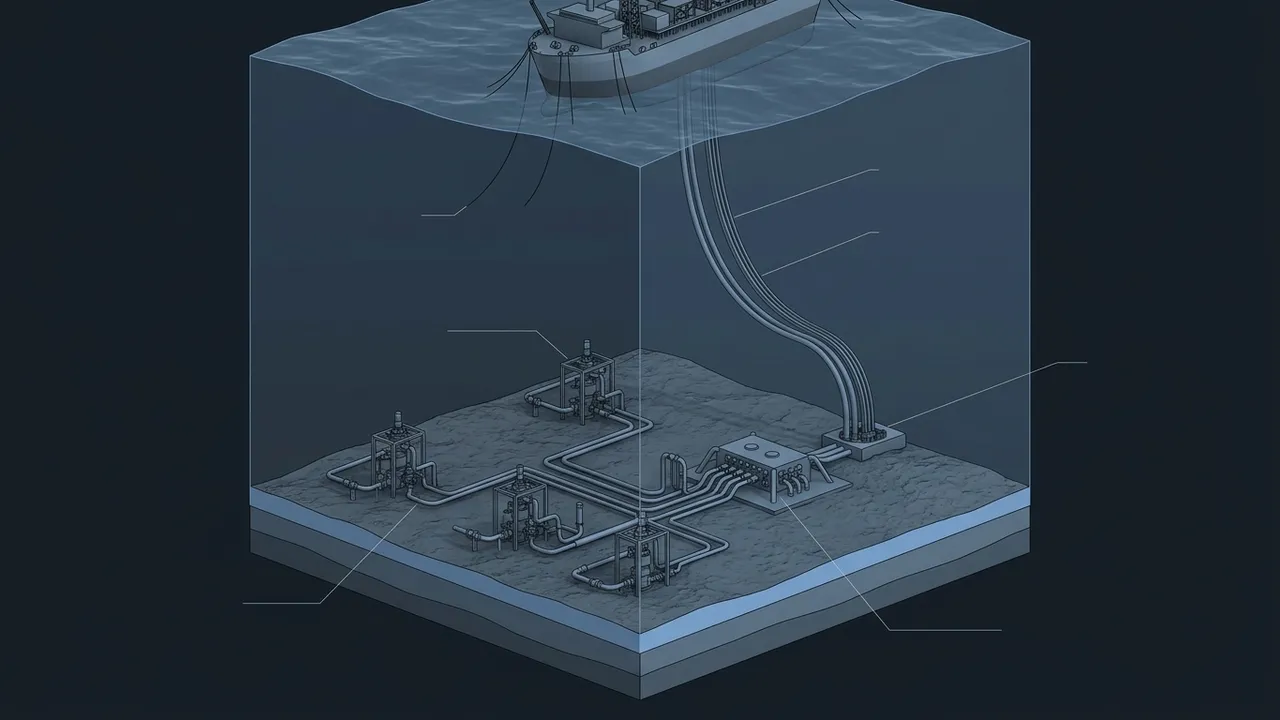
Most people picture offshore oil coming from a big platform with a flare stack. Increasingly, though, the wells aren't under the platform at all. They sit on the seafloor, sometimes many miles away, with no structure above them but open water. Oil and gas travel along the bottom through pipes and up to a host facility. It's a whole production plant that nobody ever walks through. So how do subsea production systems actually work, and what are all the pieces?
Subsea production systems are the wellheads, trees, manifolds, flowlines, umbilicals and controls that produce oil and gas from wells on the seafloor and send it to a host facility. Each well has a subsea tree that controls flow. Jumpers carry that flow to a manifold, which gathers production from several wells into larger flowlines. Those flowlines run along the seabed to a riser that lifts the fluids to a platform or floating production vessel. An umbilical from the host supplies power, hydraulic fluid, chemicals and communications so operators can control everything remotely.
What Are Subsea Production Systems Used For?
Subsea production systems let operators produce from wells without building a platform over each one. That's the core economic case.
In deep water, building a fixed or floating facility is expensive. If a field is small, or sits near an existing facility, it often makes more sense to put the wells on the seafloor and pipe the production to a host that's already there. In very deep fields, subsea wells around a single floating production vessel are common too.
Subsea production is a big part of offshore output worldwide, from the Gulf to the North Sea, Brazil and West Africa. The U.S. Energy Information Administration covers the bigger picture of offshore oil and gas production in federal waters.
What Are the Main Components of a Subsea System?
Here's the equipment you'll find in a typical subsea development, from the well outward.
| Component | What it does |
|---|---|
| Subsea wellhead | The pressure-containing base of the well, left in place after drilling |
| Subsea tree | Valve assembly that controls and shuts in flow from the well |
| Jumper | Short pipe spool that connects a tree to a manifold or flowline |
| Manifold | Gathers flow from several wells and routes it to flowlines |
| PLET / PLEM | Pipeline end terminations that connect flowlines to other equipment |
| Flowlines | Pipelines along the seabed that carry production to the host |
| Umbilical | Bundle carrying hydraulics, power, chemicals and signals from the host |
| Production riser | Lifts production from the seabed to the host facility |
| Control system | Topside and subsea controls that operate valves and read sensors |
Not every field has every piece. A single-well tieback might skip the manifold entirely and run a flowline straight from the tree.
What Does a Subsea Tree Do?
The tree is the control point for each well. It sits on the wellhead and contains valves that open, close and choke flow, plus connections for chemical injection and monitoring sensors.
A tree on the seafloor is often called a wet tree, as opposed to a dry tree that sits on a platform deck. Wet trees are operated remotely through the control system, with an ROV available for manual overrides and inspections. There's more detail on designs and valve layouts in the article on the subsea tree, including the difference between vertical and horizontal trees.
What Is a Subsea Manifold?
A subsea manifold is a steel structure full of pipes and valves that collects production from several wells and sends it on through one or more flowlines. Think of it as a gathering hub on the seafloor.
Manifolds let operators route individual wells to different flowlines, isolate a well, or send one well to a test line. They also reduce the number of long, expensive flowlines needed back to the host.
Some developments use a template instead, a single large frame that holds several wells and the manifold together. Others use a cluster layout, with wells spread around a central manifold and connected by jumpers.
What Is an Umbilical in Subsea Production?
An umbilical is a bundled cable that connects the host facility to the subsea equipment. It's the subsea system's nervous system and supply line.
A typical umbilical can carry:
- Hydraulic fluid to open and close valves on trees and manifolds
- Electrical power for control modules and sensors
- Communication signals, through copper or fiber optics
- Chemicals such as hydrate inhibitors, corrosion inhibitors and scale inhibitors
The umbilical ends at an umbilical termination assembly on the seafloor. From there, smaller flying leads distribute services to each tree and manifold. Each tree has a subsea control module that turns those signals and fluids into valve movements.
How Does a Subsea Tieback Work?
A subsea tieback connects new subsea wells to an existing host platform or floating production vessel. Production flows from the new wells, along the seabed, and into the host's processing equipment.
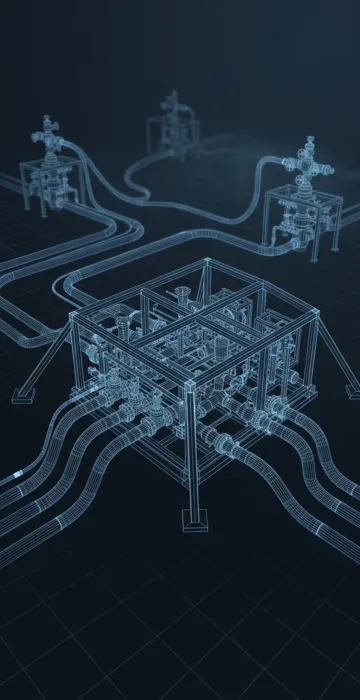
Here's the flow path, step by step:
- Oil, gas and water flow up the well and into the subsea tree.
- The tree's valves and choke control the rate.
- A jumper carries the flow to a manifold, or directly to a flowline.
- The manifold combines flow from several wells.
- Flowlines carry the mixed fluids across the seabed to the host.
- A production riser lifts the fluids up to the host facility.
- The host separates oil, gas and water and sends products to export pipelines or tankers.
Tiebacks can be short, a few miles, or very long, stretching tens of miles. Longer distances add cost and make it harder to keep fluids warm and flowing.
If you ask me, tiebacks are some of the smartest money spent offshore. They squeeze more value out of facilities that already exist, which usually makes the economics far better than starting from scratch.
Why Is Flow Assurance Such a Big Deal?
Flow assurance is the work of keeping fluids moving through long, cold subsea lines. It's often the hardest engineering problem in a subsea development.
Deep seawater is cold. As production cools on the way to the host, wax can deposit inside lines and hydrates can form. Hydrates are ice-like solids made of water and gas under pressure, and they can plug a flowline completely.
Operators fight these problems with insulated or heated flowlines, chemical injection through the umbilical, careful shutdown and restart procedures, and pigging to clean lines. Planning for flow assurance starts long before anything is built.
What Is Subsea Processing?
Subsea processing moves some of the host's work to the seafloor. That can include multiphase pumps that boost flow, separators that remove water near the wells, and in a few fields, gas compression.
The appeal is simple. Boosting or separating near the well can increase recovery and extend tieback distances. The catch is that equipment on the seabed is costly to install and hard to repair, so it has to be very reliable.
How Are Subsea Systems Maintained?
Nobody walks up to a subsea tree with a wrench. Routine inspection and many interventions are done with remotely operated vehicles launched from support vessels.
For well work, operators use intervention vessels or bring back a drilling rig. Components are designed to be retrievable where possible, so a failed control module can be swapped without pulling the whole tree.
Subsea Wells vs Platform Wells: What Are the Trade-Offs?
Subsea wells aren't automatically the better choice. They trade lower upfront facility cost for harder access later.
- Pros of subsea: no new platform needed, wells can be spread across a wide area, and small or remote fields become worth developing.
- Cons of subsea: well work requires a vessel or rig, which is costly, and repairs take longer to arrange.
- Pros of dry trees on a platform: easy, cheaper access for well maintenance and workovers.
- Cons of dry trees: the platform must sit right over the wells, and building one is a major expense.
Many large deepwater fields use both. Some wells sit under a platform with dry trees, while outlying wells are tied back subsea.
Subsea Production Systems: A Plant on the Seafloor, Run From Miles Away
Subsea production systems put the wellheads, trees, manifolds and flowlines on the seabed and control them through umbilicals from a host facility. Production flows from trees to manifolds to flowlines, then up risers to the host.
The benefit is flexibility. Operators can develop fields without building new platforms, and tie new wells into facilities that already exist.
If you want to understand the system from the well up, start with the tree. It's where the subsea system meets the reservoir, and every other piece depends on it.