What Happens Under an Oil Rig? – Legs, Jackets and Reefs

From a boat or a helicopter, an offshore platform looks like a small steel town on stilts. What you see above the water is only part of it. Below the surface, there's a structure as tall as a skyscraper in some cases, covered in life and anchored deep into the seabed. Most people never get to see an oil rig underwater, which is why the question comes up so often. So what actually happens under an oil rig?
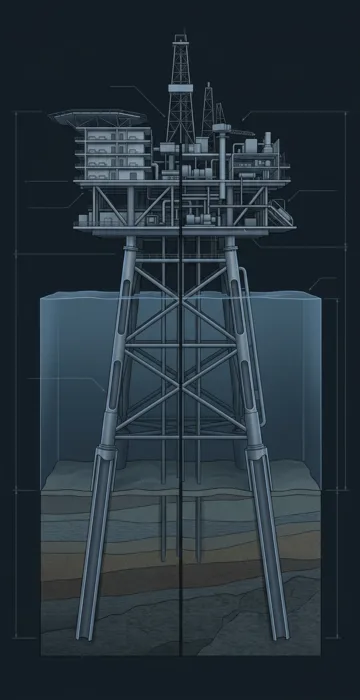
Under a typical fixed oil platform is a steel framework called a jacket, pinned to the seafloor by long piles, with well conductors and pipelines running down through it. Over time, that steel becomes covered in marine growth like barnacles, mussels, sponges and corals, and it attracts large numbers of fish. Floating rigs are different: underwater they show a hull or pontoons, mooring lines and risers, with the wells themselves sitting on the seafloor far below. When a platform reaches the end of its life, it's usually removed, but some are left partly in place as artificial reefs. Not everyone agrees that's the best outcome.
What Does an Oil Rig Underwater Look Like?
For a fixed platform, the underwater part is the foundation that holds everything up. It's usually made of three main pieces.
- The jacket: a tall steel lattice of legs and braces that reaches from the seafloor to just above the waves.
- Piles: steel pipes driven deep into the seabed through or alongside the jacket legs to lock it in place.
- Conductors: large pipes running from the deck down into the seabed, one for each well, protecting the wells near the surface.
You'll also find risers and pipelines connecting the platform to the seafloor network, plus sacrificial anodes bolted on to slow corrosion. The deck and production equipment sit on top of the jacket, high enough to stay clear of storm waves.
In shallow water, a jacket might be modest in size. In deeper water, some fixed platforms stand in more than a thousand feet of water, with most of their height hidden below the surface.
What Is a Platform Jacket?
A platform jacket is the welded steel frame that supports an offshore platform. It gets its name because it's slipped over the piles like a jacket: the piles are driven through its legs or through sleeves on its sides.
Jackets are built on land, then carried out on a barge and either lifted into place or launched off the barge and tipped upright. Once they're on bottom, piles are driven to fix them to the seabed. Then the deck is installed on top.
The lattice design is deliberate. Open bracing lets waves and currents pass through instead of pushing against a solid wall, which keeps loads manageable in storms.
What Does a Floating Rig Look Like Underwater?
Floating rigs and platforms don't have jackets. Underwater, you'd see the submerged part of the hull, the mooring lines spreading away to anchors, and the risers dropping toward the seafloor.
A semisubmersible shows its columns and pontoons. A spar is a giant vertical cylinder that extends far below the surface. A tension leg platform is held down by taut steel tendons anchored to the seabed.
The wells for these floaters often sit on the seafloor thousands of feet below, with subsea trees and pipelines in place of a jacket. If you want to see how wells get drilled in the first place, here's how offshore drilling works from rig positioning to riser.
Why Do Fish Gather Around Oil Rigs?
An offshore platform is a hard structure in a part of the ocean that may have very little of it. Much of the Gulf's seafloor is mud and sand, so a steel jacket rising through the water gives marine life something to attach to and hide around.
Within months, the steel starts to collect barnacles, algae and other growth. Over years, that becomes a thick layer of mussels, sponges, soft corals and in some areas hard corals. Small fish come for shelter and food. Bigger fish follow the small ones.
That's why platforms are famous fishing and diving spots. Snapper, amberjack and many other species are commonly found around them. Anyone who's fished the Gulf knows the old rule: find a platform, find fish.
How Are Underwater Structures Inspected and Maintained?
The underwater part of a platform is inspected regularly for corrosion, cracking, damage and scouring around the legs. Divers do some of this work in shallower water. Remotely operated vehicles handle most of it at depth.
Sacrificial anodes are the main corrosion defense. They're blocks of metal that corrode in place of the steel structure, and they're replaced as they wear away. Marine growth sometimes has to be cleaned off too, because thick growth adds weight and wave load.
What Happens to Oil Rigs When They're Decommissioned?
When a platform stops producing, the operator has to plug the wells and generally remove the structure. In U.S. federal waters, the rules call for removal within a set period after the lease ends, with the site cleared so it won't snag fishing gear or ships.
Removal usually means cutting the piles and conductors below the mudline, lifting the deck off, and lifting or cutting up the jacket for transport to shore. It's expensive, slow work, and decommissioning has become a major business in the Gulf as older platforms reach the end of their lives.
What Is Rigs-to-Reefs?
Rigs-to-reefs is an approach where part or all of an old platform's jacket is left underwater as an artificial reef instead of being hauled to shore. Several Gulf states run programs that accept retired structures, and the U.S. Energy Information Administration covers it in its page on oil and the environment.
There are three common methods:
- Tow-and-place: the jacket is removed and towed to a designated reef site.
- Topple-in-place: the jacket is cut free and laid on its side where it stands.
- Partial removal: the top section is cut off well below the surface, leaving the rest standing.
The operator usually saves money compared with full removal and typically contributes part of those savings to the state program.
Is Rigs-to-Reefs a Good Idea?
Supporters point to the established habitat, the fishing and diving value, and the cost savings. Critics argue it lets companies leave steel in the ocean that they'd otherwise have to remove, and some researchers question whether the reefs produce new fish or simply attract existing ones.
Personally, I think it depends heavily on the site. A well-placed reef in an area with little natural hard bottom can be a real asset. It shouldn't be a blanket excuse to skip cleanup.
What Happens Under an Oil Rig? Steel, Life and a Second Act
Under an oil rig, you'll find a steel jacket and piles holding the platform up, well conductors and pipelines running down, and, given a few years, a thriving community of marine life. Floating rigs swap the jacket for hulls, moorings and risers.
When production ends, the structure is either removed or, in some cases, left as an artificial reef. Both choices have trade-offs worth understanding.
If you want to see what all that steel supports, start with how offshore wells are drilled in the first place.