How Do Perforating Guns Work?
The well is drilled, cased and cemented. That's great for keeping the hole stable, but there's a problem: the oil and gas are on the other side of steel and cement, and they have no way in. Something has to punch a path through, at exactly the right depth, without wrecking the well. That's the job of the perforating gun. How do perforating guns work?
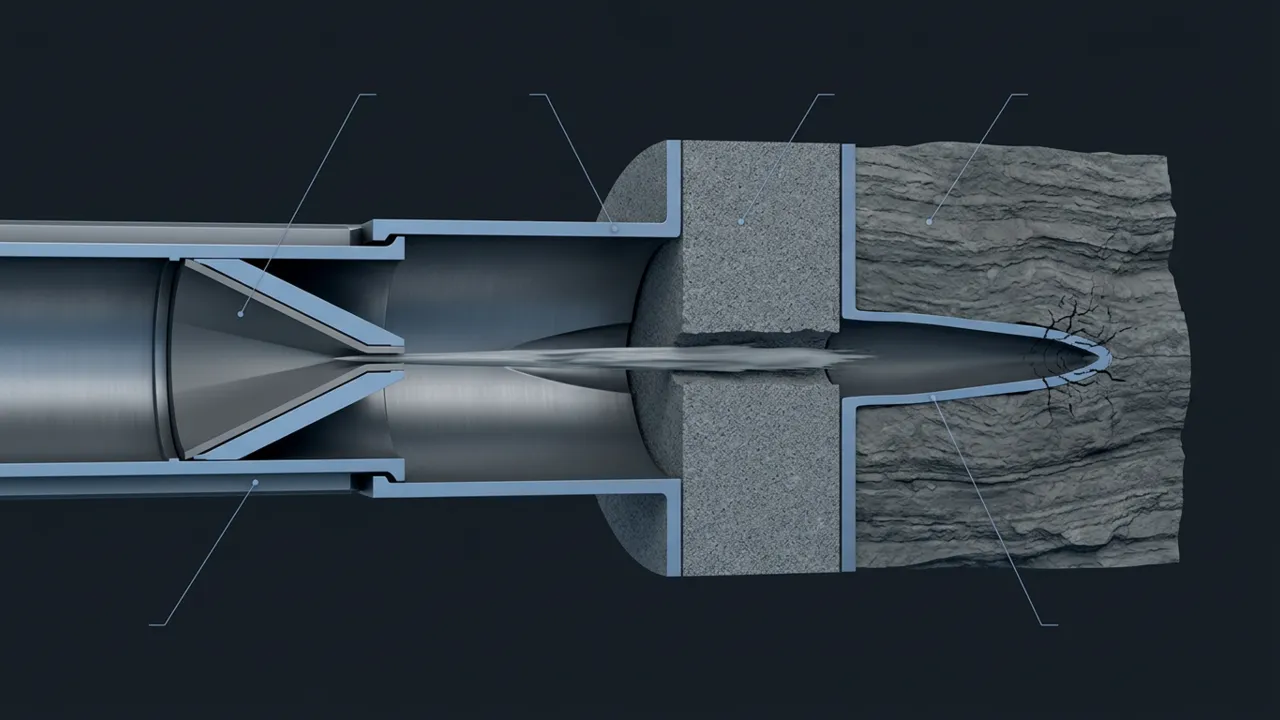
A perforating gun works by firing a set of shaped explosive charges that each blast a narrow, high-speed jet of metal through the casing, the cement and into the reservoir rock. Each shaped charge has a cone-shaped metal liner backed by explosive inside a small case. When the charge detonates, the liner collapses into a jet that travels at extreme speed and pressure, so it pushes through steel and rock instead of burning or drilling it.
The gun is lowered to the target zone on wireline, tubing or coiled tubing, lined up on depth, and fired electrically or by pressure or a dropped bar. The result is a set of perforation tunnels that let reservoir fluids flow into the well.
What Is Inside a Perforating Gun?
A perforating gun is basically a steel carrier tube loaded with charges and wired to fire on command. The main parts are:
- Carrier: a hollow steel tube that holds the charges and keeps well fluid out until firing. Some older and specialty guns are "exposed," with no full carrier.
- Charge tube or loading tube: the inner tube that holds each charge at the right angle and spacing.
- Shaped charges: the explosive units that make the holes.
- Detonating cord: a cord of explosive that runs past every charge and sets them off in a fast sequence.
- Detonator and firing head: the device that starts the detonation, triggered electrically or mechanically.
The SLB glossary entry on the perforating gun gives a short textbook definition if you want one for a training sheet.
How Does a Shaped Charge Make a Hole?
A shaped charge focuses explosive energy into one direction. The explosive sits behind a cone-shaped liner, often made from pressed metal powder. When it fires, the detonation wave crushes the liner inward and squeezes it into a thin, fast-moving jet.
That jet hits the casing at enormous pressure. The steel doesn't melt so much as get pushed aside, and the jet keeps going through the cement and into the formation. What's left is a tunnel, with a clean entrance hole in the casing and a deeper, narrower path into the rock.
Charges come in two broad styles:
- Deep penetrating charges make smaller holes that reach farther into the rock. They're used when the goal is getting past drilling damage near the wellbore.
- Big hole charges make larger entrance holes with shorter tunnels. They're common for sand control and gravel pack completions.
What Do Shot Density and Phasing Mean?
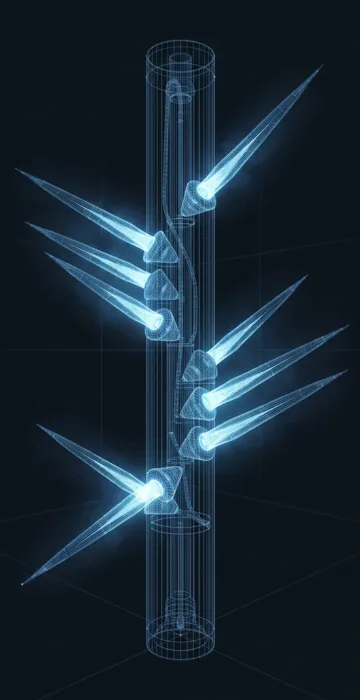
Shot density is how many charges fire per foot of gun, usually written as shots per foot. Phasing is the angle between charges around the gun, like 60, 90 or 180 degrees.
More shots and wider phasing spread the holes around the casing, which usually helps flow and makes the perforations less likely to plug. On frac jobs, engineers often use limited clusters of holes on purpose to steer the frac fluid into specific spots. The engineer picks the design based on the rock and the completion plan.
How Are Perforating Guns Run in the Well?
There are three main ways to get a gun to the zone. Each one has its place.
| Method | How it works | Good for |
|---|---|---|
| Wireline-conveyed | Guns hang on electric line and fire from surface | Fast single runs, plug-and-perf frac stages, short intervals |
| Tubing-conveyed perforating (TCP) | Guns are run on the bottom of tubing or drillpipe | Long intervals, heavy gun strings, underbalanced perforating, highly deviated wells |
| Coiled tubing-conveyed | Guns are run on coiled tubing | Horizontal wells and live-well work where wireline can't reach |
Tubing conveyed perforating is the heavy hauler. You can run hundreds of feet of guns in one trip, set a completion packer above them, and fire with the well already set up to flow. That lets the crew perforate underbalanced, which helps clean debris out of the new tunnels.
What Is Underbalanced Perforating?
Underbalanced perforating means the pressure in the wellbore is lower than the reservoir pressure when the guns fire. The moment the tunnels open, reservoir fluid surges into the well and flushes out crushed rock and charge debris.
Overbalanced perforating is the opposite. Wellbore pressure is higher, so fluid tends to push into the rock. It's simpler for well control, but the tunnels can stay partly plugged. Which one to use is the engineer's call, and it depends on the rock, the pressure and the safety plan.
What Goes Wrong With Perforating Guns?
Perforating is fast when it works and expensive when it doesn't. Here's what to watch for:
- Misfire. The gun comes back with charges unfired. Treat it as a live explosive and follow the explosives procedure to the letter.
- Off-depth shots. Holes in the wrong zone can let in water or gas. That's why crews correlate depth with a collar or gamma ray log before firing.
- Stuck guns. Guns swell slightly when fired, and debris can lodge around them. Keep an eye on overpull on the way out.
- Poor flow after shooting. Shallow penetration, plugged tunnels or formation damage can all choke the well. A cleanup or acid job may help.
- Gun shock. The blast can hit nearby packers and tubing hard. Engineers model this on big TCP jobs.
Don't make this mistake: treating a gun as safe because it "probably fired." Until the explosives hand clears it, every charge is live. No radios, no welding and no shortcuts near armed guns, and the wireline supervisor and company man run the show.
How Is Perforating Kept Safe?
Perforating crews handle real explosives, so the rules are strict. Guns are armed only at the well, often after they're below a safe depth or behind a barrier. Radio silence and stray voltage checks are common, because some detonators can be set off by electrical energy. Many crews now use safer detonator designs that resist stray current.
Storage, transport and handling of explosives are regulated, and companies train their people heavily before they ever arm a gun. Respect that training. It exists for a reason.
How Do Perforating Guns Work? Shaped Charges, Clean Tunnels, Flowing Rock
A perforating gun lines up shaped charges along a carrier, runs them to the pay zone on wireline, tubing or coiled tubing, and fires them. Each charge turns its metal liner into a jet that punches through casing, cement and into the rock, creating a path for oil and gas.
The design choices (charge type, shot density, phasing and pressure balance) decide how well the well flows afterward. Depth control and explosive safety decide whether the job goes smoothly.
If you're new to perforating, learn the firing sequence and the safety rules before anything else. The physics is cool, but the procedures are what keep everybody whole.