What Is Wireline? – Wireline Services in Oil and Gas
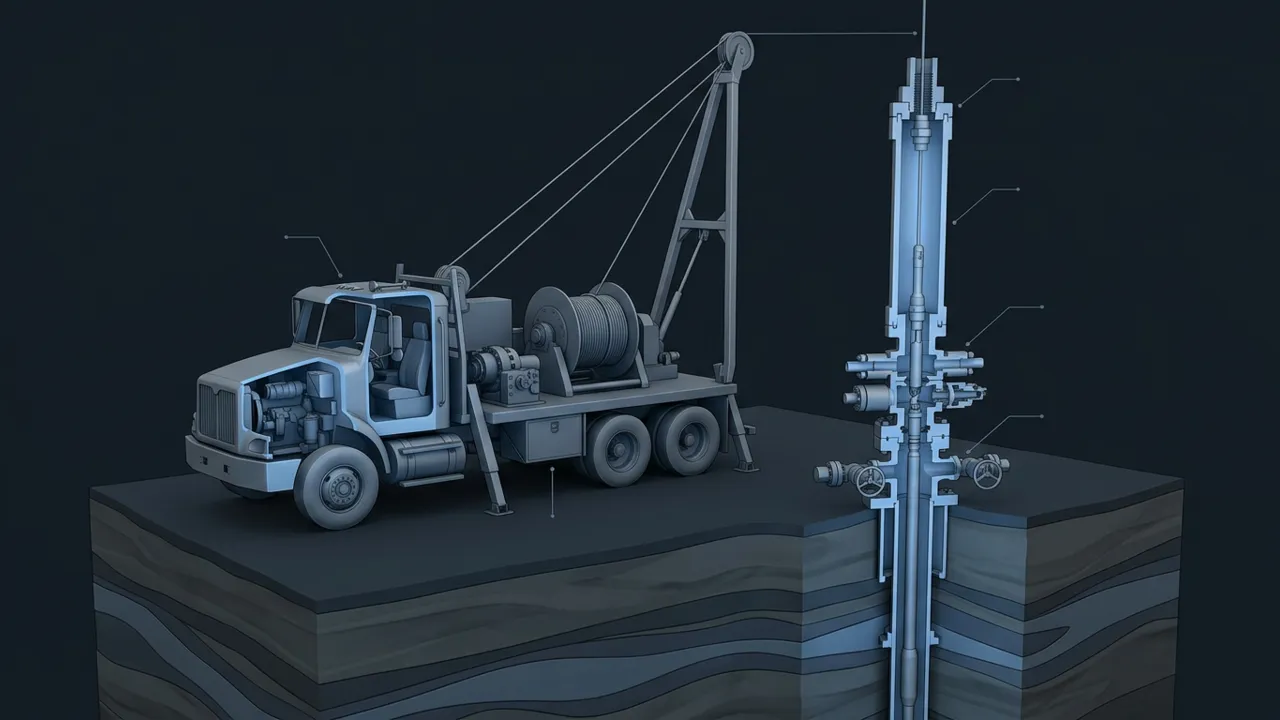
A big truck with a cable drum rolls onto location, a crew rigs up a lubricator on the tree, and in a few hours they've logged the well, shot perforations or pulled a plug. To an outsider it looks like magic on a string. To the people paying for it, it's one of the most useful services in the oilfield. So what is wireline, and what do wireline services actually do?
Wireline is a cable, spooled on a winch at surface, that lowers tools into a well and pulls them back out. Wireline services use that cable to log the well, perforate casing, set and pull plugs and packers, run cameras and gauges, cut pipe and fish out lost items. There are three main types: slickline (a single solid wire for mechanical jobs), braided line (a stronger multi-strand cable for heavy work), and electric line or e-line (a cable with conductors inside that carries power and real-time data).
Because the line is light and fast to rig up, wireline can do many jobs without a rig on location. The trade-off is that wireline can only push tools down with gravity, so steep or horizontal wells often need tractors, coiled tubing or pipe to get tools to depth.
What Is Wireline Used For?
Wireline is used any time someone needs to get a tool or a measurement to a specific depth in a well without running pipe. The work falls into a few big buckets:
- Logging: measuring rock and fluid properties, cement quality, casing condition and well temperature or pressure.
- Perforating: firing shaped charges to punch holes through casing and into the reservoir.
- Setting and retrieving: installing or pulling plugs, packers, valves and gauges.
- Well maintenance: cutting paraffin and scale, checking depth, swapping gas lift valves.
- Fishing and recovery: grabbing tools or debris that came loose downhole.
- Pipe recovery: free-point tools and cutters for stuck pipe.
The SLB definition of wireline covers both the logging sense and the cable intervention sense. In the field, people use the word for both, and context tells you which one they mean.
Slickline vs Wireline: What's the Difference?
Slickline is a solid, smooth single-strand wire with no electrical conductor. E-line has insulated conductors inside a braided armor jacket that carry power down and data back up. That's the core of the slickline vs wireline difference, and it decides what each one can do.
| Slickline | Braided line | Electric line (e-line) | |
|---|---|---|---|
| Construction | Single solid wire | Multi-strand braided cable, no conductor | Braided armor with insulated conductors |
| Power and data | None (memory tools only) | None | Real-time power and telemetry |
| Strength | Lowest | Higher; good for heavy pulls | Higher than slickline |
| Pressure control | Simple stuffing box | Grease injection head | Grease injection head |
| Typical jobs | Setting plugs, gauges, gas lift valves, tagging fill | Fishing, heavy jarring, swabbing | Logging, perforating, setting plugs and packers electrically |
In plain terms: slickline is quick, cheap and mechanical. Braided line is the muscle. E-line is the one with eyes and a trigger.
What Is E-Line, and Why Does It Matter?
E-line is electric wireline. The conductors inside the cable let the crew send power to downhole tools and get data back in real time. That's what makes open-hole and cased-hole logging possible, and it's how perforating guns are fired from surface.
Real-time data changes everything. The engineer can watch a log come up the screen, confirm depth against a gamma ray or collar log, and decide on the spot where to shoot or set a plug. On a slickline job, memory tools record data downhole, and you don't see it until the tool is back at surface.
On shale wells, e-line crews run the plug-and-perf work stage after stage. They pump the gun string and frac plug down the lateral, set the plug, fire the perforating guns and pull out so the frac crew can pump the next stage.
What Is the Difference Between Open-Hole and Cased-Hole Wireline?
Open-hole wireline runs in a freshly drilled section before casing goes in. Cased-hole wireline runs after the casing is set and cemented, and for the rest of the well's life.
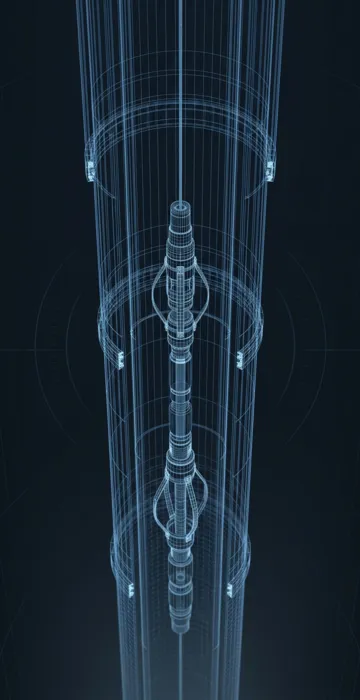
Open-hole logging is how geologists and engineers first see what they drilled. The tools measure things like natural gamma ray, resistivity, density and porosity to find the pay zones and decide whether the well is worth completing. The rig usually sits waiting while the logs run, so speed and good hole conditions matter.
Cased-hole work covers everything after that. Cement bond logs check whether the cement sealed the casing. Collar locators and gamma ray tools nail down depth for perforating. Production logs measure flow, temperature and fluid type to show which zones are making oil, gas or water. Caliper and corrosion tools check casing condition in older wells.
Some data can also be collected while drilling with LWD tools in the bottomhole assembly. That has replaced open-hole wireline on some wells, but wireline is still the go-to when the operator wants specific measurements or better data quality.
How Does a Wireline Job Work at the Wellhead?
A wireline job on a live well uses pressure control equipment so the crew can run tools without killing the well. The usual setup, from the tree up:
- Wireline valve (often called a BOP for wireline) that can close around the cable.
- Lubricator: sections of pipe long enough to hold the whole tool string above the tree.
- Stuffing box (slickline) or grease injection head (braided and e-line) to seal around the moving cable.
- Sheaves that guide the cable from the truck or skid to the top of the lubricator.
The tool string goes into the lubricator, the lubricator is pressure tested, and then the crew opens the tree valves and runs in. Coming out, the tool is pulled back into the lubricator before the tree is closed and the pressure is bled off.
The one that ruins a day: closing a tree valve on the cable. A master valve gate is not a cutter. It can damage the valve, cut the line and drop your tool string. Confirm the tools are in the lubricator first, every time.
What Goes Wrong on Wireline Jobs?
These are the problems wireline crews run into most, and what usually comes next. The service company's procedures and the company man's call decide the actual response.
- Tool won't go down. Usually high deviation, a tight spot, fill or paraffin. Next step: check the schematic, consider weight bars, a tractor or a cleanup run.
- Tool won't come up. Could be hung on a profile, buried in fill, or stuck in a bad spot of casing. Next step: work it gently within the line's safe pull, jar if the string has jars, avoid pulling out of the rope socket.
- Bird's nest or line damage. Too much slack downhole tangles the cable. Next step: stop, assess, and avoid making it worse with more line.
- Depth mismatch. The log doesn't line up with the schematic. Next step: correlate on a known collar or gamma ray marker before you shoot or set anything.
- Leaks at the stuffing box or grease head. Next step: adjust the seal or grease pressure, and stop if you can't hold it.
What Does a Wireline Operator Do?
A wireline operator runs the winch and the tools. On a typical wireline operator job, the crew includes an engineer or supervisor who handles the job plan and data, an operator who runs the unit, and helpers who rig up and handle tools.
The work involves:
- Rigging up pressure control equipment and testing it.
- Making up tool strings and checking every connection.
- Running in and out at controlled speeds while watching tension.
- Handling explosives on perforating jobs, under strict rules.
- Keeping depth control dead accurate.
It's a skill trade. A good operator can feel a tool through the weight indicator: when it's hanging on a ledge, when it's dragging, when it's free. Hours are long and the schedule follows the rig and the frac crew, but the job tends to pay well for a field position and teaches you a lot about how wells are built.
Most companies train new hands on the job. A commercial driver's license and a clean safety record help, since many crews drive their own units between locations. Perforating crews also go through explosives safety training.
When Does a Well Need Something Other Than Wireline?
Wireline depends on gravity to go down and cable strength to come up. That limits it in a few situations:
- Long horizontal laterals, where gravity can't push tools. Tractors or pumping down can help, or coiled tubing takes over.
- Jobs that need circulation, like cleaning out sand. Coiled tubing can pump fluid while it runs.
- Heavy fishing or milling jobs. Those need pipe and a rig or workover unit.
Even then, wireline usually shows up somewhere on the job, if only to log, set a plug or check depth.
What Is Wireline Worth to a Well? More Than One Trip Usually Shows
Wireline is a cable that runs tools into a well, and wireline services cover logging, perforating, setting equipment and recovery work. Slickline handles simple mechanical jobs, braided line handles heavy work, and e-line carries power and live data.
It's fast, flexible and usually cheaper than bringing in a rig. The limits show up in steep wells and heavy-duty jobs, where coiled tubing or pipe takes over.
If you're looking at a wireline career or planning a job, start by learning the pressure control stack and the schematic. Most wireline trouble starts at one of those two places.