How Does a Production Separator Work?
What comes out of a producing well is a mess. Oil, gas, water and a bit of sand all show up together, often churned into foam or emulsion. The buyer wants clean oil, the pipeline wants dry gas, and the water has to go somewhere legal. The first piece of equipment that starts sorting it all out is a big steel tank on the lease that most people walk right past. How does a production separator work?
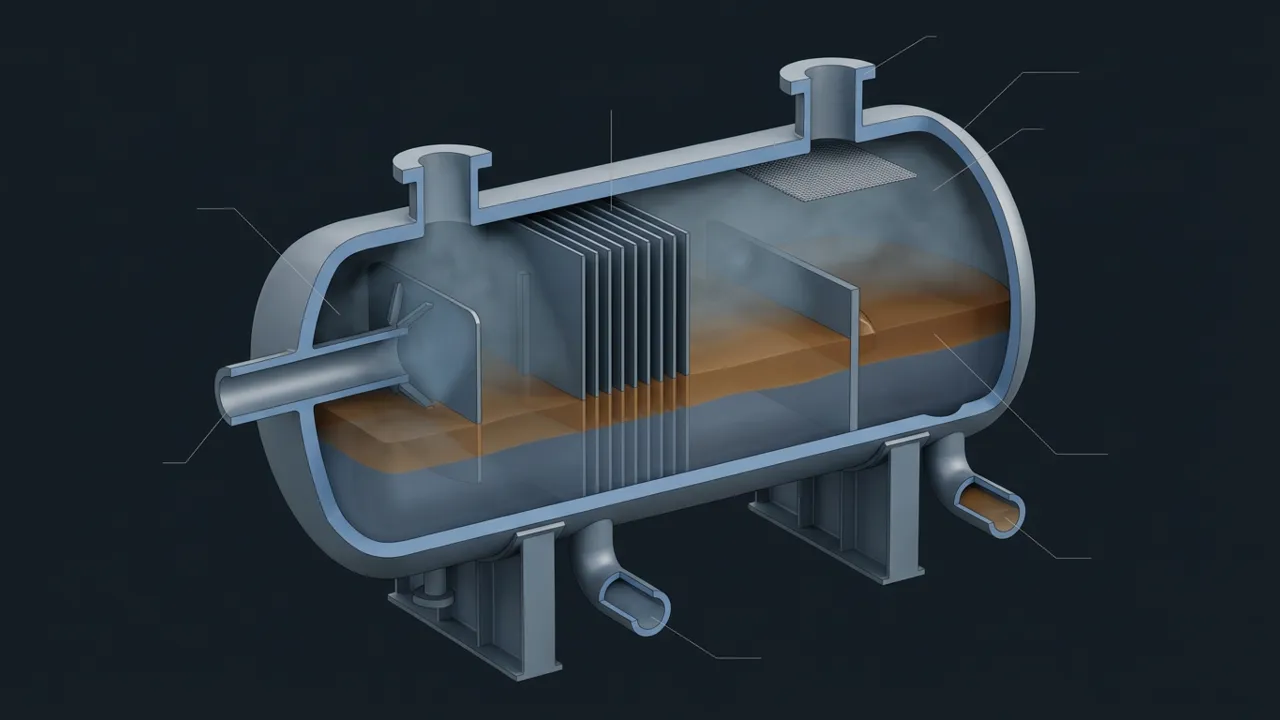
A production separator works by slowing the well stream down inside a pressure vessel and giving gravity enough time to pull the phases apart: gas rises to the top, oil floats in the middle and water sinks to the bottom. An inlet device knocks down the incoming flow, the vessel holds the liquid long enough for droplets and bubbles to break out, and a mist extractor catches fine liquid drops before the gas leaves.
Level controllers and dump valves send oil and water out of their own outlets, and a back-pressure valve controls the gas outlet. A two-phase separator splits gas from total liquid. A three-phase separator also splits oil from water.
What Are the Parts of a Production Separator?
Every separator, whatever its shape, has the same basic sections:
- Inlet diverter. A plate or device right at the inlet that breaks the flow's momentum and does the first rough split of gas and liquid.
- Gravity settling section. The open space where gas travels slowly enough for liquid droplets to fall out.
- Liquid collection section. The bottom part where liquid sits long enough for gas bubbles to rise out and, in a three-phase unit, for oil and water to separate.
- Mist extractor. A mesh pad or vane pack near the gas outlet that catches tiny droplets.
- Controls. Level controllers, dump valves and a pressure controller on the gas outlet.
- Safety devices. Pressure relief valves and often a rupture disk or high-level shutdowns.
The SLB glossary describes the separator as a vessel that splits produced fluids into oil, gas and water. That's the job in one line.
Why Does Retention Time Matter So Much?
Retention time is how long liquid stays in the vessel before it leaves. It's the single biggest factor in how well a separator works.
Too little time, and gas bubbles stay trapped in the oil, oil droplets go out with the water, and water goes out with the oil. More time lets gravity finish the job. Heavy, viscous oil and tight emulsions need more retention time than light oil and clean water.
That's why separators are sized to the well's expected rates. When a well's production goes up a lot, a separator that worked fine can start carrying over liquid or sending wet oil down the line.
What Is a Three-Phase Separator?
A three-phase separator splits the well stream into gas, oil and water, each with its own outlet. Inside, a weir (a short wall) or an interface level control holds the oil-water boundary in place.
Water, being heavier, settles to the bottom and is dumped by an interface level controller. Oil floats on top of the water, spills over the weir into its own chamber, and is dumped by a separate level controller. Gas leaves out the top through the mist extractor.
Two-Phase vs. Three-Phase: Which One Do You Need?
| Two-phase | Three-phase | |
|---|---|---|
| Outputs | Gas and total liquid | Gas, oil and water |
| Typical use | Gas wells, test separators, first-stage knockouts | Oil wells making water, main production trains |
| Internal parts | Simpler | Weir or interface control to hold the oil-water level |
| Downstream | Liquid goes to another vessel for further separation | Oil to treating or tanks, water to disposal |
Separators also come in vertical and horizontal shapes. Vertical ones take less floor space and handle sand and slugs well. Horizontal ones offer more liquid surface area and usually handle larger liquid volumes and foamy oil better.
What Is a Free-Water Knockout?
A free-water knockout (FWKO) is a vessel built to drop out the large volume of water that separates easily, before the fluid goes on to further treating. Wells with high water cuts send far more water than oil to the lease, and there's no point heating all of it in a treater.
The FWKO gives that free water time to fall out and sends it toward disposal. What's left, oil with a smaller amount of water mixed in, moves on to a heater treater or a three-phase separator. It saves fuel and makes the downstream equipment's job easier.
Why Do Some Leases Use More Than One Separator?
Stage separation drops the pressure in steps instead of all at once. A high-pressure separator takes the well stream first, then the liquid goes to a lower-pressure separator, and finally to the stock tanks.
Dropping pressure gradually keeps more of the lighter hydrocarbons in the oil, which can mean more barrels to sell. It also gives you gas at more than one pressure level, and the higher-pressure gas may go straight to the sales line without much boosting.
What Does a Heater Treater Do?
A heater treater breaks emulsions that a regular separator can't. Some oil and water mix so tightly that gravity alone won't split them in a reasonable time. Heat thins the oil and weakens the film around water droplets, so the droplets can join and settle out.
A typical heater treater has a firetube in the lower section, a settling section above, and controls for oil, water and gas outlets. Many use chemical demulsifiers injected upstream to help. Some larger units add electrostatic grids that pull water droplets together.
This is the heart of oil dehydration on most leases. Buyers set a limit on how much water and sediment can be in the oil they purchase, and treaters are how the lease meets it.
What Goes Wrong With Separators?
Here's the troubleshooting list for a separator acting up. Lease operators and the production foreman call the fix, and the facility's procedures come first.
- Liquid carryover into the gas line. Mist extractor plugged, liquid level too high, or rates beyond the design. Check level controls and gas rate.
- Gas blowby into the liquid outlet. The liquid level dropped too low and gas escaped out the dump. Often a stuck dump valve or failed level controller.
- Wet oil. Water in the oil outlet. Interface set wrong, not enough retention time, or an emulsion that needs treating.
- Oil in the water. Same causes in reverse. It also leads to trouble at the disposal well.
- Foaming. Some crudes foam badly and flood the gas section. Defoamer chemicals and bigger vessels help.
- Sand buildup. Sand settles in the bottom and eats retention time. Many vessels have sand jets or drains to flush it out.
Never do this: bypassing a high-level shutdown or relief valve to "keep the well on." Those devices exist because a separator is a pressure vessel. Overpressure or liquid carryover into a gas system can lead to fires and equipment damage.
Where Does the Gas Go After the Separator?
Gas leaving a separator is usually still wet with water vapor and at whatever pressure the separator runs. It typically heads to dehydration, then to a meter and into the gathering system.
Low-pressure separators and stock tanks give off gas that's too low in pressure to get into the sales line on its own. That's one of the main jobs of gas compression on a lease: picking up low-pressure gas and boosting it into the line, rather than venting or flaring it.
How Does a Production Separator Work? Slow It Down and Let Gravity Sort It
A production separator slows the well stream down and lets gravity sort it, with gas rising, oil floating and water sinking, while level and pressure controls send each phase to its own outlet.
Two-phase units split gas from liquid. Three-phase units split oil from water too. Heater treaters use heat and chemicals to finish the job on tight emulsions.
When a separator misbehaves, check rates, levels and controls first. Most of the time, the problem is a stuck valve, a bad level setting or a well making more than the vessel was built for.