Slips, Elevators and Tongs – How Drill Pipe Gets Handled
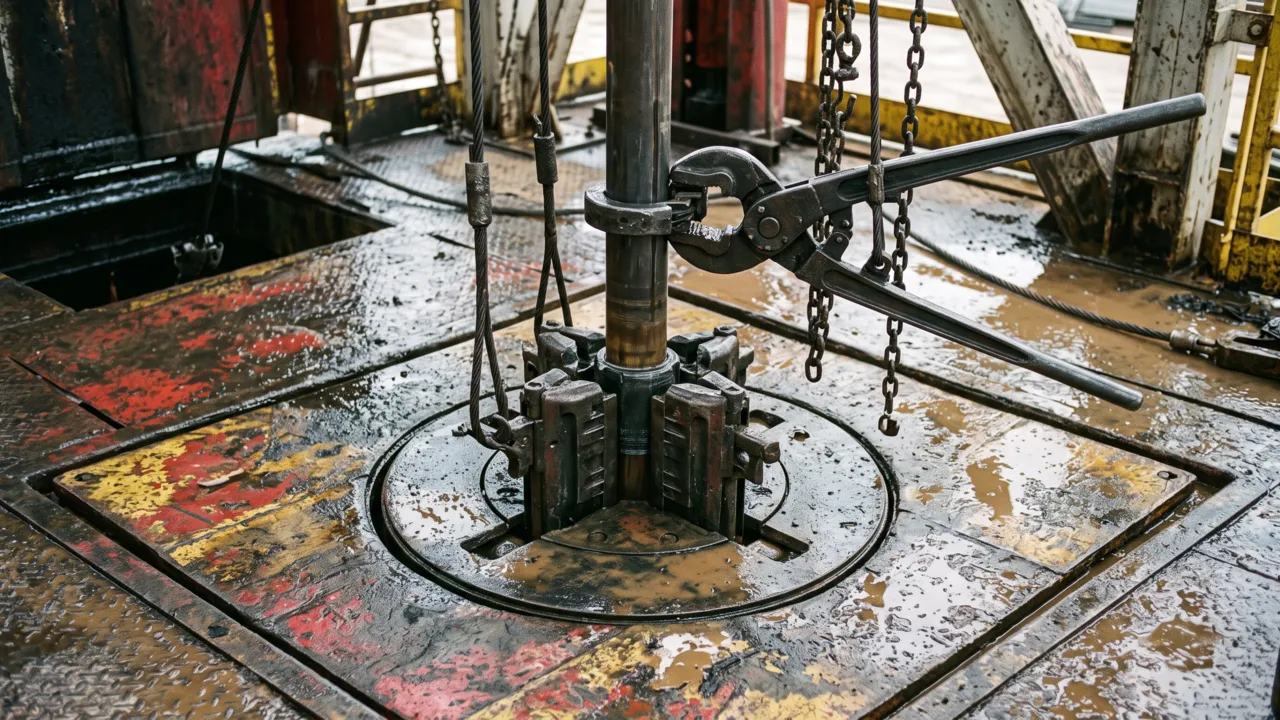
Every foot of hole a rig drills, every joint of pipe that goes in or comes out, passes through the same three tools: slips, elevators and tongs. You'll handle them thousands of times before you ever run a rig, and the hands who handle them well go home with all their fingers. So how do they work, and how do they work together? How does drill pipe get handled with slips, elevators and tongs?
Drill pipe slips hold the pipe in the rotary table, elevators lift and lower it, and tongs screw the joints together or break them apart. The slips are toothed wedges that drop into the bowl around the pipe and grip tighter the more weight sits on them. The elevators clamp under the shoulder of the tool joint so the traveling block or top drive can pick up the string. The tongs are big wrenches, one holding the lower joint and one turning the upper, to put the right torque on each connection. Every connection uses all three, in a set order.
What Are Drill Pipe Slips?
Drill pipe slips are curved steel wedges hinged together, usually three or more segments, with handles on top. The inside faces carry hardened, toothed inserts called dies. When the crew drops the slips around the pipe, they slide down into a tapered bowl in the master bushing at the rotary table.
The whole drillstring then hangs on those slips. On a deep well that can be a lot of weight, and the slips take all of it while the crew works on the connection above.
There's more than one kind. Rotary slips are sized for drill pipe. Drill collar slips are longer and grip the heavier, thicker collars. On many rigs, power slips set and pull themselves with air or hydraulics, so the hands don't have to lift them at all. I like power slips, because hand slips are heavy and awkward and lifting them a few hundred times a tour takes a toll on your back.
How Do Slips Hold Pipe?
Slips hold pipe with a simple wedge. The bowl is tapered, narrow at the bottom and wider at the top. When the pipe's weight pulls down, the slips get pulled deeper into that taper, and the taper squeezes them tighter against the pipe.
So the heavier the string, the harder the slips bite, and that's the beauty of it. No motor, no pump, just geometry and steel teeth.
Here's what I'll tell any new hand about slips:
- Never set slips on moving pipe. The driller stops the block, then the slips go in.
- Keep the dies clean and sharp. Worn or packed dies can let the pipe slip.
- Keep your hands on the handles, never underneath them or between the slips and the pipe.
- Collars are different. Many crews add a safety clamp above the slips on smooth drill collars, as a backup in case the slips let go.
Slips are also hard on pipe if they're used wrong. Setting them too hard or at speed can crush or mark the tube. The driller should ease the weight onto them.
What Do Drill Pipe Elevators Do?
Drill pipe elevators are hinged clamps that hang from bails (the long steel links) under the traveling block or top drive. They open, close around the pipe just below a tool joint, and latch shut. When the block goes up, the elevators catch on the shoulder of the tool joint and lift the whole string.
Notice they lift by that shoulder instead of gripping the pipe body like slips do. Drill pipe tool joints usually have a tapered shoulder, and the elevators are cut to match it. That's why elevators have to match the size and shoulder style of the pipe you're running. Wrong elevators on the wrong pipe is how strings get dropped.
You'll hear a few names:
- Center-latch elevators, which open in the middle and are common for drill pipe
- Side-door elevators, which open on one side and show up for tubing and casing
- Single-joint elevators, small ones for picking up one joint at a time
- Slip-type elevators, used for things like casing or collars without a lifting shoulder
For collars, crews usually screw a lift sub into the top so the elevators have a shoulder to grab. Always check that the latch is closed and locked before the driller picks up. That one look saves lives.
What Are Rig Tongs Used For?
Rig tongs are the big pipe wrenches of the drilling world. They hang from cables in the derrick, counterweighted so a hand can swing them around. Their jaws close around the tool joint and bite in with dies, just like slips.
You always use them in pairs. One tong, the backup, grabs the lower tool joint and holds it still. The other grabs the upper tool joint and gets pulled to turn it. On a makeup, that pull tightens the threads to the right torque. On a breakout, it cracks a tight connection loose.
The pull usually comes from a line run to the cathead on the drawworks or to a hydraulic cylinder. A gauge shows the line pull, and the driller converts that to torque. Getting torque right matters. Too little and the connection can leak, wash out or back off downhole. Too much and you can damage the threads or the tool joint itself.
Tongs are serious hardware. When a tong is under load, the jaws can slip or the line can part, and the tong will swing hard. Stand clear of the tong's swing path and keep out from between the tong and the pipe.
How a Connection Gets Made, Step by Step
Here's how the three tools work together while drilling ahead on a kelly rig, adding one joint to the string. Top drive rigs follow a similar pattern, just from above and with a full stand.
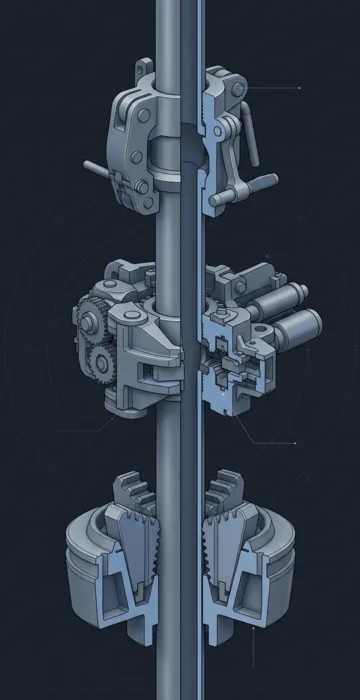
- The driller drills down the kelly, stops rotating, picks up off bottom and shuts down the pumps.
- The floorhands set the slips around the pipe in the rotary table, and the driller lowers the string onto them.
- The crew latches the tongs on, one on each side of the connection, and breaks out the kelly.
- The kelly is swung over to the new joint waiting in the mousehole, stabbed into it and spun up.
- The tongs put the final torque on that connection.
- The driller picks the kelly and new joint out of the mousehole and swings them over well center.
- The new joint is stabbed into the box of the pipe hanging in the slips, spun in and torqued with the tongs again.
- The driller picks up a little, the crew pulls the slips, and the pumps come back on before going back to bottom.
When you're tripping out instead, the elevators pick up a stand, the slips go in, the tongs break the connection, and the stand gets racked back by the derrickman. A good crew works that cycle like a rhythm. Smooth and steady beats rushed every time.
The OSHA tripping guide lays out the hazards of each part of that cycle, and it's worth reading before your first trip.
Why Do Tool Joints Matter So Much?
All three tools work on the tool joint, the heavy threaded end on each joint of drill pipe. It's thicker than the pipe body, so the tongs and elevators have something solid to work on, and the threads can take the torque.
Each joint has a pin (the male end) and a box (the female end). The pin of the upper joint goes into the box of the lower one. Before they go together, a hand brushes thread dope on the pin to protect the threads and help it seal.
Take care of those threads. Keep thread protectors on pipe being moved, don't let pins bang on the floor, and clean and dope them right. A tool joint failure downhole means a fishing job, and nobody wants that.
What Replaced Manual Tongs on Many Rigs?
A lot of modern rigs use machines to do the tong work. An iron roughneck combines a spinning wrench and a torque wrench in one unit that rolls up to well center. It spins the joint in, torques it to the right value and records the number, all without a hand on a tong.
Power slips do the same for the slips, and pipe-handling machines bring pipe to the floor. You'll still see manual tongs on plenty of rigs, especially workover units and older land rigs. And even on the newest rigs, the hands still need to understand what the machines are doing.
My opinion? Anything that takes a hand out from between two pieces of moving iron is a good thing. But you still learn the manual way first, because machines break and the work doesn't stop.
Slips, Elevators and Tongs: How Drill Pipe Gets Handled Safely
So how does drill pipe get handled? Drill pipe slips hold the string at the rotary, elevators lift it by the tool joint shoulder, and tongs make up or break out each connection to the right torque. Every connection uses all three, in the same order, over and over.
Learn each tool's job and its hazards before you put your hands on it. Watch the hands who've done it for years, ask why they do things the way they do, and never rush a connection. Smooth beats fast, and safe beats both.